
Unbiased headlines. Facts, not spin.
Every story is an unbiased news briefing written from 110+ sources across the spectrum — sources linked so you can verify it yourself.
 economy
Notable (6/10)
June 8, 2026 at 06:02 AM
economy
Notable (6/10)
June 8, 2026 at 06:02 AM
Iran's Economy Is Crumbling Under Sanctions and Mismanagement — and Its People Are Paying the Price
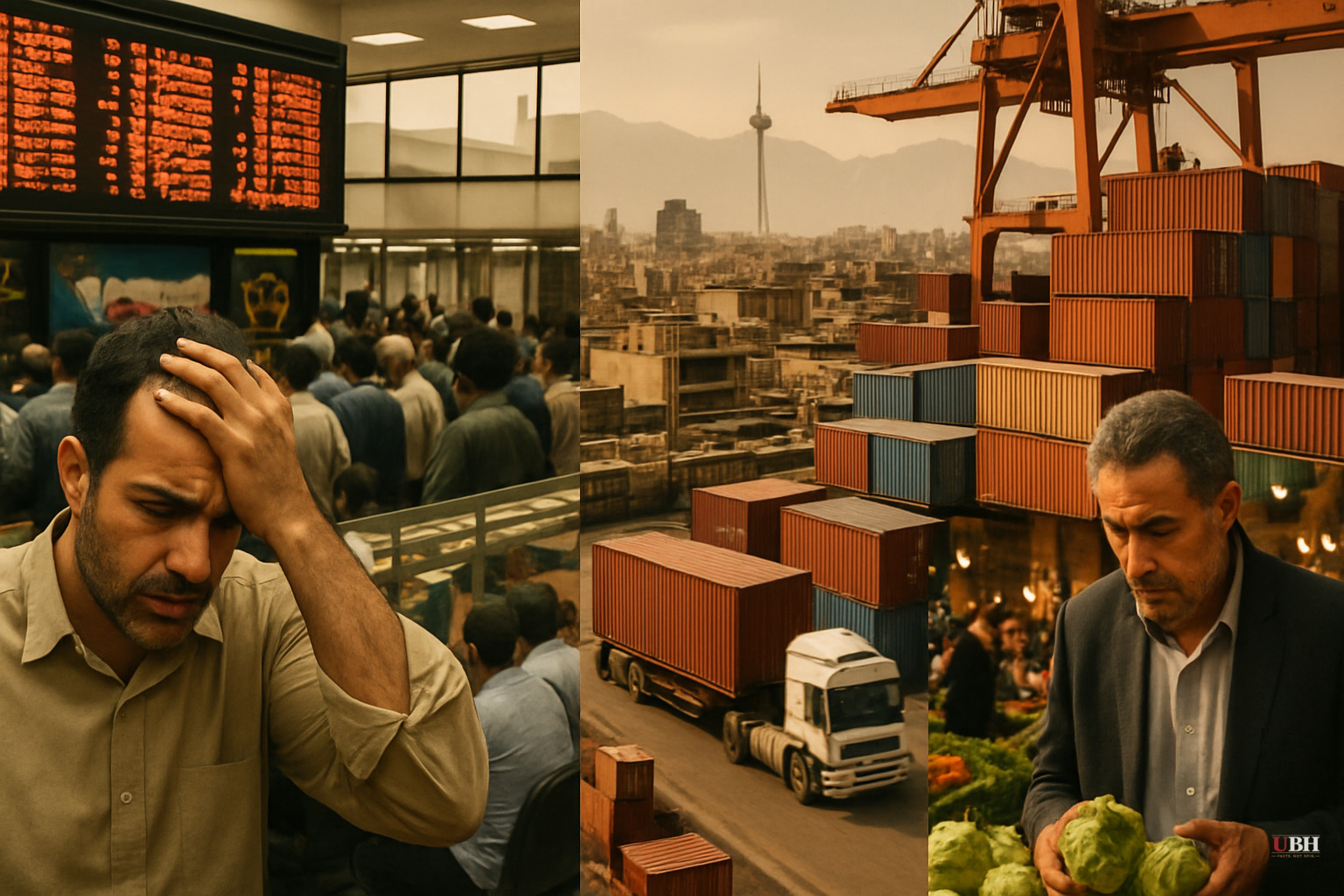
Iranians Are Broke — and Their Government Did It to Them
Inflation has been running above 40% annually for several consecutive years, according to Iran's own Statistical Centre. The rial has lost more than 90% of its value against the dollar over the past decade. A middle-class family that had savings in 2015 has been financially gutted.
This isn't ancient history. As of mid-2026, ordinary Iranians are still navigating a cost of living that has made basic goods — cooking oil, chicken, medicine — genuine luxuries for large portions of the population.
Two Causes. Both Real. Neither Gets a Pass.
Western media, particularly outlets leaning left, defaults to framing this as a U.S. sanctions story. That framing captures part of the reality — but only part.
Yes, American sanctions, reimposed aggressively under Trump's 2018 maximum pressure campaign and never fully lifted since, have hammered Iran's oil export revenues. Iran was exporting roughly 2.5 million barrels per day before 2018. That number cratered. Oil revenue is the Iranian government's financial oxygen.
Yet the sanctions narrative omits a critical piece of the story.
The Islamic Republic has been systematically looting its own economy for decades. The Iranian Revolutionary Guard Corps — the IRGC — controls an estimated 30 to 40% of the Iranian economy through a network of front companies, construction monopolies, and import rackets, according to analyses from the Foundation for Defense of Democracies and the Wilson Center. This isn't a minor footnote. It's the central fact.
When sanctions tighten, the regime protects IRGC-linked enterprises first. Regular Iranians absorb the hit.
The People Know It
Iran has seen repeated waves of mass protest — 2017, 2019, 2022 — that weren't primarily about American foreign policy. They were about a corrupt government that prioritizes funding proxy militias in Yemen, Lebanon, Syria, and Iraq over feeding its own people.
The 2019 protests, which erupted after the government hiked fuel prices by 50% overnight, were met with a government internet blackout and a security crackdown that Amnesty International reported killed at least 304 people in a matter of days. The regime didn't hesitate.
The 2022 "Woman, Life, Freedom" uprising, triggered by the death of Mahsa Amini in morality police custody, revealed the same dynamic: a population furious not just at economic pain, but at a government that treats its citizens as subjects to be controlled and taxed rather than people to be served.
The War Fear Is Real
On top of the economic misery, Iranians are living under genuine fear of military conflict. The Israeli strikes on Iranian territory in 2024, and ongoing tensions over Iran's nuclear program, have created an atmosphere of dread that no economic statistic can fully capture.
The regime has spent billions — numbers that Iranian economists like Djavad Salehi-Isfahani at Virginia Tech have flagged publicly — on missile programs, drone manufacturing, and nuclear enrichment while hospitals run short of basic medications.
That is a choice. A deliberate, conscious choice by Iran's Supreme Leader Ali Khamenei and the clerical establishment.
What the Left Gets Wrong — and the Right Gets Wrong Too
Left-leaning outlets tend to emphasize the human suffering caused by sanctions and stop the analysis there. That's emotionally resonant but intellectually incomplete. It lets the Iranian regime off the hook entirely for its own role in creating this catastrophe.
Right-leaning media, on the other hand, often talks about Iran purely through the lens of nuclear threat and terrorism, barely acknowledging that 90 million real human beings are living with the economic wreckage every single day.
The reality is that U.S. sanctions hurt Iranian civilians. The Iranian government hurts Iranian civilians. Both things are simultaneously true.
What This Means for Regular People
For Iranians, this means deciding between buying bread and buying blood pressure medication. It means educated young people fleeing the country in a brain drain the Iranian Parliament's Research Center has called a "national crisis." It means a generation that has largely given up on the idea that their government will ever work for them.
For Americans, it means recognizing that sanctions are a blunt instrument with real civilian costs — and that those costs should be weighed honestly. It also means understanding that removing sanctions without demanding structural change from the regime simply refunds a government that will spend the money on missiles, not medicine.
The Iranian people deserve better than their government. They also deserve better than being used as props in other countries' foreign policy debates.
Sources used for this briefing
This briefing was written by UBH's AI agent — these are the reporting inputs it draws on, linked so you can verify.


