
Unbiased headlines. Facts, not spin.
Unbiased Headlines is an independently owned news organization. We bring you the facts, not opinions, written fresh from 110+ named sources. Sources linked so you can verify it yourself.
 defense
Major Story (8/10)
Event date: October 28, 2026 ·
Iran War Tab Reaches $47.1 Billion Days Before Midterms, With a $95 Billion Funding Request Still Stalled
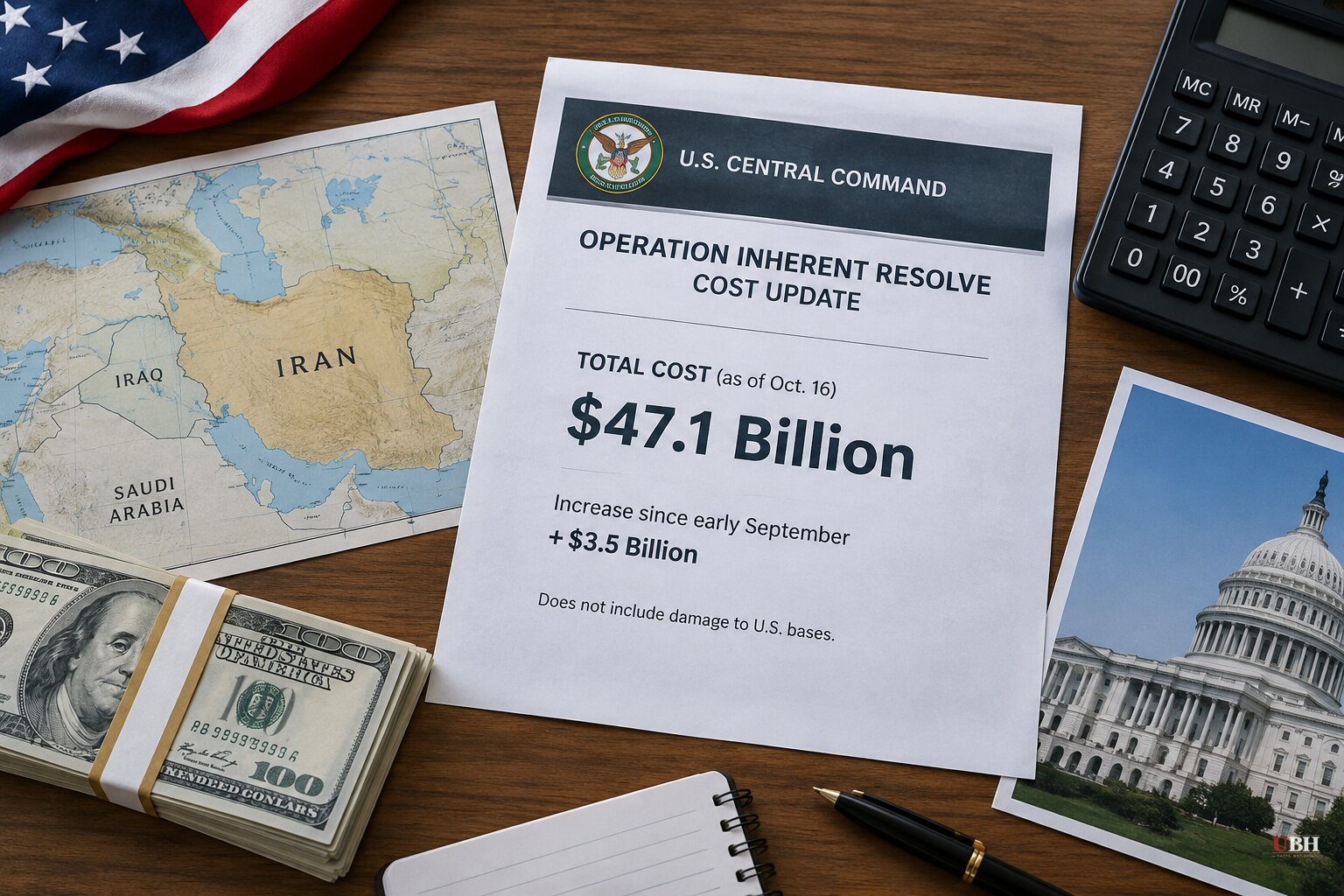
Since the U.S. and Israel launched the Iran war in late February, the Pentagon's running tally has grown at every update, and the latest one lands days before the midterms.
U.S. Central Command told lawmakers the war had cost $47.1 billion as of Oct. 16. In early September the figure was about $43.6 billion, a jump of roughly $3.5 billion in six weeks. Defense Secretary Pete Hegseth put it at around $37.5 billion in July.
The largest line item is munitions. CENTCOM pegs replacement of expended weapons at about $29 billion. Another $6.1 billion covers lost equipment, and about $11.9 billion goes to incremental costs such as support for service members.
The estimate does not include repairs to U.S. bases in the Middle East, many of which Iranian drones and missiles hit. That number is still missing from the public ledger.
Interceptors drive the bill
The most heavily drawn-down weapons are defensive interceptors, including those fired by the Army's Patriot and THAAD systems. A single Patriot interceptor costs millions of dollars.
The Congressional Budget Office said last month the war could cost $2 billion to $3 billion a month for as long as it continues, largely to replace those interceptors. Tit-for-tat exchanges between the U.S. and Iran, common over the summer, have been quiet in recent weeks.
The Pentagon's inspector general warned last month of "strategic inventory shortfalls" from the munitions expended. The Defense Department is working to speed up production.
The administration rejects the shortage framing. "We have virtually unlimited amounts of Mid to High Grade Ammunition, far more than we could ever use," Trump said in early September.
Money Congress hasn't approved
The White House wants lawmakers to approve a $95 billion package that would help fund the Iran war and other priorities. It is also pushing a historic $1.5 trillion military budget. An earlier supplemental request for tens of billions of dollars has not passed.
Democrats have pressed Hegseth for a more detailed accounting. They have also tried to end the war through legislation, and those bills have failed in the Republican-controlled Congress.
"Trump and his ego led us into this war with no plan, no authority, and no exit strategy," Senate Minority Leader Chuck Schumer said in a news release.
An AP-NORC poll found most voters want Congress to prioritize ending the conflict. Trump originally promised a campaign lasting only weeks. The war is now in its ninth month.
The administration's case
Trump says the pressure campaign is working. At a rally in Sioux City, Iowa, for Senate candidate Ashley Hinson, he said "more oil came out of the Hormuz Strait over the last week than at any time previous, including before the war." He said the U.S. naval blockade has cut off Iran's own oil exports and that fuel prices will fall once the war ends.
Trump also invoked the Defense Production Act to speed domestic oil production. His statement said industry cannot expand output quickly enough alone because of constrained financing, long lead times, permitting and infrastructure bottlenecks.
He conceded a problem on the diplomatic side. "The problem we have is we wiped out their leaders," he said, leaving no viable counterpart to negotiate with.
RAND analysts Raphael Cohen and Howard Shatz, in a commentary first published by Foreign Policy on Oct. 26, argue for staying the current course over escalating or walking away. They say the blockade is hurting Iran badly. By their figures, the rial has fallen to about 2.5 million to the dollar from roughly 630,000 in 2024, inflation is near 90 percent, and Iran's floating oil storage is depleted. They concede the approach "almost certainly will not bring quick results."
The same authors put the U.S. toll at 800 casualties, hundreds of damaged or destroyed buildings on U.S. bases, and strained munitions supplies. They say U.S. inflation has hit a level last seen in 2023.
What comes next
Trump has said new strikes are an option after the elections. "We may do another little Epic Fury, or they'll agree," he told supporters at a Florida rally last week. He is also sending more military resources to the region.
A separate study by the International Institute for Strategic Studies questions how well U.S. bases and the Gulf states' trillion-dollar arsenals protected the region. Those questions, and the base-repair bill, sit outside the $47.1 billion.
Voters decide which party controls Congress on Tuesday, Nov. 3. The $95 billion package and the Pentagon's still-uncounted base damage will land on whoever holds the gavel.
Sources used for this briefing
5 links from 5 independent newsrooms (syndicated copies of the same report count once)
These are the sources it draws on, linked so you can verify.


