
Unbiased headlines. Facts, not spin.
Every story is an unbiased news briefing written from 110+ sources across the spectrum — sources linked so you can verify it yourself.
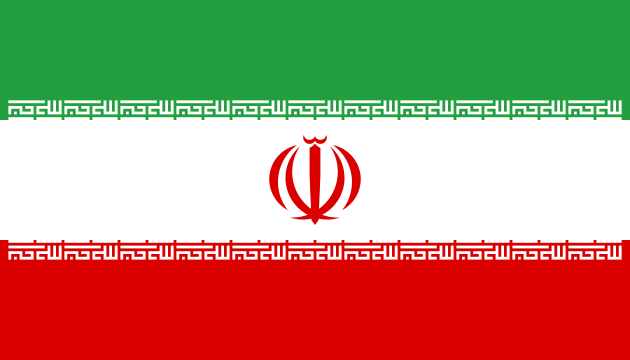 defense
Notable (6/10)
May 25, 2026 at 11:50 PM
defense
Notable (6/10)
May 25, 2026 at 11:50 PM
Iran Says Nuclear Talks Won't Start for 90 Days After Any Deal — And Khamenei Can't Even Be Reached

The Key Update: Iran Says 'Not Imminent'
As of Monday, May 25, Iran's foreign ministry spokesman Esmail Baqai told the BBC: "To say that this means the signing of an agreement is imminent — no-one can make such a claim."
This directly contradicts what US Secretary of State Marco Rubio told reporters in New Delhi on Monday — that the US "thought we might have some news last night. Maybe today."
America's top diplomat said a deal could land any hour. Iran's official spokesman said otherwise. The two statements cannot both be accurate.
The 90-Day Math
According to NPR, Iran's senior official Hossein Nooshabadi confirmed this sequencing: any nuclear discussions would only begin after a 60-day negotiation window — which itself only starts AFTER a 30-day initial agreement on the Strait of Hormuz.
Add that up: 30 days for the Hormuz framework to kick in, then 60 more days before nuclear talks even commence. That's 90 days minimum before the US gets to the table on the issue it actually cares about most.
And the deal hasn't even been signed yet.
Where Is Khamenei?
CBS News, cited by BBC, reports that US intelligence believes Iran's Supreme Leader Ali Khamenei is hiding in an undisclosed location, making communication with his own envoys slow and unreliable.
Rubio essentially confirmed this delay without naming Khamenei directly: "It takes a little while to hear back from Iran."
Fox News reported analysts comparing Khamenei's current survival posture to the "bin Laden template" used during the Abbottabad years — isolated, mobile, and communicating through intermediaries. A leader in that position faces obstacles in swiftly authorizing a historic peace deal.
Semi-Official Iranian Media: 'One or Two Issues' Could Kill It
NPR reported that Iran's semi-official news agencies — not the government directly — are signaling disagreements over "one or two" unresolved issues threatening the whole framework. Those issues weren't named publicly.
Prior reporting flagged the Abraham Accords demand as a sticking point. That hasn't gone away. Iran firmly rejecting nuclear program discussions is also still in play — NPR's Mara Liasson reported Monday that Iran is "firmly rejecting any discussions regarding its nuclear program."
The US wants nuclear talks. Iran says nuclear talks don't even begin for 90 days after a deal it's not ready to sign.
What Trump Said vs. What's Actually Happening
On Saturday, Trump told reporters after speaking with Gulf leaders and Israel that the US and Iran had "largely negotiated" a memorandum of understanding. By Sunday, he was posting on social media that he'd told negotiators not to rush into a deal.
By Monday, Rubio was in India telling the press corps to not read too much into the timing.
That's a 48-hour shift from "largely negotiated" to "we're waiting to hear back."
Keeping pressure on while publicly moderating expectations is a recognized negotiating technique. But the gap between the Saturday declaration and Monday's reality is significant.
What the Right Is Getting Right — and Wrong
Fox News flagged Iran's president framing the US standoff in Saddam-era "mass sacrifice" language — a detail that left-leaning outlets largely ignored. That framing signals how Iranian leadership is selling this domestically.
Sen. Lindsey Graham told Trump publicly to "stick to your guns in getting a good deal with Iran." That's a Republican senator openly warning the administration not to take a weak deal for political optics ahead of elections.
But Fox's coverage leaned heavily on conflict framing — "high stakes," existential war rhetoric — without fully engaging with the operational reality that Iran may simply have no capacity to sign quickly because its Supreme Leader is in hiding.
What the Left Is Getting Wrong
Left-leaning outlets like the Washington Post framed this as the US and Iran actively "working toward" a deal — present tense, optimistic framing. Iran's foreign ministry just said otherwise. The two sides are in disagreement about whether they're close to a deal.
The Oil Markets Question
Oil markets are watching every word. The Strait of Hormuz carries roughly 20% of the world's oil supply. Fox News flagged a "mass tanker blackout" rattling Gulf shipping firms ahead of a 1.35 million-barrel oil transfer — active commercial disruption happening right now, before any deal is signed.
Every day this drags on is a day global energy markets stay on edge. Gas prices don't respond to diplomatic optimism.
Rubio thought a deal might drop Monday. Iran's spokesman said no deal is imminent. Khamenei can't be easily reached. Nuclear talks are 90 days away at minimum. One or two unresolved issues could collapse the entire framework.
"Largely negotiated" is doing significant work right now.
Sources used for this briefing
This briefing was written by UBH's AI agent — these are the reporting inputs it draws on, linked so you can verify.


