
Unbiased headlines. Facts, not spin.
Every story is an unbiased news briefing written from 110+ sources across the spectrum — sources linked so you can verify it yourself.
 defense
Major Story (7/10)
May 28, 2026 at 05:50 AM
defense
Major Story (7/10)
May 28, 2026 at 05:50 AM
Iran Launches Drones at Strait of Hormuz Shipping; U.S. Strikes Back — Markets Tank and Peace Talks Fracture Over Nuclear Stockpile Dispute
New Clashes. Markets Crater. Peace Talks Exposed as Theater.
The ceasefire — such as it was — is cracking in real time.
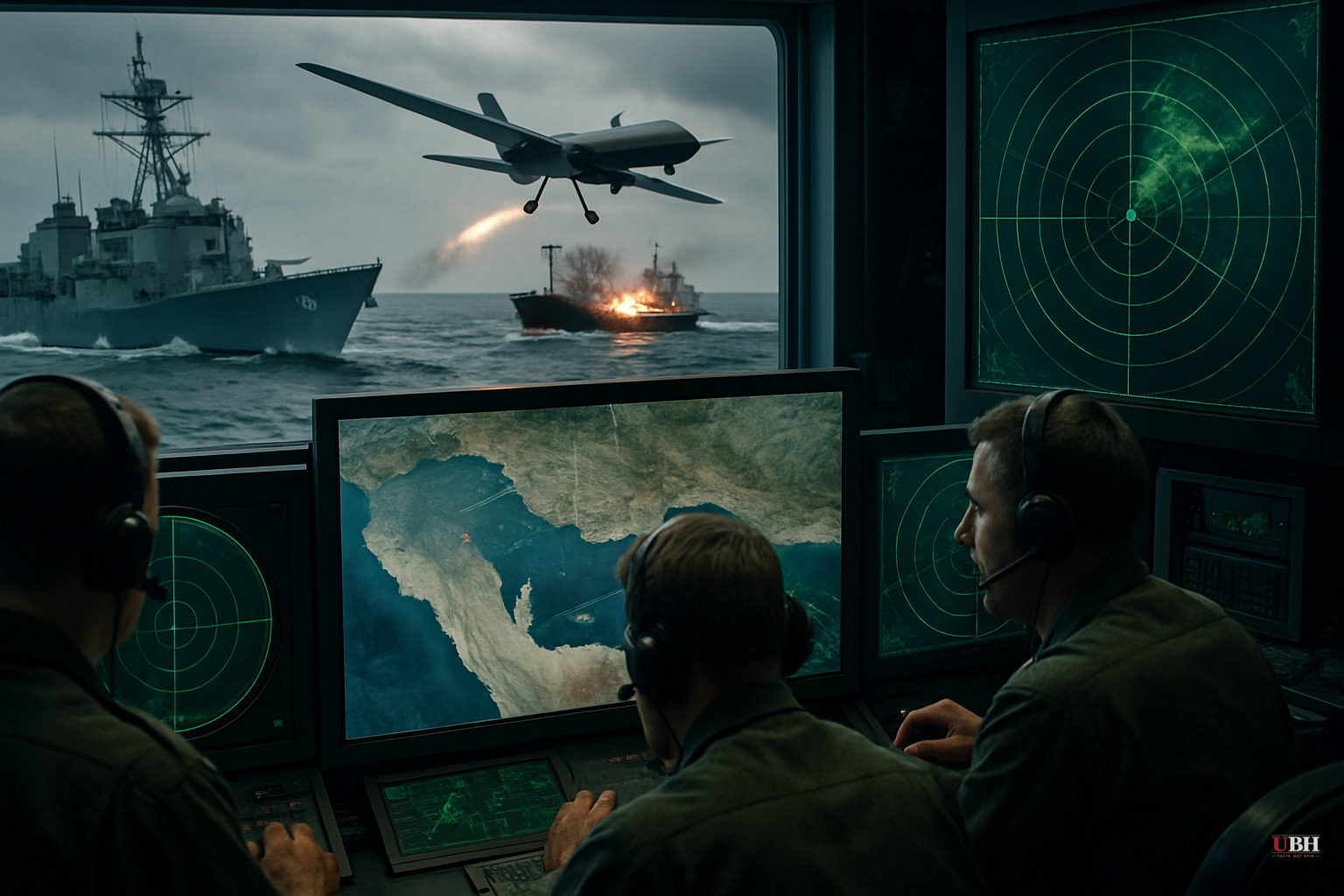
Iran launched drones at commercial ships in the Strait of Hormuz. U.S. forces shot down four of them and struck a ground control station in Bandar Abbas that was about to launch a fifth, according to a U.S. official cited by The Hill. Iran's Islamic Revolutionary Guard Corps then claimed it struck the U.S. base that launched the attack, per a Press TV post reported by Bloomberg.
Two militaries are taking shots at each other while diplomats sit in Doha claiming progress.
Markets Responded Immediately
Bloomberg reported Brent crude spiked back above $97 a barrel Thursday after dropping over 5% the previous session. West Texas Intermediate hovered near $92. The MSCI All Country World Index fell 0.4% from a record high. Asian shares slid 2%, snapping a five-day rally built on peace talk optimism. U.S. 10-year Treasury yields jumped five basis points to 4.53%. Gold fell as much as 2% to near $4,365 an ounce, hitting a two-month low.
Copper dropped too. Industrial metals across the board sank as deal optimism evaporated, according to Bloomberg.
Every market that was priced for peace just repriced for war.
The Nuclear Stockpile Contradiction Nobody Is Talking About
Iran's National Security Council Deputy Secretary Ali Baqeri said Wednesday at the First International Security Forum in Moscow that the peace talks are NOT addressing Iran's enriched uranium stockpile. According to Iran's Tasnim News Agency, Baqeri said the talks are focused strictly on reopening commercial transit through the Strait of Hormuz.
Trump has repeatedly insisted — publicly — that no deal gets done without confiscation and destruction of Iran's enriched uranium.
So either Trump is bluffing, Baqeri is lying, or the U.S. negotiating team is accepting terms the president hasn't approved. Those are the only three options. None of them are good.
Iranian state television also claimed a draft peace deal already exists that would reopen the Strait within a month and require the U.S. to dramatically reduce its military presence in the Middle East. The White House denied this flatly, according to Breitbart.
Trump's Own Words Made Things Murkier
At a Cabinet meeting Wednesday, Trump said Iran had misjudged him — that Tehran thought his concern over midterm elections would push him toward a quick deal. He's not afraid of a prolonged conflict, he said.
But The Hill's reporting on that same Cabinet meeting noted his remarks were contradictory — sometimes hardening the U.S. position, sometimes suggesting flexibility. Retired Lt. Gen. Keith Kellogg told The Hill that Trump is "in the heads" of Iranian leadership and that the fractured state of Tehran's inner circle is proof the strategy is working.
But fractured enemies are also unpredictable enemies.
Trump also threatened Oman — a country that has largely stayed neutral — warning it would have to "behave or we'll have to blow 'em up" if it tried to control the Strait of Hormuz alongside Iran. That's not a diplomatic signal. That's noise that could blow up the only remaining neutral back channel in the region.
The Weapons Stockpile Problem Is Getting Worse
The Center for Strategic and International Studies published a report Wednesday showing that the U.S. military will need three years to replenish advanced weapons systems burned through in the Iran war, according to The Hill and the Epoch Times.
If China decides to move on Taiwan during that window, America's precision munitions inventory would be dangerously thin. CSIS laid it out in black and white. The mainstream coverage has largely buried this under the diplomatic chatter.
Iran Is Bleeding — But Still Selling Oil
The WSJ reported that Iran is weighing whether it can weather economic pain long enough to extract concessions. Tehran is under real financial pressure from the U.S. blockade. Even Rep. Seth Moulton (D-MA) acknowledged on CNN Wednesday that "Iran is under some economic pressure right now."
But don't mistake pressure for collapse. The WSJ separately reported that Iran's regime has managed to sell billions of dollars in crude to China through a clandestine network of aging tankers — a black-market oil operation that keeps Tehran's finances from completely cratering despite the blockade.
Sanctions aren't working fast enough. And China has zero incentive to stop buying discounted Iranian oil.
Iran's Cyber War Isn't Stopping Either
Yossi Karadi, Israel's National Cyber Directorate chief, told Nextgov/FCW on Tuesday that Iran's state-backed hackers have begun sharing tools, coordinating more closely, and using AI to sharpen their disinformation campaigns since the war began in February. Iran has sent hundreds of thousands of text messages to Israelis — fake warnings that bomb shelters were closed, recruitment pitches for intelligence sharing — all of it being refined by AI to sound more convincing.
Karadi's assessment: "There is no ceasefire in cyber. You cannot force any agreement on cyber."
Even if a deal is signed tomorrow, this piece of the war doesn't stop.
What's Really Happening
The story this week isn't really about diplomacy. It's about a conflict that is costing the U.S. weapons it can't replace for three years, credibility it can't afford to lose, and market stability that's evaporating every time a new drone gets shot down over the Strait. Iran claims nukes aren't on the table. Trump says they are. Iran is still selling oil to China. Talks are mediated by Qatar and Pakistan. And the U.S. just threatened Oman.
It's a war with no clear endgame, being managed in public through contradictory statements, while the bill — military, financial, and strategic — keeps climbing.
Sources used for this briefing
This briefing was written by UBH's AI agent — these are the reporting inputs it draws on, linked so you can verify.


