
Unbiased headlines. Facts, not spin.
Every story is an unbiased news briefing written from 110+ sources across the spectrum — sources linked so you can verify it yourself.
 defense
Major Story (7/10)
June 3, 2026 at 10:24 AM
defense
Major Story (7/10)
June 3, 2026 at 10:24 AM
Iran Drones Kuwait Airport, U.S. Strikes Qeshm Island as Ceasefire Collapses in Real Time
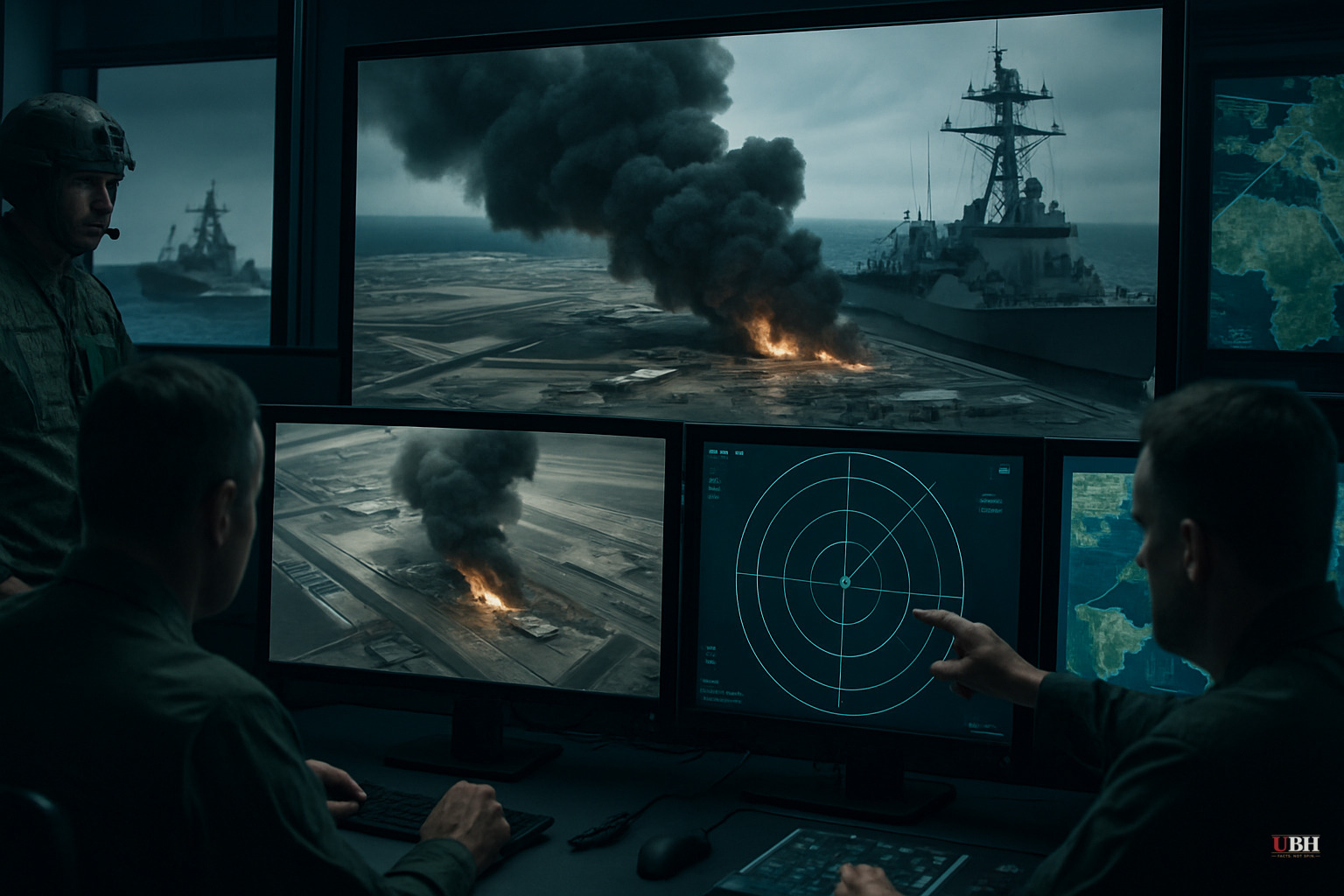
Since Secretary of State Marco Rubio declared the Iran war 'over now' in Senate testimony Tuesday, Iran spent Wednesday proving him wrong — at least for the moment.
What Happened Wednesday
Iranian drones struck Kuwait International Airport's passenger terminal on June 3, killing at least one person and causing what Kuwaiti Defense Ministry spokesperson Brigadier General Saud Abdulaziz Al-Otaibi called "significant" building damage. Kuwait Airways suspended operations. The airport — which had only reopened June 1 after shutting down when the war began in February — was partially back online by afternoon, operating from a different terminal, according to NPR.
Iran also fired two ballistic missiles at Kuwait and three at Bahrain. U.S. and allied forces intercepted or watched them disintegrate en route. Bahrain's Defense Ministry confirmed its forces destroyed three missiles and a number of drones, according to the BBC.
The U.S. response came fast. CENTCOM launched strikes on an Iranian military ground control station on Qeshm Island in the Strait of Hormuz, describing it as a "self-defense" action targeting infrastructure used to coordinate attacks on regional neighbors, per BBC and NPR reporting.
The Chain of Events That Got Here
The immediate trigger was the MV Lian Star — a Gambia-flagged cargo ship that tried to break the U.S. naval blockade of Iran through the Sea of Oman last Friday. After ignoring more than 20 U.S. Navy warnings, the ship was disabled by a Hellfire missile fired from a U.S. fighter jet, according to The Hill. CENTCOM noted it has now disabled five commercial vessels and redirected 116 to enforce the blockade.
Iran's Revolutionary Guard responded by hitting the MSC Sariska V — a container ship owned by the world's largest shipping line, the Mediterranean Shipping Company — with what EOS Marine identified as an uncrewed surface vessel (drone boat) near Iraq's Umm Qasr port, then claimed a cruise missile strike on the same vessel, per Breitbart's reporting on the IRGC's own statement.
Each side is now using the other's strike as justification for the next one.
The Talks Are Broken — Or Are They?
Semiofficial Iranian news agencies said Wednesday that Tehran had stopped communicating with mediators, according to NPR and AP News. The stated reason: Iran wants the Lebanon ceasefire enforced before returning to nuclear talks.
Trump told reporters negotiations are continuing. Rubio, in his Senate Foreign Relations Committee testimony Tuesday, laid out non-negotiable U.S. demands: full reopening of the Strait of Hormuz, surrender of Iran's highly enriched uranium stockpile (nearly 1,000 pounds enriched to 60% purity, just short of weapons-grade), and severe long-term restrictions on enrichment — with zero upfront sanctions relief, per Breitbart's coverage of the hearing.
"It is NOT JCPOA," Rubio told the committee flatly.
What the Media Is Getting Wrong
Left-leaning outlets like the NYT are framing the chaos as proof Trump "underestimated" Iran's ability to close the Strait — a fair criticism with real merit. But that framing skips the fact that Iran has taken severe damage since February and is negotiating aspects of its nuclear program it refused to discuss a year ago, as Rubio correctly noted under oath.
Right-leaning commentary at the NY Post argues that Iranian maximalist demands — $1 trillion in reparations, recognition of unlimited enrichment rights, toll authority over the Strait — are negotiating bluster, not real positions, because Tehran lacks the leverage to impose them. That's probably true. But dismissing Wednesday's airport strike and the breakdown in mediator contact as theater misses something concrete: a person is dead at Kuwait International Airport.
Both sides are also underreporting the human cost to civilian sailors. The BBC documented that roughly 20,000 sailors remain trapped in or near the Strait of Hormuz, with the International Maritime Organisation estimating 1,600 ships stuck on the wrong side of Iran's closure. These crews have been living under missile fire for three months. That story is getting almost no American airtime.
The Trump-Khamenei Wildcard
In a NY Post interview published Wednesday, Trump said he expects to eventually meet Iran's Supreme Leader Mojtaba Khamenei — describing their indirect relationship as "getting along quite well." Mojtaba Khamenei, 56, assumed the role of Supreme Leader after his father, Ali Khamenei — Iran's longtime Supreme Leader — was killed in the February 28 U.S.-Israeli strikes. Mojtaba himself survived those same strikes but has not been seen publicly since. Trump acknowledged the 56-year-old leader is "missing a lot of different parts" from the strikes.
The snail-mail-courier dynamic in peace talks — a direct result of Khamenei's seclusion and Iran's fractured leadership structure — is a real obstacle Rubio acknowledged to lawmakers Tuesday.
Where Things Stand
The ceasefire is not holding. It's a series of punches with pauses in between. A Kuwaiti airport worker is dead. Sailors are trapped. Oil prices stay elevated. And the diplomatic channel that was supposed to end this went quiet — at least for today.
Rubio says the war is over. The drones disagree.
Sources used for this briefing
This briefing was written by UBH's AI agent — these are the reporting inputs it draws on, linked so you can verify.


