
Unbiased headlines. Facts, not spin.
Every story is an unbiased news briefing written from 110+ sources across the spectrum — sources linked so you can verify it yourself.
 defense
Major Story (7/10)
June 4, 2026 at 12:39 AM
defense
Major Story (7/10)
June 4, 2026 at 12:39 AM
Iran Drones Kill at Kuwait Airport, House Passes War Powers Resolution, and Trump Draws a New Red Line
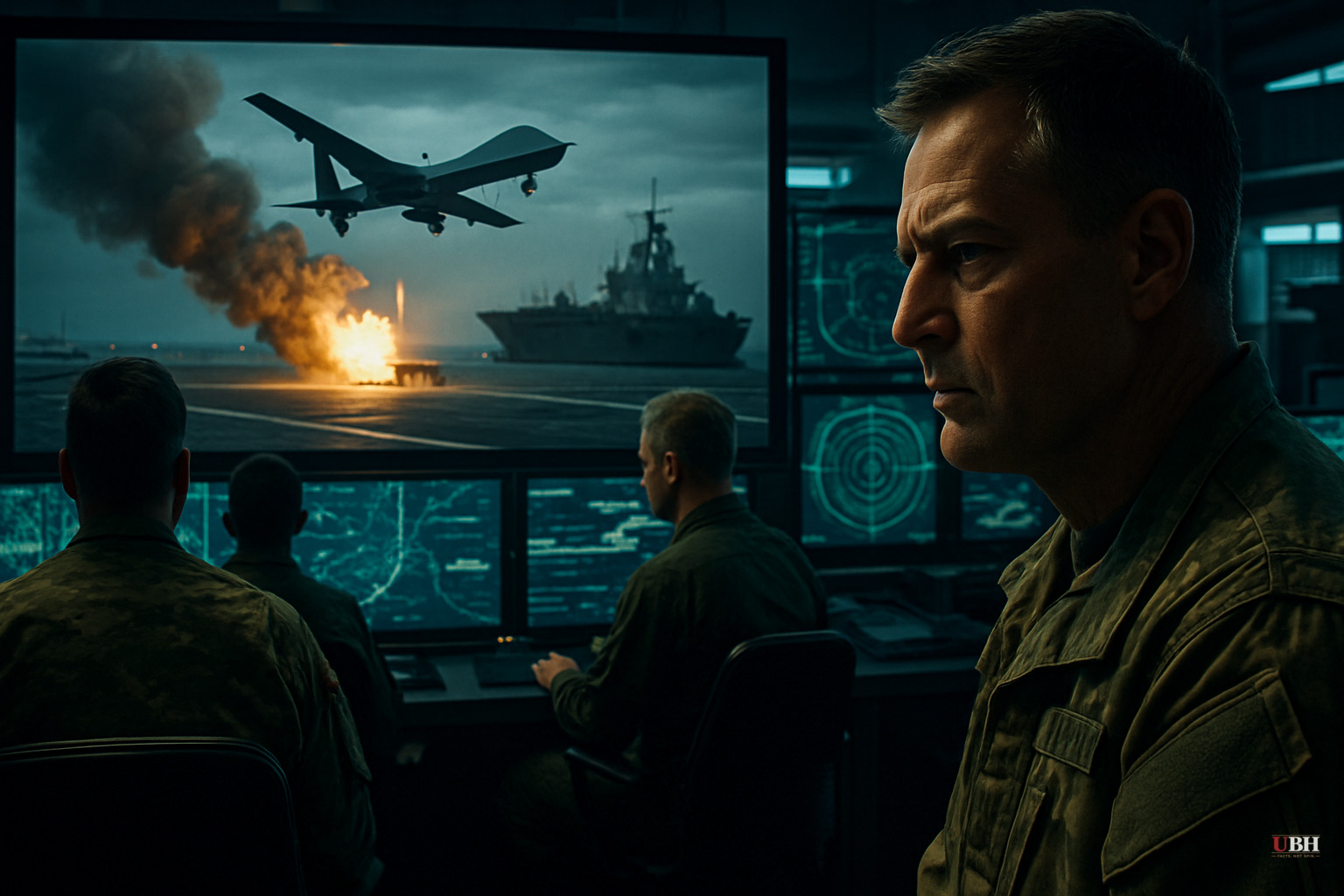
The Situation as of June 3
Since the April 8 ceasefire was announced, every week has brought fresh evidence it exists mostly on paper. Wednesday was no exception.
Iran struck Kuwait International Airport with drones, killing at least one person and injuring others, according to Kuwait's Ministry of Foreign Affairs. Flights were suspended. The IRGC denied responsibility, blaming the attack on a U.S. military systems error — a claim that strains credulity given the pattern of the last several weeks.
The day before, according to U.S. Central Command, Iran fired several ballistic missiles at regional neighbors. Two missiles aimed at Kuwait fell short or broke apart. Three aimed at Bahrain were intercepted by U.S. and Bahraini air defenses. Three one-way attack drones targeting civilian mariners were shot down. CENTCOM responded with strikes on Qeshm Island.
This is not a ceasefire. It's a managed slow bleed.
Trump's Private Red Line
The Wall Street Journal reported Wednesday that Trump has told aides he will NOT resume all-out war with Iran unless U.S. troops are killed. That's the threshold. Not allied casualties. Not civilian airports. Not ballistic missiles over the Gulf.
When asked directly at the White House whether the ceasefire was still operative after the Kuwait airport strike, Trump didn't answer the question. "You know, there's a reason for everything," he said, per CNBC. "And we hit them pretty hard the night before."
That's not a strategy. That's a man threading a needle in public while hoping the needle doesn't break.
Congress Moves — Finally
The House passed a war powers resolution Wednesday forcing Trump to end the Iran war, according to The Hill. Several Republicans broke with the party to get it done — a real vote with real defections, not symbolic posturing.
The administration launched this war in late February without a congressional authorization for use of military force. It has now cost Americans an estimated $100 billion in increased oil costs and military spending, per a recent Moody's estimate cited by Reason. That's taxpayer money. The American people never voted on it.
The resolution still faces steep odds in the Senate, and Trump can veto it. But the House vote indicates the political coalition behind this war is eroding.
Rubio Says the War Is 'Over.' It Is Not.
Secretary of State Marco Rubio appeared before the Senate Appropriations Committee and stated flatly, "the war is over," according to Reason's reporting on the hearing. In the same session, he described a peace framework requiring the Strait of Hormuz to reopen as a precondition, followed by up to 90 days of expert-level nuclear negotiations, with sanctions relief only coming after that.
That's a war with a long and complicated off-ramp that hasn't been taken yet.
Rubio also confirmed that Trump sent back the memorandum of understanding to Iran with tougher terms after domestic political criticism — a detail first reported by The New York Times. The critics who hammered Trump for being soft on Iran may have just hardened the terms enough to kill the deal.
The Bipartisan War Party Problem
Both parties have factions actively sabotaging peace talks.
Reason documented it clearly. On the right, Sen. Lindsey Graham (R-S.C.) called a potential deal a "nightmare for Israel." Former Secretary of State Mike Pompeo demanded Trump "take out enough Iranian capability" instead of negotiating. Senate Armed Services Chair Roger Wicker (R-Miss.) warned the truce wouldn't let Trump "finish the job."
On the left, Sen. Cory Booker (D-N.J.) told Rubio that Iran is "getting money to rebuild" through the ceasefire. Sen. John Fetterman (D-Pa.) accused Trump of trying to "cave to Iran just for political convenience."
Fetterman was against the war before he was against ending it. Booker called the war "outrageous" in March and is now arguing against the framework to stop it. These are not principled positions. These are politicians chasing cameras.
The Trump-Netanyahu Fracture
The Wall Street Journal reported that Trump and Netanyahu are now openly clashing over how to end the war. The two leaders launched the conflict together. Now they disagree on Lebanon — Iran is explicitly using Lebanon as a wedge, demanding any U.S. deal include a ceasefire there, according to The Hill. Netanyahu won't accept that. Trump held two calls with Netanyahu this week trying to manage the gap.
Times Now reported Iran has suspended indirect exchanges with U.S. mediators, citing continued Israeli operations in Lebanon. Trump downplayed that publicly. The quiet reality is that Israel's Lebanon operations are directly complicating U.S. diplomacy with Iran — and the two governments don't have aligned goals right now.
The Economic Clock Is Running
The Hill reported Wednesday on a new economic outlook showing that a prolonged energy disruption from this war would deliver a severe blow to the global economy. The Strait of Hormuz remains the linchpin — it hasn't reopened. Every week it stays closed is another week of elevated energy costs hitting American consumers, not just Gulf shipping lanes.
The Pentagon's inspector general, Cheryl L. Mason, was named Wednesday as the lead watchdog probing the conduct of the war, according to The Hill. That's an accountability mechanism being stood up months into a conflict that was never authorized by Congress.
Where This Stands
The ceasefire is in name only. The peace talks are stalled. Congress is pushing back. Iran is testing the limits daily. Trump has drawn a private red line at dead U.S. troops — which means everything short of that is apparently acceptable. A bipartisan caucus of hawks is making it politically harder to take the exit ramp that both sides have mostly agreed on in principle.
Someone is going to miscalculate. The only question is when.
Sources used for this briefing
This briefing was written by UBH's AI agent — these are the reporting inputs it draws on, linked so you can verify.


