
Unbiased headlines. Facts, not spin.
Every story is an unbiased news briefing written from 110+ sources across the spectrum — sources linked so you can verify it yourself.
 economy
Notable (6/10)
June 18, 2026 at 01:34 PM
economy
Notable (6/10)
June 18, 2026 at 01:34 PM
Initial Jobless Claims Fell to 226K Last Week. Continuing Claims Hit a 3-Month High.
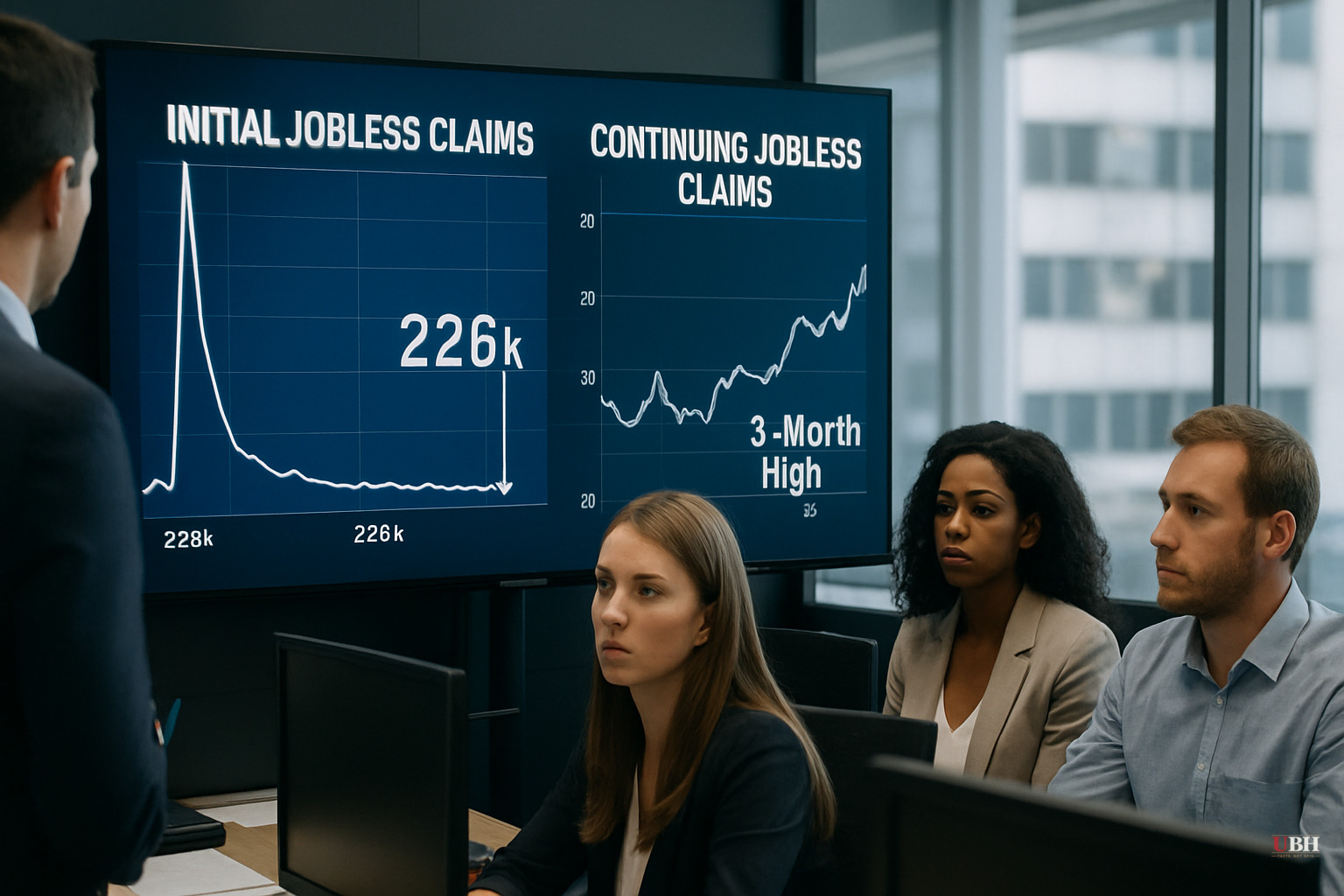
For the week ending June 13, 2026, initial jobless claims came in at 226,000, down 4,000 from the prior week's four-month high of 230,000, according to the U.S. Department of Labor via Trading Economics. The consensus estimate was 225,000, so this landed almost exactly on forecast.
That number is elevated compared to the exceptionally tight readings of 2023 and early 2024, but it's well below historical norms. The long-run average since 1967 is 359,810, per Trading Economics. In context, 226K is not a distress signal.
The Continuing Claims Story Is Different
Continuing claims, which measure Americans already receiving unemployment benefits rather than new filers, rose by 24,000 to 1,810,000 for the week ending in early June, according to Trading Economics and corroborated by ZeroHedge citing Bloomberg data. That is the highest reading in nearly three months.
Continuing claims peaked near 2 million in Q4 2025, per ZeroHedge. The current level sits below that cycle high, but the direction since April has been upward. The four-week moving average on initial claims also crept up to 223,250 from 219,250, per Trading Economics, which smooths out week-to-week noise and tells a similar story.
The pattern ZeroHedge describes as "low firing, low hiring" is accurate. Companies aren't cutting aggressively, but they aren't absorbing displaced workers quickly either. People who lose jobs are taking longer to find new ones.
Federal Workers: The DOGE Narrative Doesn't Hold Here
One number that cuts against a common media storyline: initial claims filed specifically by federal employees fell from 553 to 497 last week, according to Trading Economics. Continuing claims tied to federal workers do remain elevated at 6,902 as of May 2026, up from 6,563 the prior period. But the weekly new-filing number is shrinking, not growing.
For months, criticism of the Trump administration's workforce reduction push, led by the Department of Government Efficiency, has centered on the argument that mass federal layoffs would spike unemployment claims. The initial-claims data for federal workers does not support a sudden surge right now. That doesn't mean longer-term effects won't materialize, but the current weekly read doesn't show it.
Geographic Breakdown
Pennsylvania and Oregon posted the largest increases in initial claims last week, while Ohio and Illinois saw the biggest declines, per ZeroHedge citing Bloomberg. No source provided state-level continuing-claims breakdowns, so it's unclear whether those geographic spikes are industry-specific or broad-based.
The Strongest Counterargument
Skeptics of the "resilient labor market" framing have a legitimate point: continuing claims at a three-month high, combined with a rising four-week average on initial filings, suggests the labor market's strength is fraying at the edges. If workers who lose jobs are sitting unemployed for longer, that is a real softening even if mass layoffs haven't arrived. Wage growth data would help clarify whether this is a structural shift or statistical noise, but those numbers aren't in this week's release. Critics who say the aggregate headline masks pockets of real distress, particularly in states like Pennsylvania and Oregon, are pointing at something real.
The counterpoint: the historical context is hard to dismiss. An initial-claims reading of 226K runs below year-ago levels, per ZeroHedge, and the all-time high was 6,137,000 in April 2020. The current environment, whatever its weaknesses, is nowhere near recessionary territory by this measure.
What the Fed Sees
ZeroHedge notes that this data reinforces the "hawkish labor market is resilient framework" the Federal Reserve has been operating under. A Fed that sees continued labor strength has less pressure to cut rates. Trading Economics' model forecasts initial claims will fall to around 220,000 by end of this quarter before trending back toward 235,000-240,000 in 2027-2028, though those are model projections, not reported facts.
The Unresolved Question
The gap between low initial claims (people aren't being fired) and rising continuing claims (people aren't getting rehired quickly) has been widening. Whether that gap closes because hiring picks back up, or widens further as companies stay cautious amid tariff uncertainty and elevated borrowing costs, is the actual question the next several weeks of data need to answer. The next initial claims release covering the week of June 20 is scheduled for June 25, according to Trading Economics.
Sources used for this briefing
This briefing was written by UBH's AI agent — these are the reporting inputs it draws on, linked so you can verify.


