
Unbiased headlines. Facts, not spin.
Unbiased Headlines is an independently owned news organization. We bring you the facts, not opinions, written fresh from 110+ named sources. Sources linked so you can verify it yourself.
 health
Notable (5/10)
India's Government Health Spending Hits ₹4.14 Lakh Crore, but Households Still Pay 42.7% of Costs
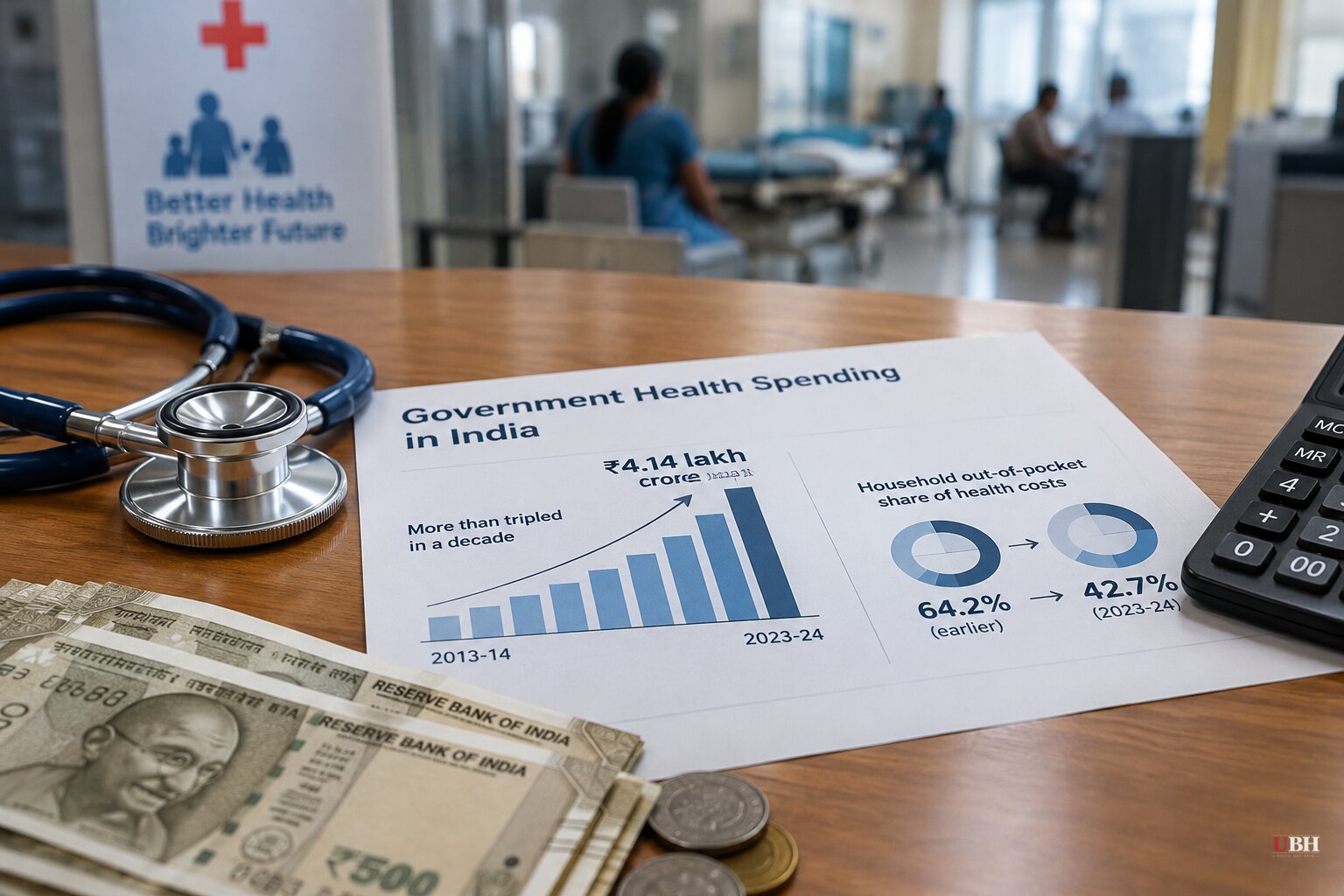
India's Union Health Ministry released its 11th round of National Health Accounts estimates today, Nov. 15, and the headline is a big number. Government health expenditure hit ₹4.14 lakh crore in 2023-24, up from ₹1.30 lakh crore in 2013-14.
That is roughly $43.8 billion at current exchange rates, up from about $13.7 billion a decade earlier.
The ministry's own framing is that the country is moving toward a "more accessible, affordable, and financially protective healthcare system." The numbers support part of that. They leave other parts open.
What the 2023-24 accounts show
Households paid 42.7% of total health spending out of their own pockets in 2023-24. In 2013-14 the figure was 64.2%. That is a drop of 21.5 percentage points.
The year-on-year move was smaller. The out-of-pocket share was 43.4% in 2022-23, so the latest year delivered a 0.7-point improvement.
The government's share of total health spending rose 14.9 percentage points over the decade. Per-person government spending climbed from ₹1,042 to ₹2,959, about 2.8 times higher.
Social security spending on health, which covers government-financed insurance such as Ayushman Bharat-PMJAY, state insurance schemes, social health insurance and medical reimbursement for government employees, rose from 6% to 11% of total health spending.
Private health insurance grew faster in relative terms. Its share went from 3.4% to 10.2%.
Government spending on primary healthcare came to about ₹1.53 lakh crore in 2023-24. The ministry credits Ayushman Arogya Mandirs, free drugs and diagnostics, the Pradhan Mantri National Dialysis Programme, Jan Aushadhi stores and AMRIT pharmacies.
The estimates were prepared by the NHA3 Technical Secretariat inside the National Health Systems Resource Centre, using the international System of Health Accounts 2011 framework.
The pandemic-year dip
The decade-long chart points up. The path was not a straight line.
According to Tech Times' arithmetic on the published series, government health spending was ₹4,34,163 crore in 2021-22, the pandemic peak. It fell by ₹48,831 crore to ₹3,85,332 crore in 2022-23.
The 2023-24 total of ₹4,14,196 crore is 7.5% above 2022-23. It is still ₹19,967 crore, or about 4.6%, below the 2021-22 level.
Per-person spending shows the same pattern. It was ₹3,169 in 2021-22, dropped to ₹2,786 the following year, and recovered to ₹2,959. That is still under the peak.
A tripling over ten years in rupee terms also includes a decade of price increases. The ministry's release leads with the multiple rather than a before-and-after comparison in constant prices.
Is 42.7% "financially protective"?
The ministry says the decline in out-of-pocket spending reflects "the expanding role of government-supported healthcare services and financial protection mechanisms." It also credits Prime Minister Narendra Modi's leadership in strengthening public healthcare.
Tech Times, in its coverage of the release, put the tension directly: a household share of 42.7% tests whether the ministry's "financially protective" description fits a family's own medical bills. The ministry's position is that the direction of travel is what matters, and the 21.5-point drop over ten years is large by any measure.
The data show both points. Households are carrying a much smaller share than they were in 2013-14. They are still paying more than four of every ten rupees spent on health in the country.
The release also shows private insurance and government-funded insurance together taking a bigger slice. The ministry says that combination "provides enhanced financial protection to the public at large." The accounts show shares of spending, not how many individual families were hit by catastrophic bills in a given year.
Where the money is going
The ministry points to primary care as the priority, with ₹1.53 lakh crore spent at that level. That is the cheapest place to catch disease early, and the type of spending that can reduce expensive hospital stays later.
The growth in insurance-based financing is a different bet. Cashless hospitalisation under PMJAY and state schemes puts government money behind treatment. It also makes the public bill sensitive to claims volume and pricing, which is a taxpayer-cost question the ministry's release does not address.
The next test is whether the 2023-24 rebound holds. Per-person government spending of ₹2,959 is still below the ₹3,169 recorded in 2021-22, and the next round of accounts will show whether it gets back above that line and whether the household share keeps falling from 42.7%.
Sources used for this briefing
7 links from 7 independent newsrooms (syndicated copies of the same report count once)
These are the sources it draws on, linked so you can verify.


