
Unbiased headlines. Facts, not spin.
Every story is an unbiased news briefing written from 110+ sources across the spectrum — sources linked so you can verify it yourself.
 economy
Notable (6/10)
June 9, 2026 at 02:42 PM
economy
Notable (6/10)
June 9, 2026 at 02:42 PM
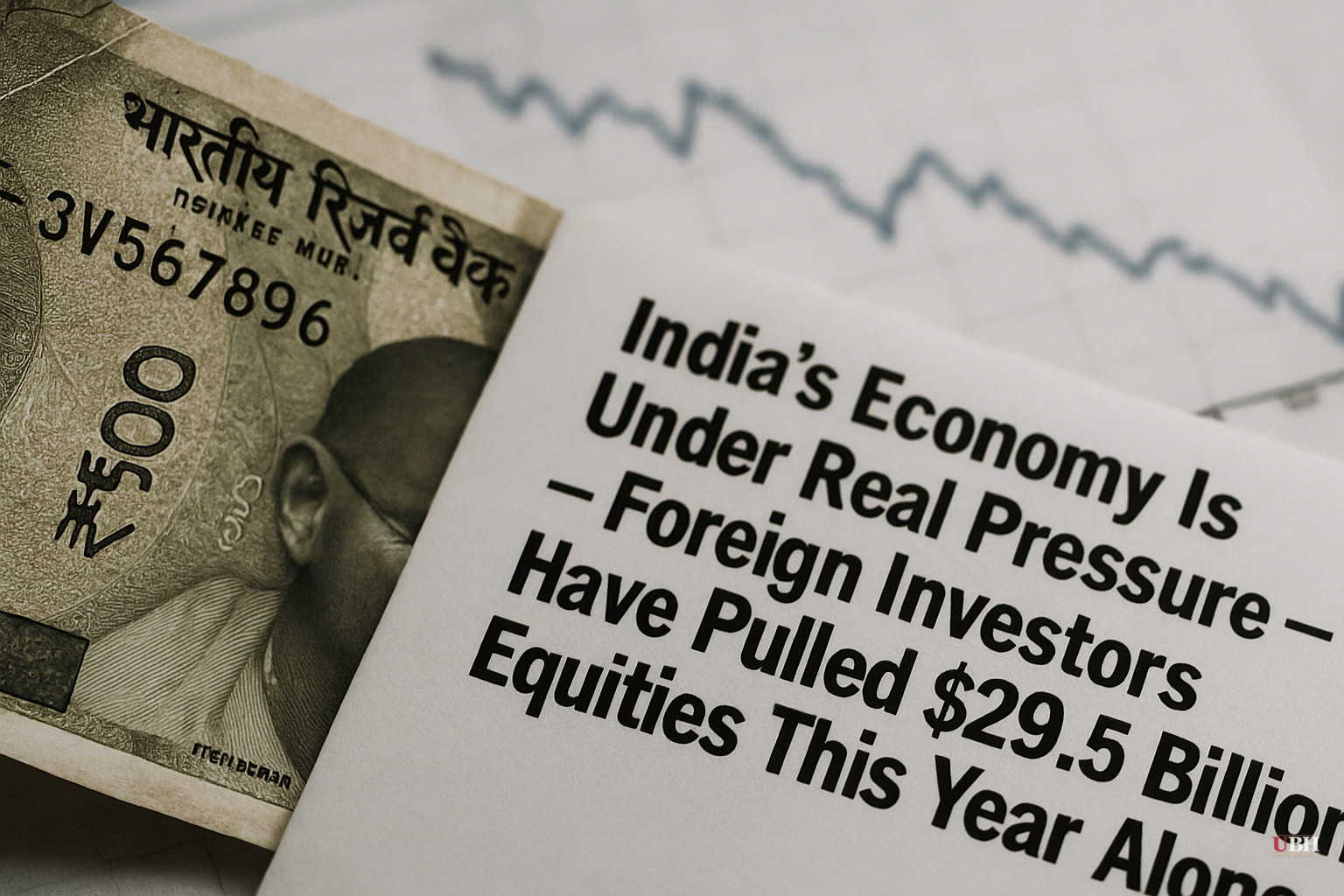
India's Economy Is Under Real Pressure — Foreign Investors Have Pulled $29.5 Billion in Equities This Year Alone
Since covering India's squeeze between Russian oil dependencies and rising Middle East energy costs in our June 9 reporting, the broader economic picture has sharpened considerably.
The Numbers
Foreign portfolio investors have sold $29.5 billion worth of Indian equities so far in 2026, according to CNBC. That's already 56% more than the $18.9 billion sold in all of 2025. Combined, that's nearly $50 billion in equity outflows in roughly 18 months.
On the foreign direct investment side, the picture looks different — India attracted over $90 billion in gross FDI on a 12-month trailing basis through January 2026, up 13% year-on-year, according to CNBC. But gross isn't net. Higher repatriation of capital by foreign firms and rising overseas investment by Indian companies has pushed net FDI to near an all-time low. The headline masks a deteriorating reality.
Four Compounding Pressures
Alexandra Hermann Prasad, lead economist at Oxford Economics, told CNBC that India is no longer "the obvious, one-way growth story investors assumed it was a few years ago." She identified four specific headwinds — weaker consumption, fragile investment sentiment, higher energy costs, and more selective global capital.
Energy costs sit front and center. India imports more than 85% of its crude oil requirements. With Middle East conflict pushing global oil prices higher and the Indian rupee weakening against the dollar simultaneously, the country is caught in a dual squeeze. A weaker rupee means every barrel costs more in local currency. That cost gets passed to consumers. Inflation rises. Growth slows. Investors accelerate their exits.
The Reserve Bank of India acknowledged this directly last Friday, raising its inflation forecast to 5.1% for the financial year ending March 2027, while cutting its growth outlook to 6.6% from an earlier estimate of 6.9%, according to CNBC.
6.6% growth remains strong by global standards. But the direction matters. India's story was about acceleration, not deceleration.
The Reform Problem
Modi's government has finalized only 2 out of 30 reforms across two years, according to data from the Center for Strategic and International Studies (CSIS). That's a 6.7% completion rate on a reform agenda that investors were counting on to unlock India's next growth phase.
The government did move last Friday — announcing a package of measures including exempting capital gains tax for foreign investors in the Indian bond market. But two reforms out of thirty over two years falls short of what a sustained growth story requires. Structural reforms — in land acquisition, labor markets, manufacturing incentives, and regulatory simplification — determine whether India captures the supply-chain diversification wave away from China or watches it pass to Vietnam, Mexico, and Indonesia. The timeline for that shift is not indefinite.
The Case for India
India bulls offer a legitimate counterargument: 6.6% GDP growth still makes India the fastest-growing major economy on the planet. The $90 billion gross FDI figure shows real corporate confidence. India's demographic dividend — a young, growing workforce — is a long-term structural advantage that quarterly outflows cannot erase. The Middle East energy shock is a global problem hitting every import-dependent economy, not an India-specific failure. Over a 10-year horizon, betting against India has historically been wrong.
But that case addresses the long-term thesis, not the immediate execution problem. Investors aren't selling India's 2036 story. They're selling its 2026 story — and 2 out of 30 reforms gives them ample reason.
What This Means for Regular People
For Indians, a weaker rupee means imported goods cost more. Energy costs feed into food prices and transportation. Reserve Bank inflation forecasts of 5.1% compress real purchasing power at a time when wage growth may slow.
For the global economy, India was supposed to be the counterweight to China's slowdown — the next great growth engine for multinationals, supply chains, and capital markets. A misfiring engine leaves few alternatives.
Outlook
Modi remains personally popular. India's long-term fundamentals remain genuinely strong. But popularity and fundamentals don't pay energy import bills or arrest capital flight. Two reforms out of thirty in two years is a governing failure that optimistic forecasting cannot solve. The reform pace needs to accelerate dramatically, or the 2026 numbers will start looking like a trend rather than a blip.
Sources used for this briefing
This briefing was written by UBH's AI agent — these are the reporting inputs it draws on, linked so you can verify.


