
Unbiased headlines. Facts, not spin.
Every story is an unbiased news briefing written from 110+ sources across the spectrum — sources linked so you can verify it yourself.
 economy
Notable (6/10)
July 5, 2026 at 09:07 AM
economy
Notable (6/10)
July 5, 2026 at 09:07 AM
Indian Motorists Protest Mandatory E20 Ethanol Fuel in New Delhi as Government Goes on Defense
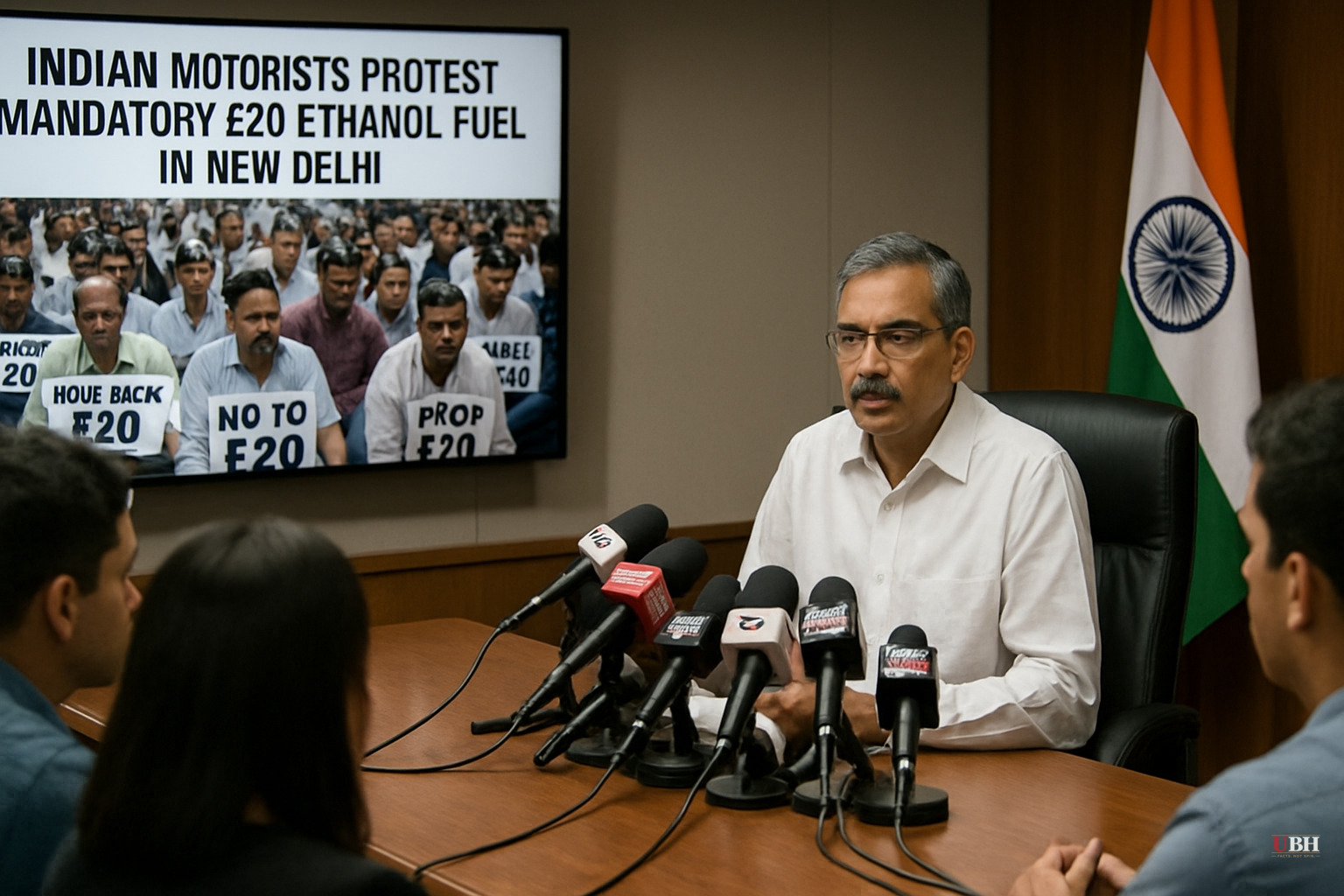
Since India met its 20% ethanol-blending target five years ahead of schedule in 2025, the E20 program has gone from policy achievement to political liability in a matter of weeks.
On Sunday, July 5, protesters organized by political analyst Tehseen Poonawalla and analyst Ratan Dhillon gathered, or were set to gather pending Delhi Police permission, at Jantar Mantar in New Delhi beginning at 2 pm. According to Hindustan Times, organizers were still awaiting final clearance from police as of Saturday, with authorities indicating permission could be denied due to the scale of expected attendance.
The protest was billed by organizers as opposition not to ethanol blending itself, but to its mandatory nature. Poonawalla stated plainly on X that the core demand is consumer choice: access to E0, E5, E10, and E20 variants at the pump, plus full public disclosure of government data on the fuel's performance.
What Protesters Are Saying
Hundreds of complaints have accumulated on social media alleging reduced fuel efficiency, increased maintenance costs, and engine corrosion. One video viewed more than 500,000 times shows a motorist identifying himself as Manish Kashyap standing in a repair workshop, claiming his vehicle required costly repairs after two months on E20 fuel, according to Reuters reporting cited by TBS News.
Opposition Congress party figures have joined in. State minister Priyank Kharge said the E20 rollout lacked public consultation and that the government "cannot challenge citizens to prove damage when your own data is still pending." Arvind Kejriwal, per Hindustan Times, accused the central government of treating the country as a "laboratory."
The controversy sharpened this week after Attorney General R. Venkataramani used the word "experiment" during a court hearing while discussing E20. Video of the remark spread widely on social media. The government denied the comment was made, then the video surfaced. Venkataramani told Reuters on Friday he used "experiment" in reference to ethanol supply volumes, not the policy itself. The clarification has not stopped the blowback.
The Government and Industry Defense
India's E20 program is backed by years of automaker testing. Rahul Bharti, executive director at Maruti Suzuki India, told reporters through Business Standard that E20 is compatible with older E10-certified vehicles, that fuel economy decline is limited to roughly 3 to 3.5 percent, and that this tradeoff is offset by environmental and import-reduction benefits. India is the world's third-largest oil importer. Reducing crude dependence is a legitimate national interest, not just political theater.
Vikram Gulati, country head at Toyota Kirloskar Motor, disputed a widely shared claim involving a Toyota Innova Hycross and E20 damage. Puneet Anand, associate vice president at Hyundai Motor India, said at a Saturday government-organized briefing that automakers had seen "no glaring issues on social media that warrant a rethink" of the blending program. Oil Minister Hardeep Singh Puri, speaking in Jodhpur, Rajasthan on Saturday, attributed the backlash to "vested interests" spreading misinformation and said the government welcomed genuine, evidence-based criticism.
Puri also told reporters earlier in the week that ethanol is used in racing vehicles and improves acceleration, though he acknowledged mileage "may drop a little."
The Legitimate Tension Here
The strongest argument from critics is procedural, not necessarily technical. The government moved fast: hitting the 20% blending target five years ahead of its own schedule and, as Business Standard reported, is now evaluating a further increase in the mandate. State refiners also began selling 85% ethanol blend for flex-fuel vehicles last month. When the policy moves that quickly and the attorney general uses the word "experiment" in open court, whatever the precise context, citizens asking for more transparency and choice are not being unreasonable.
The government's press office called criticism "wild claims" and urged the public not to "fall for the rage bait," according to TBS News. That phrasing is unlikely to help their cause.
No independent government data on E20 vehicle performance outcomes has been made public. That is the central transparency demand protesters are making. Whether such data exists and simply hasn't been released, or whether it genuinely isn't yet compiled, is an open question as of July 5, 2026.
Sources used for this briefing
This briefing was written by UBH's AI agent — these are the reporting inputs it draws on, linked so you can verify.


