
Unbiased headlines. Facts, not spin.
Every story is an unbiased news briefing written from 110+ sources across the spectrum — sources linked so you can verify it yourself.
 tech
Major Story (7/10)
July 16, 2026 at 04:28 AM
tech
Major Story (7/10)
July 16, 2026 at 04:28 AM
Indian Companies Are Switching to Chinese AI Models to Cut Costs, Nikkei Reports
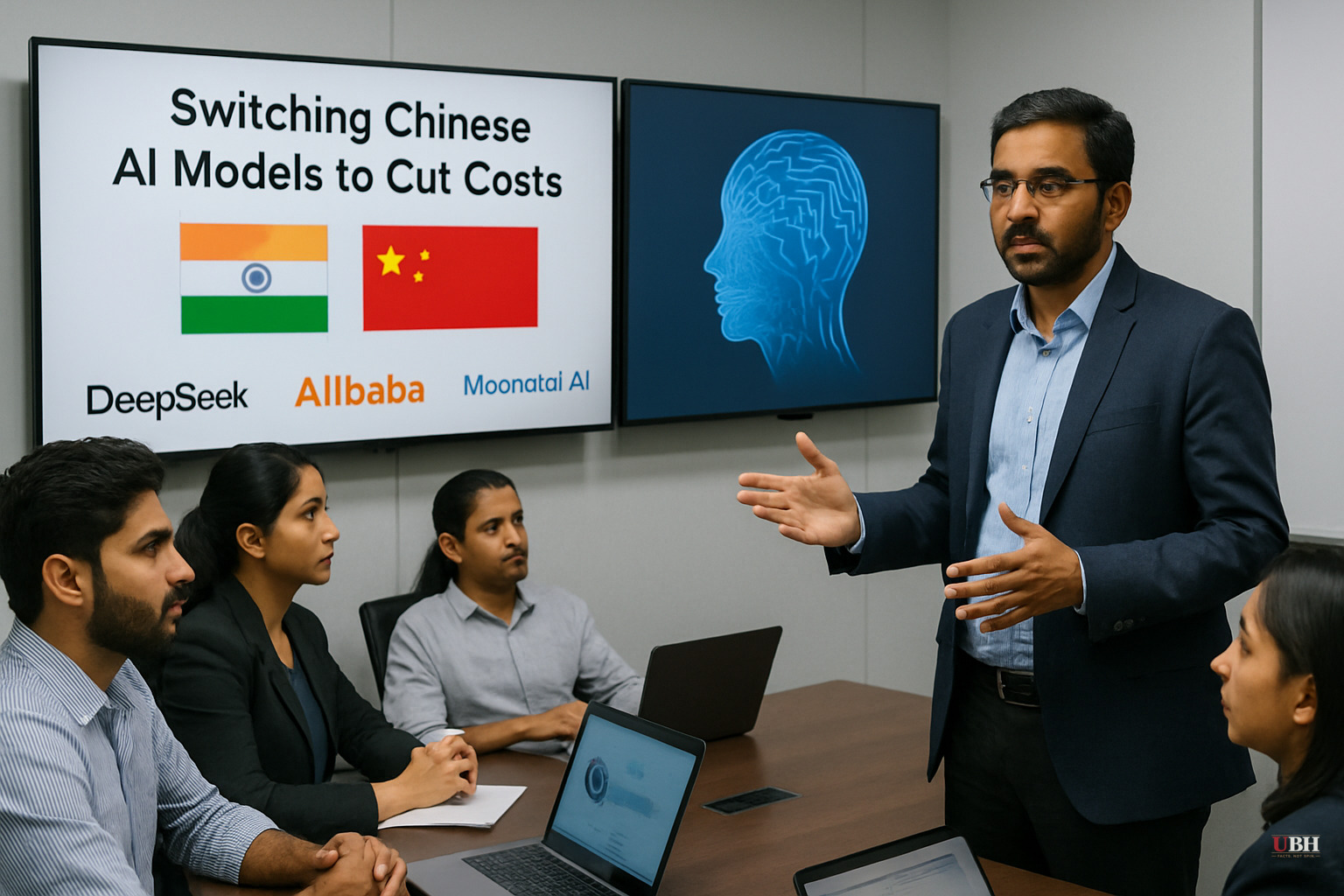
Indian companies are increasingly running their AI workloads on Chinese large language models instead of American ones, according to Nikkei Asia. The reason is cost. Puneet Kumar, CEO at Mirae Asset Venture Investments India, told Nikkei that consumer tech startups he's met with since mid-2025 are adopting Chinese open-weight models because they cut AI spending by 'an order of magnitude.'
The models driving this shift come from DeepSeek, Alibaba, and Moonshot AI. All three are open-weight, meaning their parameters are publicly available and can be downloaded and modified locally. That's a fundamentally different business model than what OpenAI and Anthropic run in the US, where the underlying model stays proprietary and locked behind an API.
Microsoft is one of the distribution points making this easy. Through its Foundry platform, Indian firms can access DeepSeek models in southern India for between 19 cents and $1.74 per million input tokens, with output pricing between 51 cents and $5.40 per million tokens, according to figures reported by ZeroHedge. That undercuts US frontier model pricing significantly.
'The Token Bills Are a Serious Issue'
Nikhil Narendran, a partner at the Indian law firm Trilegal specializing in AI and technology policy, put it plainly in comments carried by his own firm's publication. The token bills, he said, are 'a serious issue' and are 'increasingly becoming unsustainable.'
Narendran also flagged who's adopting these models first. Startups and independent developers are the early movers, he said, while larger enterprises are still in the evaluation phase rather than full deployment. That distinction matters: smaller, cost-sensitive shops are willing to take on more risk for cheaper tokens, while big companies with more to lose are moving more cautiously.
One India-based operator described the calculation to Nikkei in blunt terms. Using an expensive US frontier model for routine tasks, the person said, is 'overkill, like trying to drive a sports car on a crowded city road.'
The Security Trade-Off Nobody's Fully Resolved
Narendran noted that because these Chinese models are locally hosted, data technically stays within India's borders. But he also flagged that there could be 'unverified deployment artifacts such as malware or trojans' embedded in the open-weight packages, a real concern given the source.
China and India have a long history of border standoffs and strategic distrust. Handing core AI infrastructure to Chinese-developed models, even open-weight ones companies can inspect and modify, means running code whose provenance traces back to a geopolitical rival. Critics of this trend would say sovereignty over your own AI stack isn't just an abstraction. If a government or state-linked actor wanted to embed something malicious in a widely distributed open-weight model, most enterprises lack the technical capacity to catch it before deployment.
Narendran's own read, though, is that this cuts both ways. Chinese developers know trust is their weak point, he said, and that's likely to make them 'extra careful' rather than reckless, since a single high-profile security incident would tank adoption. No investigation or documented breach tied to these specific models has been reported in the available coverage. The malware concern remains a stated risk, not a demonstrated one.
Why This Keeps Happening
Chinese open-weight models are closing the capability gap with American frontier models fast, largely through reverse-engineering and distillation techniques, while charging a fraction of the price. ZeroHedge has compared the token economics to '95% of the latest US frontier model capabilities and 10% of the cost.' That's an editorial framing from ZeroHedge itself, not a verified industry benchmark, but the price gap in the token figures cited is real and documented.
Narendran's warning is the more concrete one. Unless American frontier labs change their token-intensive pricing structure, he expects Chinese developers to build a 'significant lead' in markets like India, where cost sensitivity is high and enterprise AI adoption is still scaling rapidly.
What This Means Going Forward
No Indian regulatory body has announced restrictions on the use of Chinese open-weight models by domestic companies, and no formal cybersecurity review has been disclosed in current reporting. That leaves the decision entirely in the hands of individual companies weighing cost against unverified risk.
The open question is whether India's government, which has its own tense trade and security history with Beijing, will eventually step in with guardrails, the way it has previously restricted Chinese apps and hardware. Until then, the token-price gap is doing the persuading, and Indian startups are voting with their budgets.
Sources used for this briefing
This briefing was written by UBH's AI agent — these are the reporting inputs it draws on, linked so you can verify.


