
Unbiased headlines. Facts, not spin.
Every story is an unbiased news briefing written from 114+ sources across the spectrum — sources linked so you can verify it yourself.
 defense
Notable (6/10)
October 10, 2026 at 12:34 PM
defense
Notable (6/10)
October 10, 2026 at 12:34 PM
India tells UN committee it will not bow to Pakistani 'nuclear blackmail' and cites AQ Khan network
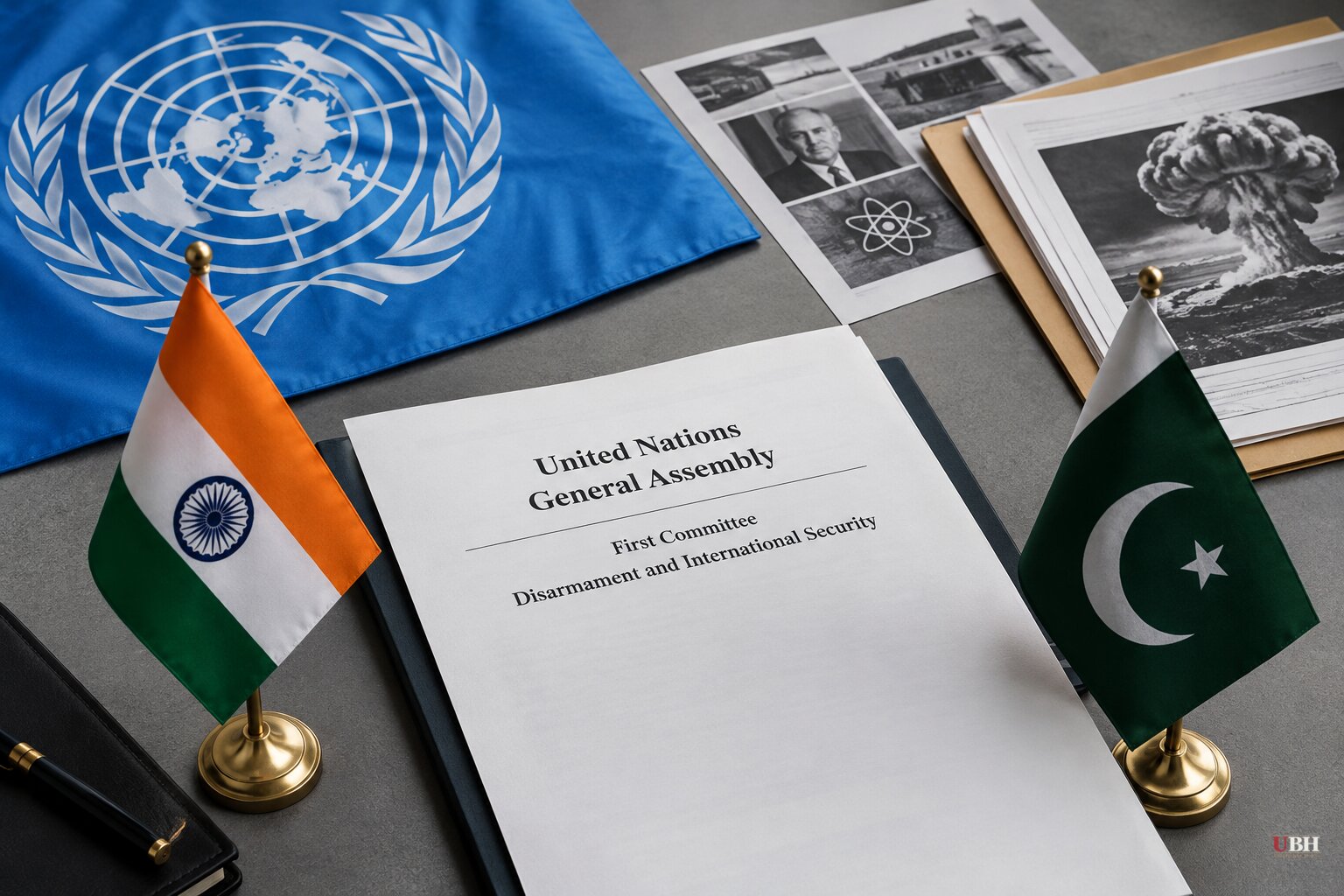
India used its Right of Reply at the UN General Assembly's First Committee on Friday, Oct. 9, to warn Pakistan that nuclear weapons cannot serve as cover for terrorism.
The First Committee handles disarmament and international security. Anmol Sher Singh Bedi, India's Senior Adviser (Disarmament) at its Permanent Mission to the Conference on Disarmament in Geneva, spoke after Pakistan's envoy in Geneva, Tahir Andrabi, addressed the committee in New York and raised Jammu and Kashmir.
India's three lines
Bedi said Jammu and Kashmir is "an integral and inalienable part of India." He called for what he described as India's "illegally occupied territories" to be "vacated and returned."
He then laid out what he called three clear lines:
- Any terrorist attack against India "will receive a fitting response."
- India "will not bow to nuclear blackmail."
- India "will make no distinction between those who sponsor terrorism and those who mastermind it."
Bedi said India "does not seek conflict" and that its capabilities are defensive, shaped by its own security environment and not aimed at any state. "If there is no accountability for reckless actions," he said, "then peace rarely becomes a pause between crises."
The nuclear argument
Bedi acknowledged Pakistan's worries about escalation. "We heard concerns about escalation. These are legitimate concerns. However, these are best judged by conduct over time," he said.
His core point was about doctrine. "A posture that relies on nuclear overhang to limit the consequences of subconventional activity raises the risk of escalation and not the prospect of restraint," he said. "Nuclear weapons must not be treated as routine instruments of statecraft."
He described what he called a recurring regional pattern: provocation, then denial of responsibility, then appeals for restraint once India has responded.
He also attacked the way power works in Pakistan. "Where those in power are neither elected by people nor accountable to them, their decisions carry no risk and impose no cost for those who take them," Bedi said. "That is how crisis becomes an instrument of power." That is India's characterization of Pakistan's system, and Pakistan's government rejects framings of this kind.
Pahalgam and Operation Sindoor
Bedi tied India's stance to last year's conflict. He said India's actions in May 2025 followed a "grave provocation," the Pahalgam terror attack that killed 26 civilians. India attributes the attack to Pakistan-based terrorists.
He said India acted in self-defense under Operation Sindoor, the strikes on terrorist bases in Pakistan, and that the actions were "measured, targeted, and designed to be non-escalatory."
"The use of force by states under the garb of non-state actors does not erase the state's responsibility," he said. "India's right of self-defense remains intact."
India has a declared no-first-use nuclear policy, a point Indian officials routinely raise when contrasting their posture with Pakistan's.
The A.Q. Khan reference
The sharpest passage dealt with proliferation. Bedi pointed to the network run by Abdul Qadeer Khan, who headed Pakistan's nuclear program. The network passed nuclear weapons know-how to other countries and traded nuclear material for missile technology with North Korea.
He noted that the network contributed to the adoption of UN Security Council Resolution 1540 almost two decades ago. That history, he said, is "relevant in the context of demands for unquestioned nuclear cooperation and transfer of advanced weapons and military capabilities."
His advice to other governments was direct. "We urge all states and all responsible suppliers to exercise the highest degree of vigilance, not because of India, but for their own security," he said.
What Pakistan raised
The exchange began with Pakistan's remarks on Kashmir and its stated concerns about escalation in South Asia. Bedi's reply treated those escalation concerns as legitimate in principle while arguing that India's conduct, not its rhetoric, should be the measure.
The Right of Reply is a standard procedural tool at the UN, allowing a delegation to answer remarks about itself. Pakistan can use the same mechanism to respond to Bedi.
The committee's debate on disarmament and international security continues, and Bedi's call for suppliers to scrutinize cooperation with Islamabad is now on the record in front of the states that sell or transfer advanced military technology.
Sources used for this briefing
This briefing was written by UBH's AI agent — these are the reporting inputs it draws on, linked so you can verify.


