
Unbiased headlines. Facts, not spin.
Every story is an unbiased news briefing written from 110+ sources across the spectrum — sources linked so you can verify it yourself.
 tech
Notable (6/10)
June 14, 2026 at 03:31 AM
tech
Notable (6/10)
June 14, 2026 at 03:31 AM
India Calls for Sovereign AI After Anthropic Shutdown Locks Out Its Second-Largest Market
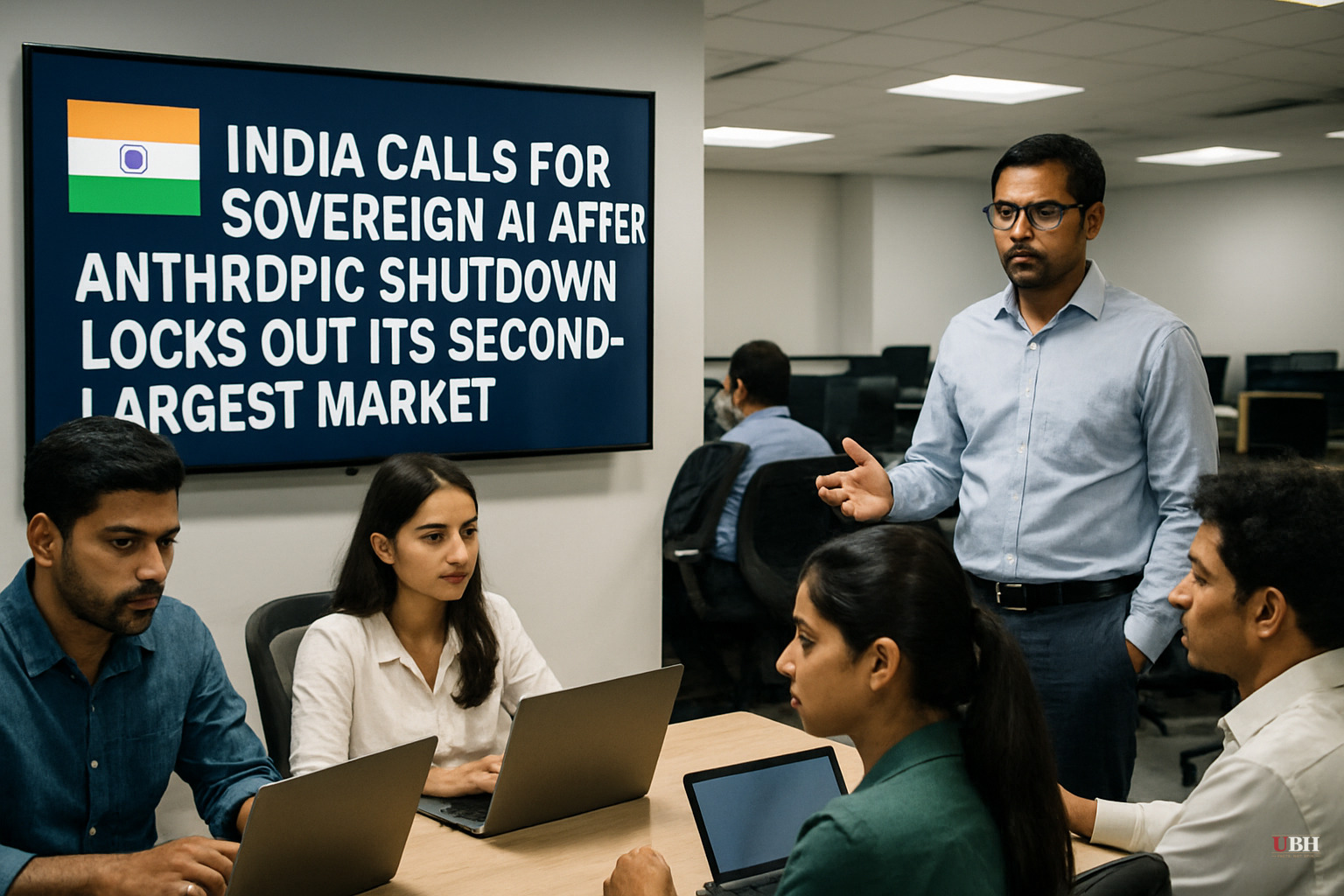
Since Anthropic suspended global access to Fable 5 and Mythos 5 on June 12, and publicly disputed the U.S. government's characterization of the jailbreak vulnerabilities that triggered the order, the story has moved decisively beyond Washington. The fallout is now reshaping how India's technology industry thinks about its own AI future.
India Was Deeply Embedded, Not Just Casually Involved
This wasn't a peripheral relationship that got disrupted. According to Crypto Briefing, TCS had been training 50,000 employees on Anthropic's models. Infosys had active collaborations with the company. Select Indian entities had begun accessing Mythos 5 through Project Glasswing, a cybersecurity initiative, in the weeks before the suspension. One day before the shutdown, Anthropic had publicly hailed India as its second-largest market — a title OpenAI has also claimed for the country — and announced the TCS enterprise expansion.
The directive cut all of that off for every foreign national, worldwide, with no advance warning.
The Voices Calling for a Break With Dependence
Zoho founder Sridhar Vembu was direct, according to the Economic Times: "Technology is the ultimate weapon. National sovereignty, national security, all of it is now about technology." He added that "globalisation is dead and Bharat must find her own way ahead," specifically calling for smaller open-source models and deeper domestic R&D, given the GPU access and capital constraints India faces at the frontier level.
Mohandas Pai, chairman of Aarin Capital, has proposed an annual Rs 50,000 crore fund — roughly $6 billion at current exchange rates — for India's national AI mission, according to both Crypto Briefing and the Economic Times.
Siddarth Pai of 3one4 Capital said India needs to "invest in semiconductor design and work on building open source models." Hemant Mohapatra of Lightspeed Venture Partners went further, warning that "nation-states will soon start needing citizenship and/or security clearances to work on the next SOTA models the way they do for defense, space, nuclear tech" — and that the resulting talent wars "will be crazy."
Sumit Gupta, co-founder of crypto exchange CoinDCX, put the economic argument starkly in the Economic Times: "If India doesn't build foundational models, we pay rent on the intelligence layer of our own economy for decades."
The Strongest Counter-Argument
Not everyone in India's tech sector is ready to declare independence from U.S. frontier models. Paytm founder and CEO Vijay Shekhar Sharma called the U.S. directive "understandable" on national security grounds, but raised the question that hangs over the whole sovereignty push: "Do you think open source models will reach this level of sophistication?" That's a fair challenge. Building competitive foundation models requires massive compute, enormous datasets, and sustained capital. India faces real constraints on all three. The sovereign AI argument is emotionally compelling after an episode like this, but the engineering and economic gap between wanting your own frontier model and having one is substantial.
The Cybersecurity Dimension Cuts Both Ways
The Times of India captures the tension that Indian security professionals are sitting with right now. Jaspreet Bindra, CEO of AI & Beyond, put it clearly: "In cybersecurity, the same model can be both a weapon and a shield." Restricting access doesn't eliminate the threat — it may just disarm the defenders.
Neehar Pathare, managing director and CIO of 63SATS Cybertech, was blunter, describing the directive as a "geopolitical seizure" rather than a security safeguard. "By pulling these models from the global market, you haven't disarmed the attacker; you have disarmed the defender," he said, noting that cybercriminals can fall back on open-source or locally hosted alternatives. Commercial AI restrictions don't bind bad actors the way they bind enterprises.
This is a legitimate concern that cuts against the U.S. government's framing of the shutdown as a straightforward security win.
What U.S. Export Controls Now Cover
U.S. export restrictions have historically focused on hardware, particularly advanced semiconductors. The Commerce Department directive applying to Anthropic's Fable 5 and Mythos 5 represents a meaningful expansion of that framework into AI software and model access itself. That precedent matters regardless of how the Anthropic situation resolves, according to Crypto Briefing.
The Information has reported that the White House is privately blaming Anthropic's handling of the alleged jailbreak vulnerabilities, and is unlikely to extend similar restrictions to other AI companies, according to TechCrunch. Anthropic has publicly disputed the government's characterization and called for the order to be reconsidered.
The Open Question India Can't Yet Answer
Aakrit Vaish, founder of AI venture platform Activate, told TechCrunch: "It completely changes things." But changes things toward what, exactly, is unresolved. India's government has not yet announced a formal response to the shutdown or committed to the kind of funding Mohandas Pai is calling for. Whether this episode produces actual policy action — a funded national AI mission, accelerated semiconductor design investment, formal open-source model development — or fades into tech-conference talking points is the question India's industry is watching as of June 13, 2026.
Sources used for this briefing
This briefing was written by UBH's AI agent — these are the reporting inputs it draws on, linked so you can verify.


