
Unbiased headlines. Facts, not spin.
Every story is an unbiased news briefing written from 110+ sources across the spectrum — sources linked so you can verify it yourself.
 economy
Major Story (8/10)
July 8, 2026 at 02:20 PM
economy
Major Story (8/10)
July 8, 2026 at 02:20 PM
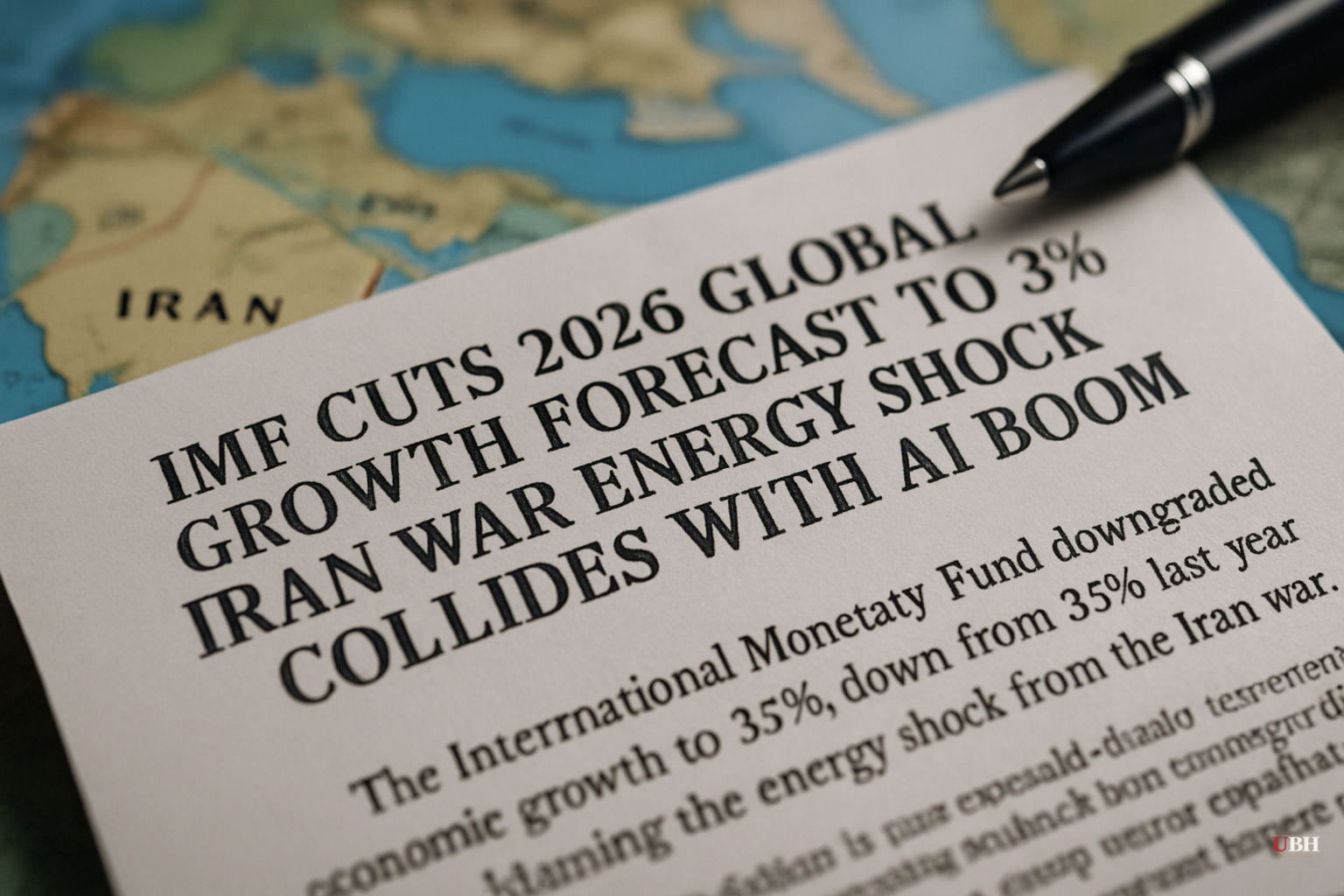
IMF Cuts 2026 Global Growth Forecast to 3% as Iran War Energy Shock Collides with AI Boom
Two Forces, Opposite Directions
The International Monetary Fund released its updated global economic outlook Wednesday, and the headline number is 3% growth for 2026. That is down from 3.5% last year and below the IMF's own April forecast of 3.1%, according to the Los Angeles Times.
The fund expects a partial recovery to 3.4% in 2027, but only if conditions stabilize.
Two forces are driving this picture in opposite directions. The Iran war is squeezing energy supplies and stoking inflation. Artificial intelligence investment is partially plugging the gap by boosting productivity and business activity.
The Energy Shock
Iran responded to U.S. and Israeli attacks on February 28 by closing the Strait of Hormuz, the chokepoint through which roughly a fifth of the world's crude oil and natural gas flows. Energy prices spiked immediately.
The IMF now expects global oil prices to end 2026 up nearly 32% for the year. Global consumer price inflation is forecast at 4.7% in 2026, up from 4.1% in 2025, according to the Los Angeles Times. The disinflation trend that held from early 2024 through last year has effectively stalled.
"These projections indicate that the disinflation trend in place since the beginning of 2024 has stalled," the IMF stated directly in its report, as quoted by the Irish Times.
The IMF's baseline projections assume the Strait of Hormuz reopens later this month and that shipping through it returns to normal by March 2027. That assumption is now under pressure. On Wednesday, President Donald Trump declared that a ceasefire with Iran was over, and oil prices rose while stocks fell worldwide, according to the Associated Press.
Petya Koeva Brooks, deputy director of the IMF's research department, told reporters Wednesday that "the world economy has weathered the shock from the war better than feared." She credited existing oil stockpiles and increased production from non-Persian Gulf exporters for limiting the damage so far.
Who Gets Hurt, Who Gets Cushioned
The IMF is explicit: net energy exporters are partly shielded from the war's economic drag, and countries benefiting from AI investment have an additional buffer.
The United States fits both categories. The IMF projects U.S. GDP growth at 2.3% in 2026 and 2.2% in 2027. The Irish Times notes that the forecast is supported by fiscal policy, strong financial conditions, and technology-related business investment. The Los Angeles Times adds that Trump's 2025 tax cuts, productivity gains, and a strong stock market are contributing factors.
Europe has no such cushion. The euro area economy is expected to grow by 0.9% in 2026, down from 1.4% in 2025. The Irish Times flagged a specific drag from Ireland, whose GDP contracted sharply in the first quarter of 2026 as a surge in exports to the U.S. in late 2025, front-loaded to beat tariffs, unwound.
China is expected to grow 4.6% in 2026, down from 5% in 2025 but slightly above the IMF's April forecast. High-tech manufacturing, public works spending, and booming exports are providing an offset to higher energy costs and an ongoing property market collapse.
India remains the fastest-growing major economy in the world at 6.4%, though that is a notable step down from 7.7% last year.
The Case for Concern
Skeptics have a fair argument that the IMF's projections are built on an optimistic foundation. The fund's entire baseline rests on the Strait of Hormuz reopening this month and trade normalizing by next spring. As of Wednesday, the U.S. ceasefire with Iran has collapsed. If the strait stays closed or trade remains disrupted beyond March 2027, every number in this forecast gets worse.
The IMF acknowledged this directly. According to the Irish Times, the fund warned that "the possibility of renewed Middle East conflict looms large and could extend commodity price volatility" and that the full fallout from supply chain disruptions has yet to fully play out. The fund also cautioned governments against using broad fiscal tools to absorb energy costs, warning that untargeted energy subsidies would be counterproductive.
That warning carries particular weight for European governments already running thin fiscal margins.
The Unresolved Question
The IMF's entire 2026 outlook depends on a geopolitical assumption: Hormuz reopens, conflict de-escalates. That assumption looked shaky even before Trump's ceasefire declaration Wednesday. If oil supply remains constrained into the fall, the 4.7% global inflation forecast could prove optimistic, and the 3% growth figure could slip further. The IMF's next formal update will either validate that baseline or require another downgrade.
Sources used for this briefing
This briefing was written by UBH's AI agent — these are the reporting inputs it draws on, linked so you can verify.


