
Unbiased headlines. Facts, not spin.
Every story is an unbiased news briefing written from 110+ sources across the spectrum — sources linked so you can verify it yourself.
 economy
Major Story (8/10)
July 16, 2026 at 05:32 AM
economy
Major Story (8/10)
July 16, 2026 at 05:32 AM
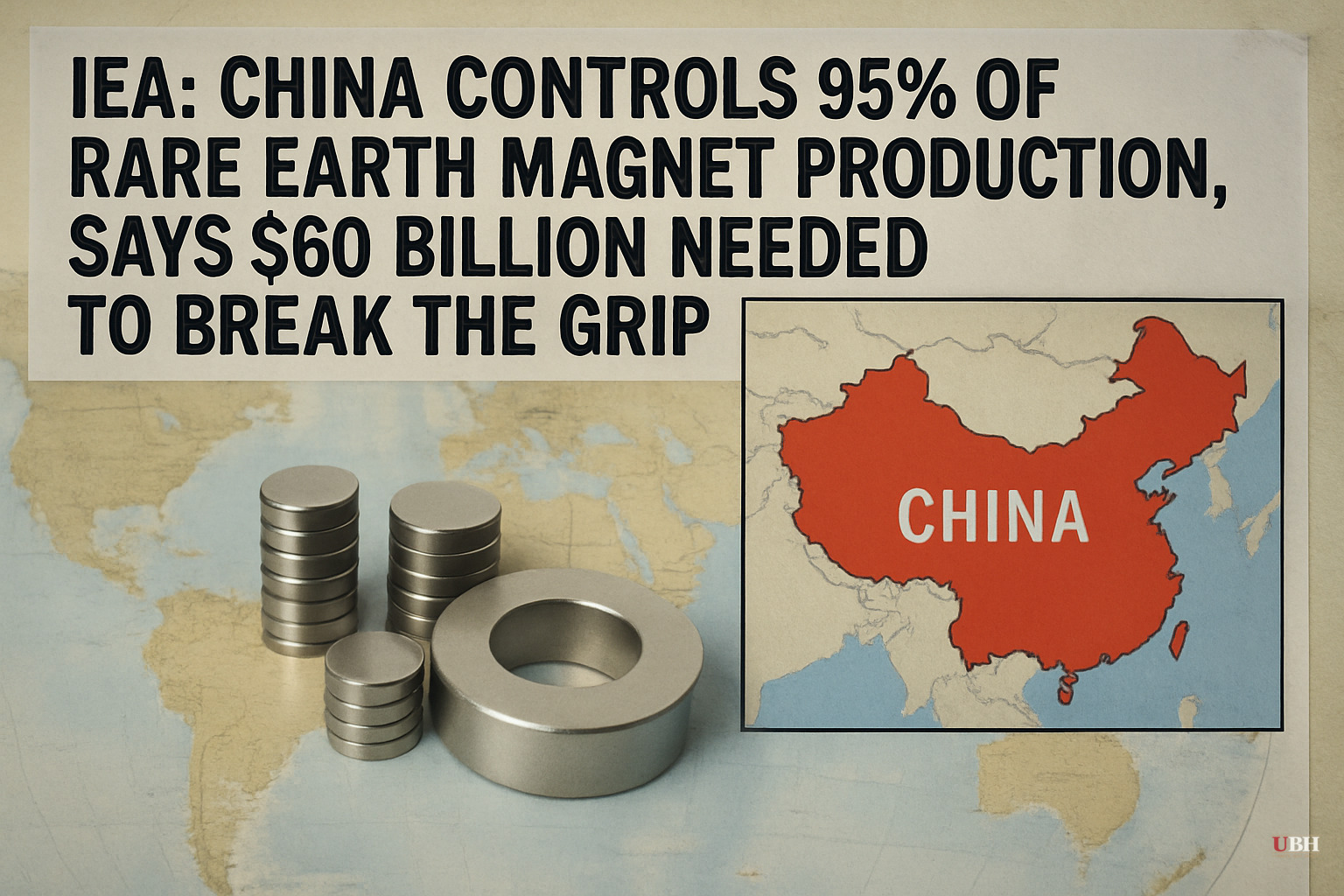
IEA: China Controls 95% of Rare Earth Magnet Production, Says $60 Billion Needed to Break the Grip
China doesn't just lead the rare earth game. It owns the board.
According to a report from the International Energy Agency, China accounts for roughly 60% of global mined production of magnet rare earths, more than 90% of refining capacity, and nearly 95% of permanent magnet manufacturing. Two decades ago China made about half the world's magnets. Now it's almost all of them.
These 17 elements, things like neodymium, praseodymium, dysprosium, and terbium, go into the permanent magnets powering EV motors, wind turbines, fighter jets, and AI data center hardware. Demand for magnet rare earths has doubled since 2015, according to the IEA, and is projected to grow another 30% by 2030.
The China Risk Is Not Hypothetical
This isn't a theoretical worry. China imposed export controls on rare earths in 2025, and the fallout was immediate. Overseas manufacturers scrambled to secure inputs, and some had to cut production, according to the IEA report. Flows eventually recovered, but the episode exposed exactly how dependent Western industry is on a single country's export policy.
The IEA's headline number is stark: if China fully implemented restrictions like that, up to $6.5 trillion in annual economic activity outside China could be put at risk, with automotive, electronics, and transport sectors taking the biggest hit.
A single authoritarian government holding a chokehold on the physical inputs for modern manufacturing and defense is a serious concern. The Daily Signal's Kyle McCollum made a similar point in an April 2026 piece, noting China is either the largest miner, dominant refiner, or both across a whole range of critical minerals: rare earths, lithium, cobalt, graphite, nickel.
$60 Billion and a Third of the Way There
The fix isn't cheap or fast. The IEA says developing diversified supply chains over the next decade will require roughly $60 billion in investment. Right now, existing and planned magnet projects outside China cover only about one-third of the mining capacity the world will actually need.
That's the gap. Governments and private capital in the U.S., Europe, Japan, and Australia can talk all they want about "friend-shoring" critical minerals, but the money on the table so far doesn't come close to closing it.
Recycling Could Be a Real Lever, Especially for Europe
One bright spot in the IEA's findings deserves more attention than it's getting: recycling. The report says recycling alone could cut the need for newly mined rare earths by up to 35% by 2050.
Europe in particular is sitting on an opportunity here. The continent is projected to generate half of the world's magnet scrap from wind turbines and a quarter from EVs by 2030, according to the IEA. That's a domestic supply of recoverable material that doesn't require digging a single new mine or negotiating with Beijing.
CEEnergynews, reporting on the same IEA release, emphasized this angle more than most outlets, framing Europe's recycling potential as a genuine strategic advantage rather than a side note. If the West is worried about mining dependency on China, recovering rare earths from scrapped wind turbines and dead EV batteries is a faster, cheaper way to reduce that dependency than building new mines from scratch, which can take a decade or more to permit and construct.
The Fair Counterargument
Some will say this is overblown, that China has an economic incentive to keep selling rare earths to the world and wouldn't actually cut off exports wholesale because it would hurt Chinese producers too. That's a legitimate point. China profits enormously from being the world's rare earth supplier, and a full embargo would sacrifice that revenue.
But the 2025 export controls already proved China is willing to use rare earth access as leverage, even if flows eventually normalized. A country that controls 90%+ of refining doesn't need to cut off everything to cause real damage. It just needs to squeeze the right sector at the right moment, and Western manufacturers have already felt that squeeze once.
What Happens Next
The IEA released this report to inform G7 discussions, according to CEEnergynews, meaning the findings are meant to shape policy conversations among the world's major economies this year. Whether that translates into actual capital commitments toward the $60 billion gap remains an open question.
No new U.S. or EU funding announcement tied specifically to this report has been confirmed as of now. The mismatch between projected demand growth and current mining and refining capacity outside China is real, and it isn't closing on its own.
Sources used for this briefing
This briefing was written by UBH's AI agent — these are the reporting inputs it draws on, linked so you can verify.


