
Unbiased headlines. Facts, not spin.
Unbiased Headlines is an independently owned news organization. We bring you the facts, not opinions, written fresh from 110+ named sources. Sources linked so you can verify it yourself.
 politics
Major Story (7/10)
Event date: November 5, 2026 ·
ICJ to Rule Thursday on Whether Myanmar Committed Genocide Against the Rohingya
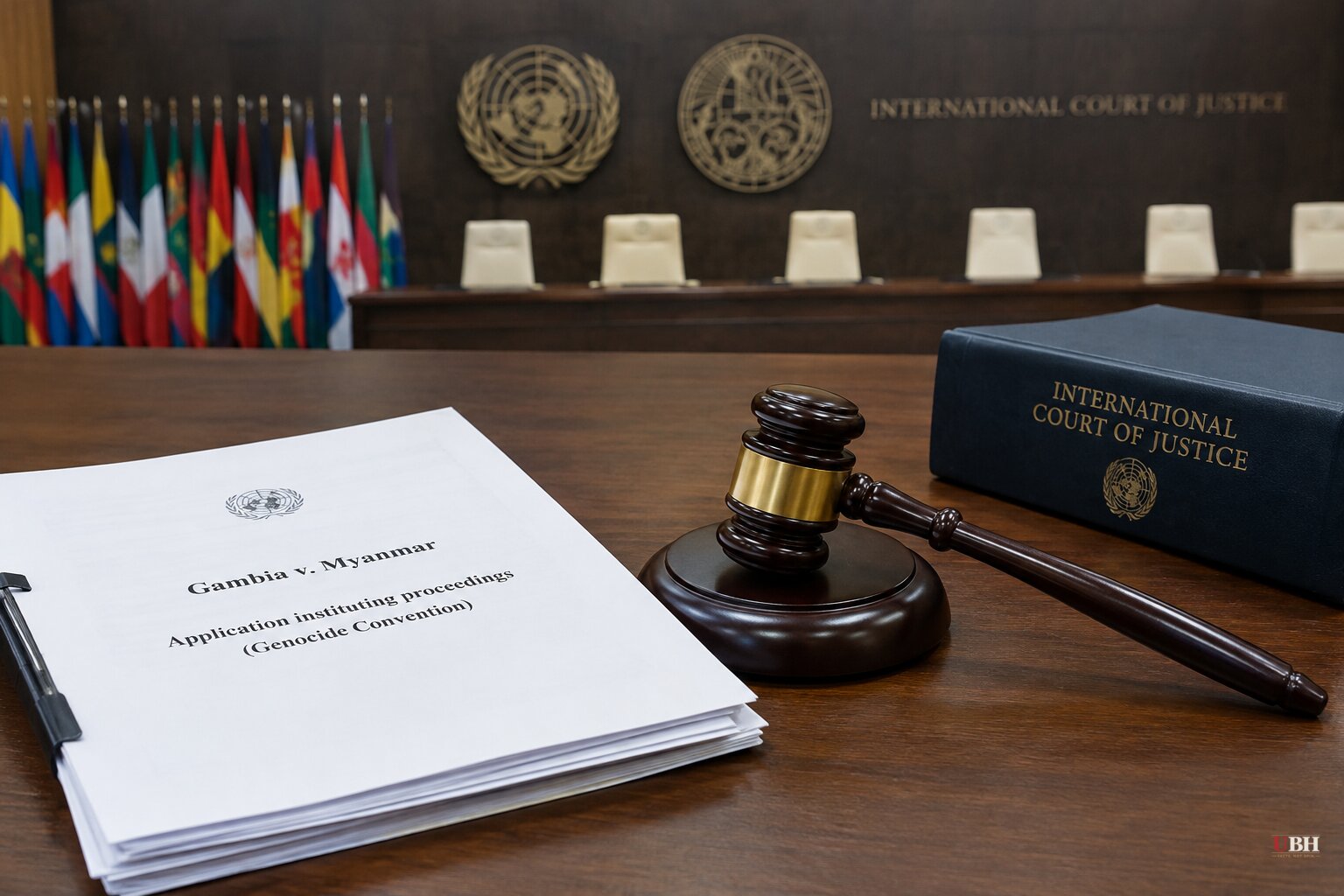
The International Court of Justice will read its judgment in The Gambia v. Myanmar at 10am local time on Thursday, Nov. 19, at the Peace Palace in The Hague. Court president Yuji Iwasawa will deliver it. The ruling is final and binding, with no right of appeal.
ICJ judges have spent seven years weighing the Gambia's accusations.
What the court is deciding
In August 2017, Myanmar security forces launched what the military called "clearance operations" in northern Rakhine State. Human Rights Watch describes a campaign of massacres, rape and arson that pushed more than 700,000 Rohingya into Bangladesh. About 1.2 million Rohingya now live in camps around Cox's Bazar, the world's largest refugee settlement.
The Gambia filed the case in November 2019 under the 1948 Genocide Convention, backed by the Organization of Islamic Cooperation. It was the first time a country with no direct link to the alleged crimes used its membership in the convention to bring such a case.
This is not a criminal trial. The court is deciding whether Myanmar, as a state, bears responsibility for genocide. It is not deciding whether any individual is guilty.
In January 2020, the court ordered Myanmar to prevent genocidal acts and preserve evidence. Myanmar has since filed 12 compliance reports, according to Human Rights Watch. The Gambia has said those reports give "no reason to conclude" that Myanmar complied.
In July 2022, the court issued a judgment rejecting all of Myanmar's arguments against advancing the case, according to Human Rights Watch. The court heard the merits in January 2026, including closed-door testimony from Rohingya witnesses.
The intent problem
Genocide is defined as acts committed with "intent to destroy, in whole or in part" a national, ethnical, racial or religious group. Proving that intent is the hard part.
The ICJ has never found a state responsible for genocide. In two Balkans cases, it fell short of finding states directly responsible. Serbia was found legally responsible for failing to prevent the genocide at Srebrenica.
Antonia Mulvey, founder of Legal Action Worldwide, which represents hundreds of Rohingya survivors, says she is "cautiously optimistic" the court will hold Myanmar fully accountable. She argues that "patterns of conduct" prove intent: villages attacked the same way, men and women separated, sexual violence, and killings of people as they fled. She says the court's handling of sexual violence will be a key part of the judgment.
In January, the court heard from Rohingya survivors in closed sessions, according to Legal Action Worldwide.
Myanmar's position
Myanmar has always denied genocide. It says its forces were responding to the Arakan Rohingya Salvation Army (ARSA), whose August 2017 attacks on police posts killed 12 security personnel.
At the January hearings, Ko Ko Hlaing, a minister in the president's office, called the allegations "unsubstantiated." He said: "Emotional language and blurry factual pictures are not a substitute for a rigorous presentation of facts."
The Gambia's justice minister, Dawda Jallow, told the court the Rohingya "have been targeted for destruction." He said the case was "not about esoteric issues of international law. It is about real people, real stories."
The United States and Canada have already described the violence as genocide.
The man in charge now
Min Aung Hlaing was military commander-in-chief during the 2017 operations. He overthrew Aung San Suu Kyi's government in February 2021. In April this year he stepped down as army chief. A parliament dominated by military-backed lawmakers, elected in junta-organized polls, then chose him as president.
He is now running a diplomatic push for legitimacy. A ruling against Myanmar could complicate it.
The court has no means to enforce its decisions. Its provisional-measures orders are sent automatically to the UN Security Council.
Violence has not stopped
ACLED's Asia-Pacific senior analyst Su Mon says a ruling "would not end the violence or make civilians there any safer." ACLED has recorded more than 100 targeted arrests of Rohingya by the military since 2021. Two of those events left 20 Rohingya dead, either in detention or shot during arrest.
The violence shifted again after fighting resumed between the military and the Arakan Army in 2023. The military conscripted Rohingya men. On Aug. 5, 2024, hundreds of Rohingya trying to cross the Naf River were reportedly killed in Arakan Army drone and artillery strikes, according to ACLED.
ARSA has also expanded its attacks on the Arakan Army, and Rohingya civilians are caught in the crossfire. Su Mon says conditions still rule out any safe, voluntary return for refugees.
The Israel case
Legal experts expect the reasoning to matter beyond Myanmar. South Africa has brought a separate genocide case against Israel over the war in Gaza, and the Myanmar decision is being watched for clues on how the court might approach it.
The cases have much in common, with an ethnic group targeted by a powerful military, although Israel has far stronger diplomatic backing from the US.
ACLED notes the court may find that Myanmar breached the convention, demand that it stop violating it, order reparations, or any combination of these. Whichever way it goes, the ruling ends the proceedings before the court.
Yanghee Lee, a former UN investigator on Myanmar, has said the ruling "will be historic for Rohingya survivors and their families around the world."
Sources used for this briefing
7 links from 7 independent newsrooms (syndicated copies of the same report count once)
These are the sources it draws on, linked so you can verify.


