
Unbiased headlines. Facts, not spin.
Unbiased Headlines is an independently owned news organization. We bring you the facts, not opinions, written fresh from 110+ named sources. Sources linked so you can verify it yourself.
 politics
Major Story (8/10)
US Loses Measles Elimination Status After 26 Years, Researchers Confirm; PAHO Briefing Set for Tuesday
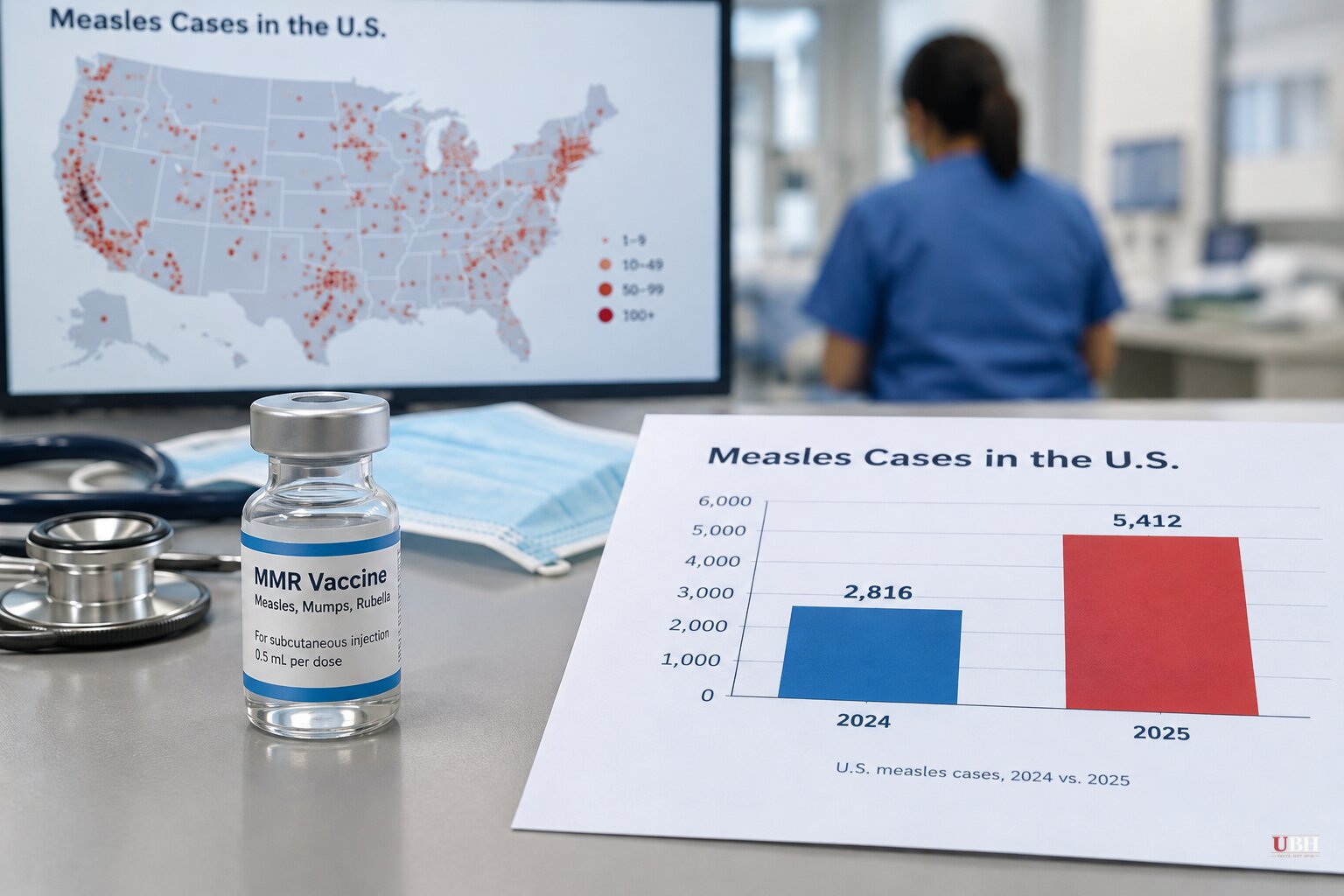
Since the Pan American Health Organization's re-verification commission began meeting in Washington on Nov. 10, the question was not whether the U.S. would lose measles elimination status but when the word would get out. It is out. Researchers with knowledge of the decision confirmed to KFF Health News on Saturday, Nov. 14, that the status is gone, a day after the Wall Street Journal first reported it citing people familiar with the matter.
PAHO has not yet commented publicly. It is scheduled to hold a news conference Tuesday, Nov. 17.
What the commission decided
The test is simple. A country loses elimination status when the same measles strain spreads person to person for 12 months or longer. The U.S. had held the status since 2000.
The commission, an independent technical body that reports to PAHO's director, first invited the U.S. and Mexico for review in April 2026. The U.S. outbreaks it examined began Jan. 20, 2025. It looked at vaccination coverage, surveillance, laboratory sequencing and outbreak response for 2025 and the first half of 2026.
The CDC submitted its own epidemiological and lab evidence. Noel Brewer, a University of North Carolina public health professor who chairs an independent advisory panel on measles, presented that report alongside his group's assessment.
Genomic data from Utah's public health laboratory pointed the same way. A preprint published in August found one strain circulated in the state for more than a year, accounted for more than 95% of cases there, and caused more than 600 infections between June 2025 and June 2026. Virologist Angela Rasmussen told CNN the Utah data alone would have been enough. Sustained outbreaks have also hit South Carolina, Pennsylvania, Wisconsin and New York.
Canada, Spain and the UK have also lost elimination status after WHO expert reviews. The U.S. left the WHO but remains a PAHO member.
The numbers
The CDC has tallied 5,412 measles cases in 2026 across 45 states and Washington, D.C., with more than 590 hospitalizations. That is more than double last year's total of 2,242 cases, which CBS News described as a 30-year record, and it is the highest annual count since 1991. In the year elimination was achieved, CIDRAP reports the CDC counted just 85 cases.
Death counts vary by source. The CDC's tally shows at least six measles deaths this year, while state health departments have confirmed ten, according to state reports. Pennsylvania, the largest outbreak with more than 1,500 cases, has reported seven deaths, according to state officials. New York and Wisconsin each reported one, their first in more than 30 years. Three more people died in 2025.
Jennifer Nuzzo, director of Brown University's Pandemic Center, told CIDRAP that cases could pass 7,000 by year's end. She described the pattern as "popcorn: outbreak, outbreak, outbreak, outbreak. All over the country."
CIDRAP also reports that congenital measles, passed from an infected pregnant woman to her newborn, is a serious threat for the first time in generations.
Vaccination rates and the federal response
The national MMR vaccination rate among school-age children fell to 92.4% in the 2025-26 school year, according to KFF's analysis of federal data. That is below the 95% threshold needed to block sustained spread, and 39 states fell short of it.
Many cases are in communities with unvaccinated people, according to the CDC and states. CDC Director Erica Schwartz and HHS Secretary Robert F. Kennedy Jr. have both endorsed the MMR vaccine as the best protection. Brewer put it bluntly: "It is a fully preventable disease. It is unconscionable that we have this amount of measles."
Schwartz's position is that the label changes little. "The measles elimination designation is not what protects Americans," she said. "Vaccination does." She told Reuters before the decision that the agency would keep doing "the same exact thing," working with states to encourage immunization, and said the CDC will keep supporting states with vaccines and personnel either way.
Critics say the federal posture helped create the problem. Demetre Daskalakis, a former director of the CDC's National Center for Immunization and Respiratory Diseases, called elimination "a vital sign for our public health system" and said losing it means the country is "less prepared." KFF's analysis says state and local health departments have faced funding and support cuts under the Trump administration, that Kennedy and other officials have downplayed measles risks and sent mixed messages on vaccination, and that the CDC stopped officially accepting states' initial measles death reports. Those are KFF's characterizations. The administration has not conceded them.
CBS News medical correspondent Céline Gounder said the practical consequences include ERs and pediatricians having to consider measles in any patient with fever and rash, travel or not, and the U.S. possibly becoming an exporter of the virus.
Still pending at the CDC
A separate item hangs over the vaccine debate. A childhood vaccine safety report ordered by President Trump missed its Nov. 8 deadline. Schwartz said at a Milken Institute event on Nov. 12 that it is "still going through the clearance process" and declined to give details, referring reporters to NIH Director Jay Bhattacharya, who leads the task force. The report is meant for the CDC's vaccine advisory committee, ACIP.
The CDC is also accepting nominations for new ACIP members, but Schwartz said the agency is waiting on an appellate court ruling before it can reconstitute the panel. Nine Kennedy appointees are being asked whether they want to stay.
PAHO's Tuesday briefing is the next hard marker. It is expected to lay out the commission's findings and the path back to the status. Reuters reports that restoring elimination status requires ending transmission and remaining free of an outbreak for at least 12 months.
Until then, it is unclear whether the 7,000-case projection holds. The CDC will keep updating its count weekly.
Sources used for this briefing
7 links from 7 independent newsrooms (syndicated copies of the same report count once)
These are the sources it draws on, linked so you can verify.


