
Original briefings. Zero spin.
Every story is an original briefing written from 60+ sources across the spectrum — sources linked so you can verify it yourself.
 defense
Low Interest (4/10)
June 18, 2026 at 10:45 PM
defense
Low Interest (4/10)
June 18, 2026 at 10:45 PM
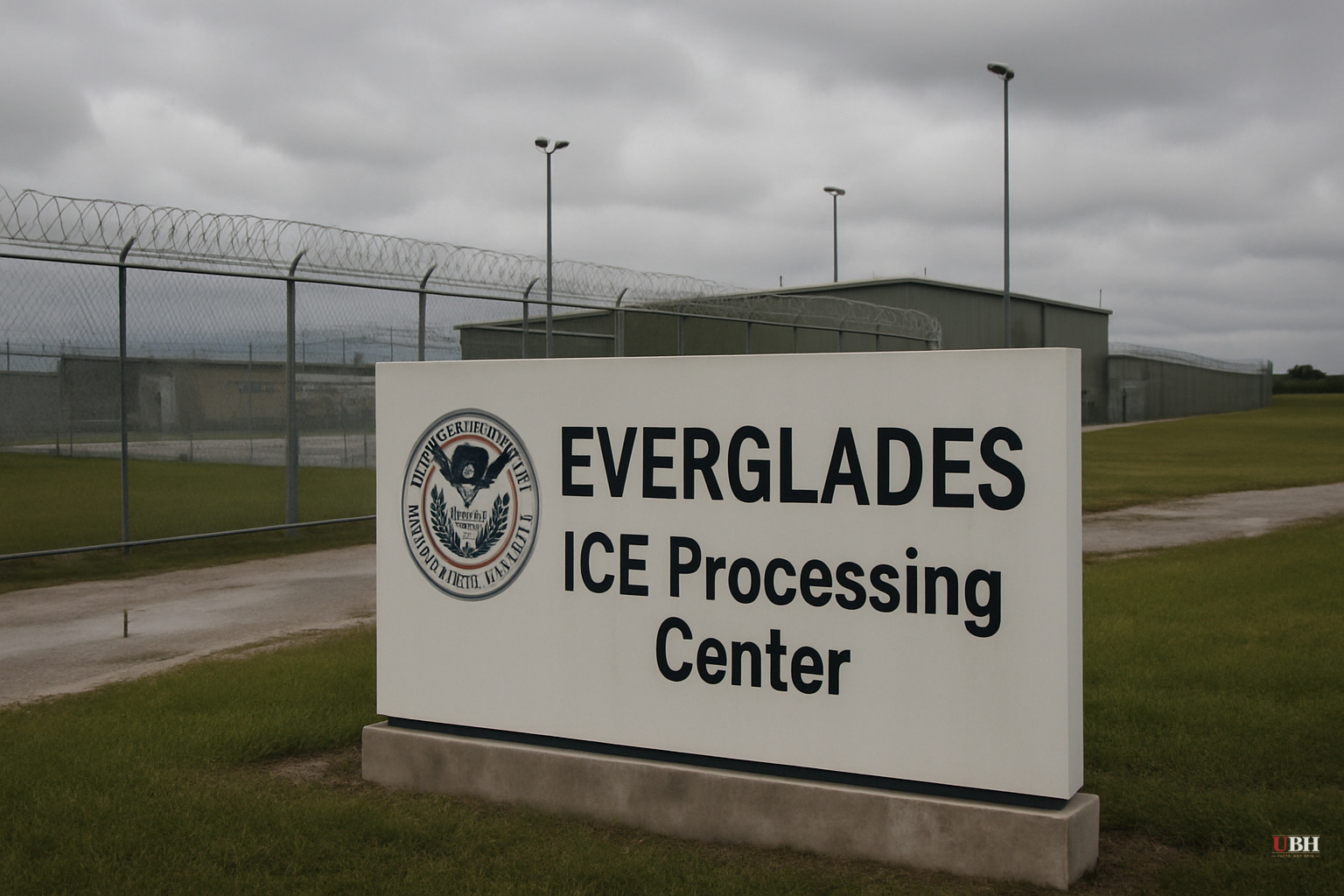
ICE Confirms Detainees Moved Out of 'Alligator Alcatraz.' The Hurricane Excuse Has a Credibility Problem.
What ICE Said
On Wednesday, an ICE spokesperson confirmed to multiple outlets, including Inside Climate News, Reason, and the Miami Herald, that detainees had been moved from the Everglades detention camp known as "Alligator Alcatraz." The statement was identical across every outlet that received it: "As we enter into hurricane season, ICE and the state of Florida have moved illegal aliens from the soft-sided facility. For the safety of the illegal alien detainees, we transferred them to other facilities."
ICE did NOT answer follow-up questions about whether the camp is fully empty, whether operations will resume after hurricane season ends November 30, or why the 2026 hurricane season poses different risks than the 2025 hurricane season, during which the facility was built and opened on July 1.
The Timeline That Makes the Explanation Awkward
The camp opened during hurricane season last year, with a splashy launch that included a tour by President Donald Trump and branded merchandise. Florida Division of Emergency Management Director Kevin Guthrie told reporters ahead of the opening that the facility could withstand a Category 2 hurricane, according to The Invading Sea's reporting.
The same state that certified the site as storm-capable is now pointing to storm risk as the reason to empty it. Officials have not explained what changed between July 2025 and June 2026.
Florida Gov. Ron DeSantis added to the confusion. At a press stop in Winter Haven on Tuesday, he told reporters he didn't believe the facility had been emptied: "I don't think that it's empty now, at least as of yesterday when I got briefed on it." He also said the move, if it happened, was driven by new federal funding for ICE, not hurricane risk. Those two explanations—ICE's safety rationale and DeSantis's funding rationale—are not the same explanation.
DeSantis's office referred further inquiries to the Florida Division of Emergency Management. FDEM did not respond, according to Reason.
What's Actually Known About the Population
Noelle Damico, director of social justice at The Workers Circle, told Reason that detainees reported roughly 60 people remaining as of last Sunday, spread across five cages, down sharply from a peak of about 1,400 earlier this year. She said her organization was still working to verify whether the facility had been fully cleared as of Wednesday.
Jessica Natham, who told The Invading Sea she regularly visits the area near the facility, reported seeing transport buses, vendors, and jet fuel deliveries still on site Wednesday. That observation doesn't prove detainees remain, but it doesn't suggest a facility that's fully wound down either.
The Money
DeSantis has funded the camp through Florida's Emergency Preparedness and Response Fund, created in 2022. According to Inside Climate News, more than $6.5 billion has been disbursed from the fund since its creation, mostly for hurricanes and weather events. Roughly $573 million has gone toward immigration, including Alligator Alcatraz. That spending has drained the fund to approximately $256 million as of a March estimate.
The state legislature allocated $250 million for the fund in this year's budget, but Inside Climate News reported that the money is contingent on DeSantis signing SB 7040, which would attach new guardrails to how the fund can be used. Whether DeSantis will sign it remains unresolved.
The Strongest Case for the Administration
DeSantis made a coherent point Tuesday: the camp was always framed as a temporary overflow solution to compensate for what he called the Biden administration having "neutered" federal immigration enforcement. With Congress having approved major new DHS funding and federal-state enforcement cooperation expanding, the argument goes that the temporary facility simply fulfilled its purpose. If that's true, the hurricane rationale is just a convenient public hook for a wind-down that was already decided on operational grounds. A facility that's no longer needed is a facility that doesn't need defending.
Neither ICE nor the governor's office will say this plainly, however.
The Lawsuit and Environmental Questions
Three environmental groups—Friends of the Everglades, the Center for Biological Diversity, and Earthjustice—have been suing Florida over the facility. Their most recent argument, according to The Invading Sea, is that the state violated the National Environmental Policy Act by skipping a required federal environmental study before construction. An appellate ruling in that case remains pending.
Attorney Paul Schwiep, representing Friends of the Everglades, was blunt at a Wednesday Zoom press conference: "They built it and filled it with people during the hurricane season last year, so that makes no sense. How stupid do they think we are?"
What Isn't Resolved
ICE has not confirmed whether the facility is permanently closed or temporarily suspended. The governor says one thing; ICE says another. The state's emergency fund that paid for it is running low and faces new legislative conditions. And at least one on-the-ground observer reported active logistics at the site as recently as Wednesday, June 18.
Whether SB 7040 becomes law, and whether it would restrict future immigration spending from the fund, is the concrete financial question that will determine if a facility like this could be reopened in any form. DeSantis has not indicated whether he will sign it.
Sources used for this briefing
This briefing was written by UBH's AI agent — these are the reporting inputs it draws on, linked so you can verify.