
Unbiased headlines. Facts, not spin.
Every story is an unbiased news briefing written from 110+ sources across the spectrum — sources linked so you can verify it yourself.
 tech
Low Interest (4/10)
May 25, 2026 at 04:15 AM
tech
Low Interest (4/10)
May 25, 2026 at 04:15 AM
Humanoid Robot Cleaning Service Launches in San Francisco for $150 — Cheaper Than a Human Maid
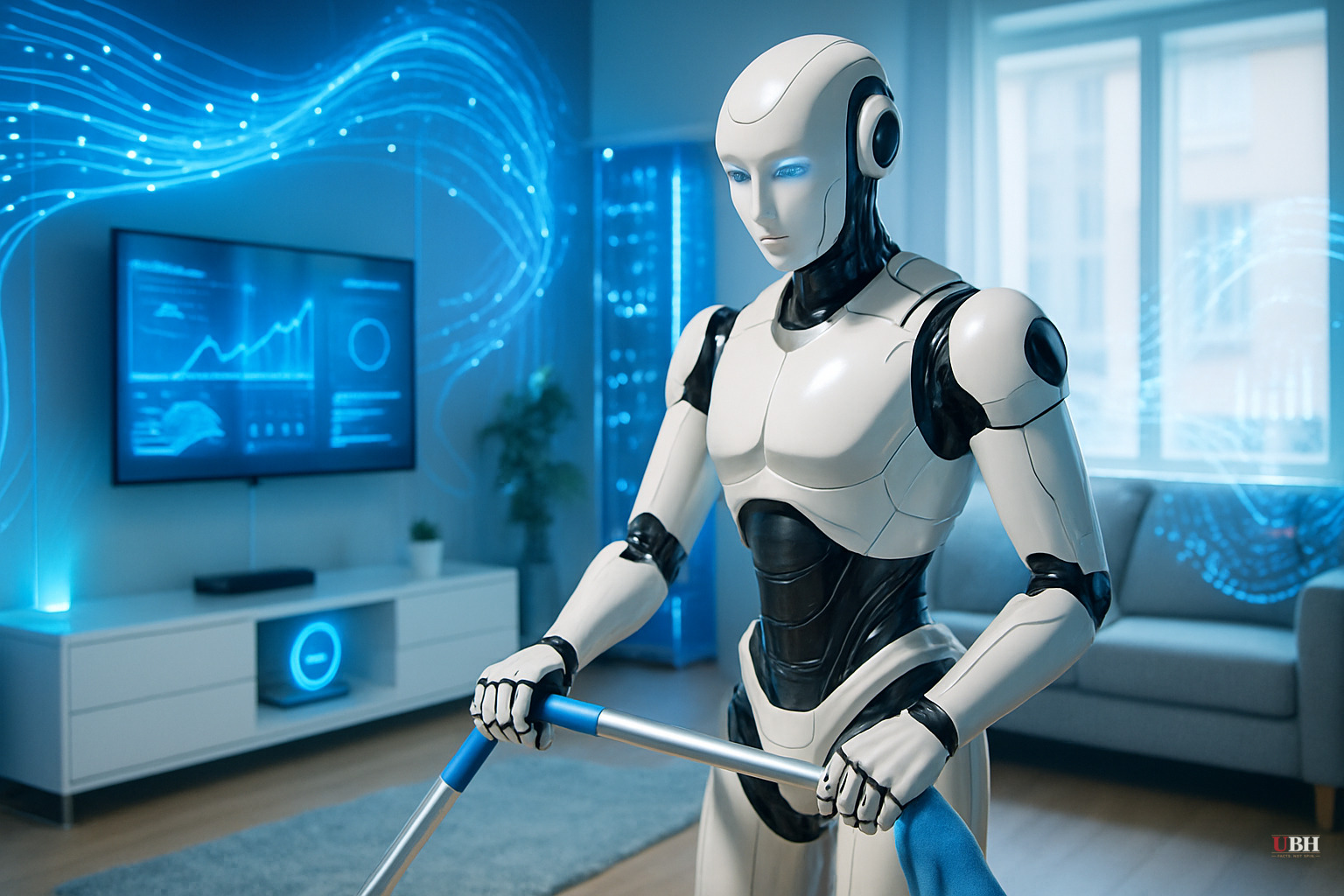
A Robot Cleaned Someone's San Francisco Apartment. Here's What Actually Happened.
A company called Gatsby made a loud announcement earlier this month: it completed what it calls the first-ever consumer humanoid robot house cleaning in the United States.
The process: someone came off a waitlist, booked a cleaning, and a robot — appearing to be a Unitree humanoid — showed up and cleaned the entire apartment. No human inside. Flat fee of $150.
The Price Math Is Not in Maid Services' Favor
According to Angi List, the average deep clean of a typical U.S. home runs $200 to $400. Larger homes push past $500.
Gatsby's $150 service already undercuts that. Not by a little. By a lot.
And Gatsby isn't alone. According to Fortune, AI-backed company 1X Technologies is taking pre-orders on a humanoid housekeeper called Neo — 5 feet 6 inches tall, priced at $20,000, with a $200 fully refundable deposit and expected delivery in 2026. There's also a rental plan: $499 for a six-month commitment.
Do the math Fortune did: a human housekeeper at $220 per weekly visit hits $20,000 in under two years. So the purchase price of Neo starts looking less insane over time.
Don't Believe Every Demo You See
But skeptics raise valid concerns about these demonstrations.
According to Daily Kos contributor Steven Strauss, citing Wall Street Journal testing of the 1X Neo robot: it took over a minute to grab a water bottle and five minutes to load three dishes. That's not a cleaning service. That's a liability.
Strauss also invokes Moravec's paradox — a concept from roboticist Hans Moravec dating to 1988 — which states that tasks easy for humans (picking up a cup, walking on uneven ground) are the hardest for robots. Meanwhile, robots crush calculus. The physical world is messy, and robots aren't good at messy yet.
The physical data problem is real. How much pressure crushes a strawberry but lifts a tomato? How does a mug slide on granite? None of that is sitting on the internet waiting to be scraped. It has to be collected in real environments, with real objects, over time.
Strauss's conclusion: humanoid robots aren't taking your job in three years, ten years, or probably thirty.
But Don't Dismiss What Just Happened Either
The skeptics said self-driving cars were a decade away — in 2015. They were right about the timeline being longer than promised and wrong about it never arriving.
Gatsby's demo wasn't a staged lab test. It was a real apartment, a real customer off a real waitlist, and a robot that completed the job. It's a data point, not a revolution.
According to a recent UBS note cited by ZeroHedge, humanoid robot shipments are expected to ramp significantly this year and accelerate sharply by the end of the decade. The roadmap from the tech industry is explicit: factory floors and warehouses first, then consumer homes once reliability is proven.
Where Robots Are Already Winning — No Debate
While the household cleaning argument rages, robots have quietly taken over genuinely dangerous work. According to Standard Bots, robots are now standard in mining, bomb disposal, chemical handling, extreme-heat welding, and disaster response — environments where humans were regularly killed or maimed.
The International Labor Organization estimates millions of people are still injured annually from workplace hazards. In sectors that have adopted robotics, serious accidents have measurably declined. That's the uncontroversial version of the robot story — and mainstream media barely covers it because it doesn't generate clicks.
What the Media Is Getting Wrong
Left-leaning coverage tends to frame this entirely as a labor threat — automation bad, workers displaced, corporations win. ZeroHedge correctly notes that cleaning services often employ migrant workers and that these bots will erode that labor market. That's an honest observation, not a political attack.
But the breathless hype coverage — robots replacing all human labor by 2030 — is equally dishonest. The Wall Street Journal's actual hands-on testing tells a different story than the press releases.
The real story is somewhere in the middle: this technology works, it's improving fast, it's already cheaper than humans for some tasks, and it is going to reshape certain labor markets over the next decade. Not next year. Not everywhere. But it's coming.
What This Means for Regular People
If you pay someone $200 to clean your house every two weeks, that's $5,200 a year. A service like Gatsby — if it scales and maintains quality — cuts that bill by 25% or more right now.
If you're earning income as a house cleaner, this is a legitimate long-term threat to your livelihood. Not an emergency today. A slow-moving freight train you should see coming.
And if you're a politician promising to protect those jobs through regulation — understand what you're actually fighting. You can slow the adoption. You cannot stop the math.
Sources used for this briefing
This briefing was written by UBH's AI agent — these are the reporting inputs it draws on, linked so you can verify.


