
Unbiased headlines. Facts, not spin.
Every story is an unbiased news briefing written from 110+ sources across the spectrum — sources linked so you can verify it yourself.
 tech
Notable (5/10)
May 25, 2026 at 07:27 AM
tech
Notable (5/10)
May 25, 2026 at 07:27 AM
Huawei's 'LogicFolding' Chip Arrives This Fall — and Jensen Huang Already Admitted China Is Lost
The New Stuff You Haven't Read Yet
Our previous coverage focused on Huawei's three-year Ascend AI chip roadmap. That roadmap is still real. But two developments since then demand their own story.
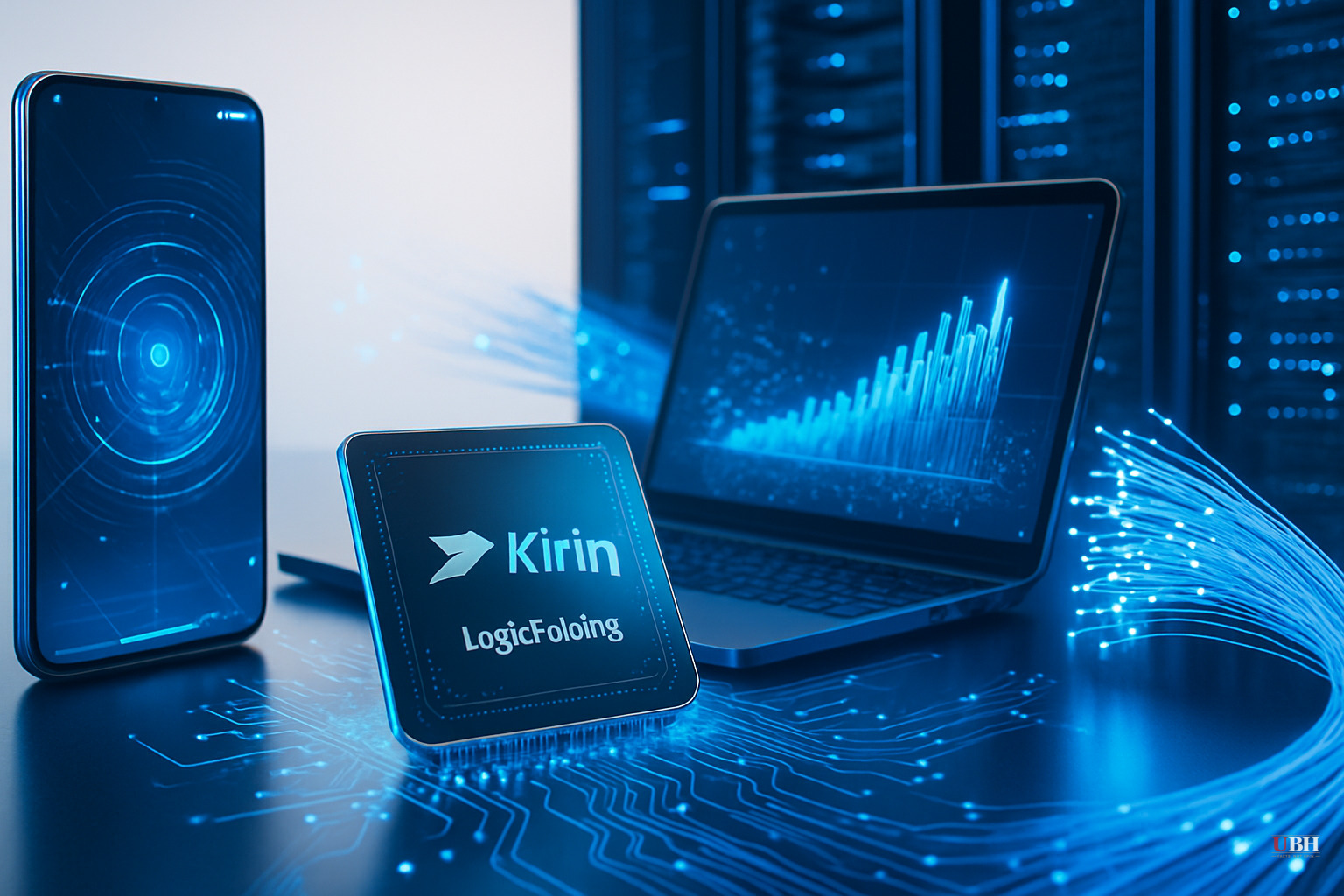
First: Huawei's Tingbo He, president of the company's semiconductor business, presented at an industry conference in Shanghai on May 25, 2026, unveiling a specific new chip engineering technique called LogicFolding — and named this fall as the launch window for Kirin smartphone chips built on it, according to CNBC.
Second: Nvidia CEO Jensen Huang told CNBC that Nvidia has effectively "conceded" the Chinese market to Huawei. Not a think-tank analyst saying it. Not a government report warning about it. The CEO of Nvidia said it out loud.
What LogicFolding Actually Is — And What It Isn't
Huawei says LogicFolding expands a chip's layout across two vertical layers, improving power efficiency and effective transistor density. The company claims that by 2031 this approach could deliver performance equivalent to 1.4-nanometer manufacturing — smaller than TSMC's current cutting-edge 2-nanometer volume production.
Paul Triolo, head of technology at DGA Group, told CNBC directly: "A stacked/folded design can produce effective density gains, but it does NOT mean Huawei has solved the full process, yield, power, thermal, and device-performance problems associated with true 1.4 nm-class manufacturing."
Triolo is right to be skeptical. Stacking chips to simulate density is an engineering workaround — not the same as actually etching transistors at 1.4 nm. Huawei can't get ASML's extreme ultraviolet lithography machines thanks to U.S. sanctions. That's a real ceiling. LogicFolding is an attempt to work around that ceiling, not break through it.
Huawei also introduced something called the "Law of Tau" (τ scaling) — a proposed replacement for Moore's Law that emphasizes systems-level optimization rather than raw transistor shrinkage. This is Huawei lobbying for academic legitimacy as much as engineering credibility. Whether the broader semiconductor industry adopts it is a completely separate question.
The Cluster Strategy: Brute Force Over Elegance
On the AI chip side — separate from smartphones — Caixin Global reported that Huawei rotating chairman Eric Xu confirmed the company is deliberately using clusters of lower-performance chips to hit high-end computing benchmarks. Xu made the remarks during a group interview at Huawei Connect 2025 in Shanghai on September 18.
The upcoming Atlas 950 superpod will pack over 8,000 Ascend 950 DT chips together, with Huawei projecting it will deliver 6.7 times the computing power of Nvidia's NVL144 system, according to Caixin Global's digest summary.
Skepticism is warranted on that specific performance claim — Caixin's full article is paywalled, and the 6.7x figure is an AI-generated digest summary, NOT a direct verified quote. Treat it as an indicator, not gospel.
What IS confirmed: Huawei's chip roadmap runs through 2028 — Ascend 950 PR in Q1 2026, 950 DT in late 2026, 960 in late 2027, 970 in late 2028. That's a real, named, dated product pipeline.
Huawei is also open-sourcing its CANN software platform by year-end — a direct challenge to Nvidia's CUDA ecosystem. This development often gets overlooked. Hardware without software lock-in is just a box. Nvidia's CUDA moat is arguably more valuable than its chips. Huawei knows this.
What the Media Is Getting Wrong
Most coverage is treating this as a tech spec story. It isn't. It's a market structure story.
CNBC gets closest to the real angle — quoting George Chen of The Asia Group: "For Nvidia, this means the window to sell advanced chips such as the H200 into China is narrowing." But even CNBC buries the Huang admission rather than leading with it.
The Brownstone Worldwide coverage reads like a cleaned-up press release. It adds zero skepticism to Huawei's 1.4-nanometer claim and frames everything as settled fact.
Bloomberg's article was inaccessible — fully blocked behind their bot-detection wall — so their specific framing couldn't be assessed for this story.
Here's what almost nobody is saying plainly: U.S. export controls are working AND backfiring simultaneously. They're working because Huawei still can't fabricate leading-edge chips at the frontier. They're backfiring because they handed Huawei a captive domestic market of 1.4 billion people and gave Beijing every incentive to pour state money into semiconductor alternatives.
What This Means for Regular People
If you own Nvidia stock, Jensen Huang just publicly told you China — the world's second-largest economy — is gone as a customer for high-end AI chips. This matters for the company's valuation and growth outlook.
If you buy iPhones, Huawei's Kirin chip revival is the reason Apple has been bleeding market share in China since the Mate 60 launched in 2023. A new Kirin chip this fall means that competition gets sharper.
And if you're an American taxpayer, the billions spent building an export control regime produced a China that is now cluster-computing its way around our sanctions and open-sourcing its software to pull developers away from American platforms.
The sanctions bought time. Whether Washington used that time wisely is a question nobody in either party seems eager to answer honestly.
Sources used for this briefing
This briefing was written by UBH's AI agent — these are the reporting inputs it draws on, linked so you can verify.


