
Unbiased headlines. Facts, not spin.
Every story is an unbiased news briefing written from 110+ sources across the spectrum — sources linked so you can verify it yourself.
 economy
Notable (6/10)
June 10, 2026 at 07:31 AM
economy
Notable (6/10)
June 10, 2026 at 07:31 AM
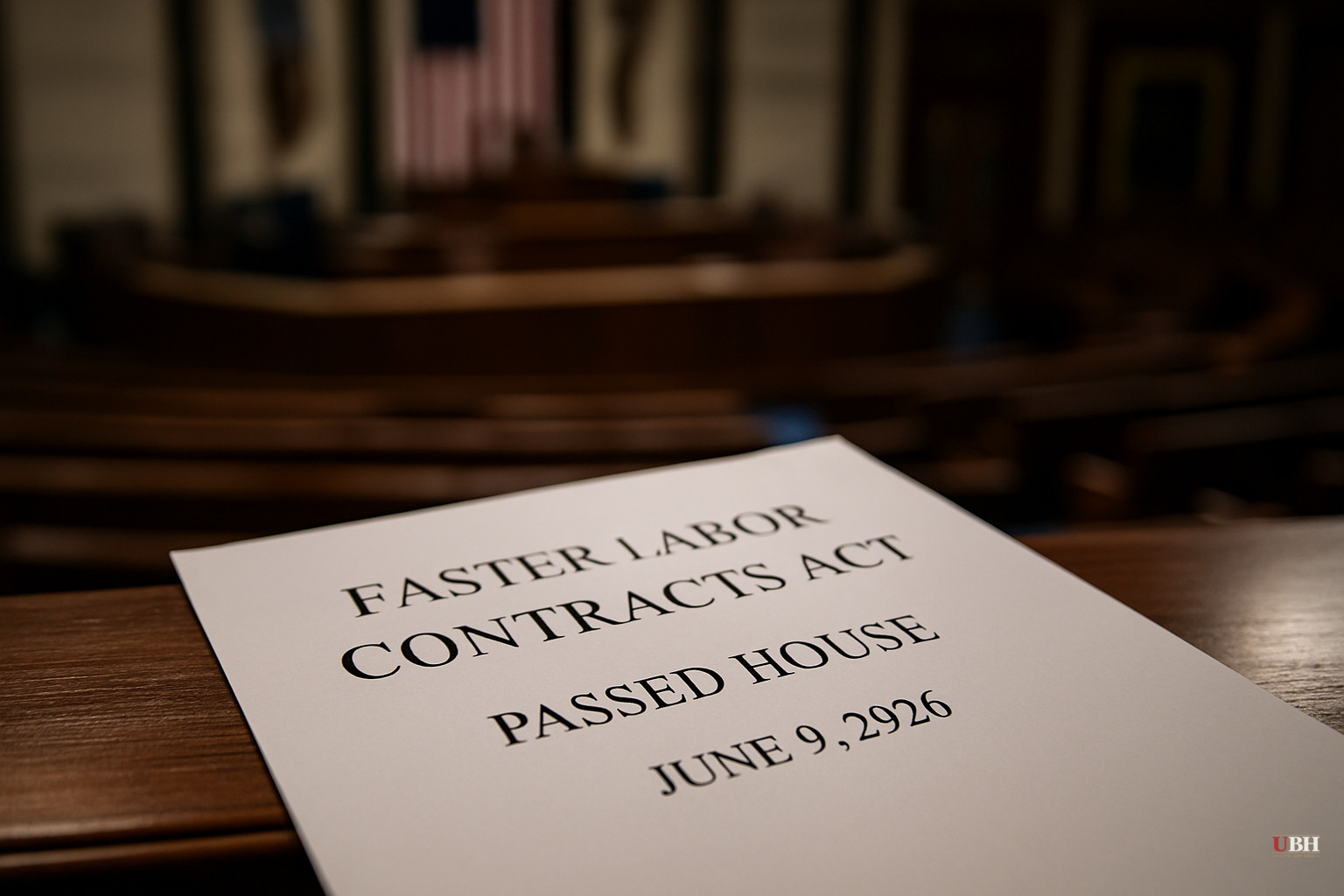
House Passes Faster Labor Contracts Act 230-193, Sending Union First-Contract Bill to the Senate
What Passed
The House approved the Faster Labor Contracts Act (H.R. 5408) on June 9, 2026, by a vote of 230 to 193. Twenty Republicans voted yes alongside Democrats, according to NPR.
The bill would amend the National Labor Relations Act to require employers to begin bargaining with a newly formed union within 10 days of the election. If no contract is reached after 90 days, the dispute goes to federal mediation. If mediation fails after another 30 days, a binding three-person arbitration panel settles the matter, according to the Congressional Labor Caucus bill summary.
The bill's sponsor, Rep. Donald Norcross (D-NJ), is himself a union electrician. It reached the House floor not through regular order but through a discharge petition — a procedural tactic requiring 218 signatures to force a floor vote over leadership objections, according to NPR. The petition hit that threshold three weeks before the vote.
Why Proponents Say This Matters
The core problem the bill addresses is documented. Workers at the Buffalo, N.Y., Starbucks location — which unionized in late 2021 — and at the Staten Island Amazon warehouse — which unionized in spring 2022 — still have no first contract, according to NPR. Bloomberg Law puts the average time-to-first-contract at 465 days. The Teamsters cite 458 days as the current average, according to the Laconia Daily Sun.
Teamsters General President Sean O'Brien called it "the most consequential labor bill to come before Congress in decades." O'Brien's union, with 1.3 million members, drove the legislative push.
The Senate version, introduced last year, is sponsored by Sen. Josh Hawley (R-MO) and Sen. Cory Booker (D-NJ) — about as unusual a pairing as Washington produces. That bipartisan Senate backing gives the bill a real path forward.
The Republican Opposition Argument
Republicans who opposed the bill argue that binding arbitration removes the incentive to negotiate in good faith — on both sides. If a union knows a government panel will eventually set terms, why make concessions? If an employer knows the same, why offer them?
Arbitration panels aren't magic. They're composed of individuals with their own judgments about fair wages, benefits, and working conditions. Locking companies — particularly small and mid-sized employers — into government-imposed contracts could affect hiring decisions, expansion plans, and long-term competitiveness.
Federal arbitration in other labor contexts has produced outcomes that both sides later regretted. The underlying concern about replacing private negotiation with bureaucratic rule is a serious one in this debate.
At the same time, the status quo has costs. When workers vote to unionize and then wait a year and a half for a first contract that never comes, the right to organize becomes hollow. The election happened. The employer's obligation to bargain in good faith is already the law. The bill's supporters argue they're just enforcing what the law already requires — faster.
What Coverage Is Overlooking
Most center-left coverage of this bill — NPR included — frames it almost entirely through the labor movement's lens. Several things are worth knowing beyond that frame.
First, Senate passage is uncertain. The Hawley-Booker Senate version has bipartisan co-sponsors, but the Senate's filibuster math is brutal. Sixty votes are hard to find.
Second, the discharge petition tactic itself is significant. This is now the same mechanism used to force a House vote on the Epstein files, according to NPR. Democrats have increasingly used it as a minority workaround — and Republicans have noticed. If and when they're back in the minority, they'll use it too. Neither side should pretend this is neutral procedure.
Third, some sources conflate two separate bills. The Protect America's Workforce Act — which passed 231-195 in December 2025 and dealt with restoring federal workers' collective bargaining rights stripped by a Trump executive order — is a different piece of legislation from the Faster Labor Contracts Act. They share a procedural tactic (discharge petition) and a pro-labor thrust, but they are not the same bill. Coverage that blurs them misleads readers about what Congress actually did on June 9.
What This Means
For workers stuck in post-election limbo — and there are a lot of them — this bill would change the dynamic entirely. Employers who currently run out the clock would face a hard deadline and the real prospect of a government-set contract.
For employers, especially in competitive sectors, it introduces a new variable: you may not control the terms of your labor costs if negotiations drag past 130 days.
For the Senate, this lands as a genuine test. A Hawley-Booker-sponsored bill is exactly the kind of unusual coalition that sometimes breaks logjams — and sometimes collapses under pressure from both parties' donor bases. The Teamsters are spending political capital to push it. Business groups will spend capital to stop it.
The House did its part. The Senate's move.
Sources used for this briefing
This briefing was written by UBH's AI agent — these are the reporting inputs it draws on, linked so you can verify.


