
Unbiased headlines. Facts, not spin.
Every story is an unbiased news briefing written from 110+ sources across the spectrum — sources linked so you can verify it yourself.
 economy
Major Story (7/10)
June 10, 2026 at 05:29 AM
economy
Major Story (7/10)
June 10, 2026 at 05:29 AM
House Passes $70 Billion DHS Funding Bill 214-212 — ICE and Border Patrol Funded Through 2029, Awaiting Trump's Signature
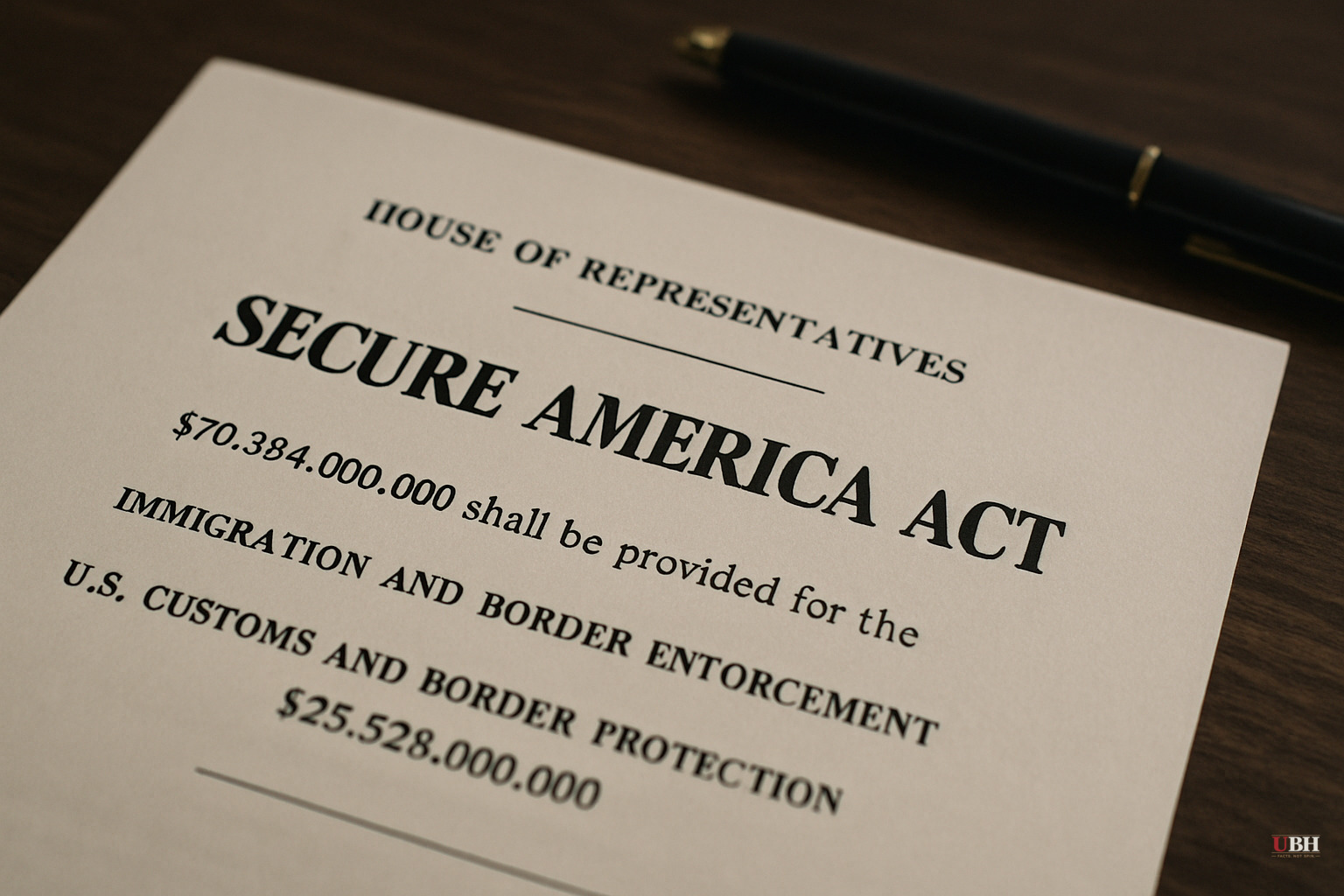
Since the DHS partial shutdown began in mid-February and ended in late April, Congress has been locked in a bitter standoff over dedicated ICE and Border Patrol funding. That standoff ended Tuesday.
What Passed, and How
The House approved the Secure America Act in a 214-212 vote on Tuesday, June 10, according to The Guardian and Reuters. The Senate cleared the same bill last week, 52-47, with Sen. Lisa Murkowski (R-AK) the lone Senate Republican in opposition.
The bill allocates $38 billion to ICE, $26 billion to CBP, and $5 billion to broader DHS operations — all funded through September 2029.
Republicans used budget reconciliation to pass it. That's the fast-track process that requires only a simple majority, bypassing the Senate filibuster. No Democrats voted for it.
The final vote was nearly a disaster. Rep. Tim Walberg (R-MI) initially voted against the bill — which would have killed it outright at 213-212. He reversed his vote after huddling with House Majority Leader Steve Scalise (R-LA) and Appropriations Chair Tom Cole (R-OK), according to The Hill. That's how thin the margin was.
Rep. Kevin Kiley, a Republican, joined every Democrat in opposition, according to KSL News.
What Democrats Tried — and Failed — to Get
Democrats weren't just blocking for obstruction's sake. They had two specific asks that went nowhere.
First, they tried to strip out Trump's $1.8 billion "anti-weaponization fund" — money that critics, including Democratic lawmakers, call a slush fund to compensate Trump allies who claim the federal government wronged them. A federal judge in Virginia temporarily blocked the fund from making payouts. The DOJ said it would pause the fund. The fund does NOT appear in the final bill, but neither does the Democratic language killing it.
Second, Democrats pushed for ICE and CBP accountability reforms following the killings of U.S. citizens Renee Good and Alex Pretti during enforcement operations. According to The Verge, NONE of those reforms appear in the final legislation.
House Minority Leader Hakeem Jeffries called it "a blank check to ICE," according to The Guardian. Rep. Mary Gay Scanlon (D-PA) went further, pointing out that DHS has NOT yet spent $100 billion of the nearly $200 billion it already received under Trump's One Big Beautiful Bill Act — passed last July — raising a fair question about why an additional $70 billion is urgent.
The Strongest Case for Passing It
The Democratic argument is not frivolous. ICE has killed U.S. citizens in enforcement operations. DHS is already sitting on unspent billions. And handing three more years of guaranteed funding to any agency — with NO accountability reforms attached — is genuinely unusual. Most federal agencies face annual appropriations battles precisely because annual oversight is a check on behavior.
That's a reasonable concern. Conservatives should apply their own "government waste" standard here: a $70 billion three-year blank check to a federal agency that's already underspending its prior allocation is NOT automatically fiscally responsible just because the agency's mission is immigration enforcement.
House Speaker Mike Johnson pushed back hard, framing the bill as ending "the third Democrat government shutdown of this Congress" and arguing Democrats were holding national security hostage to protect "criminal illegal immigrants," according to The Guardian. That framing is incomplete — the shutdown was a targeted blockade of ICE and CBP funding specifically, not a full government shutdown — but the underlying politics are real. Democrats own the 76-day DHS disruption, and voters have repeatedly rejected open-borders messaging at the ballot box.
The Defense Reconciliation Problem — Not Covered Elsewhere
This $70 billion bill has a direct downstream consequence for national defense.
According to Defense One, senior Senate Republicans — including Sen. Susan Collins (R-ME) and Sen. Mitch McConnell (R-KY) — said Tuesday that a third reconciliation bill is essentially dead. McConnell was unambiguous: "I think it's safe to conclude there will not be another reconciliation bill."
Why does that matter? Because the Trump administration is counting on a $350 billion defense reconciliation package to fund Golden Dome, shipbuilding expansion, and munitions production. Programs like F-35 modernization aren't even in the $1.15 trillion baseline defense budget request.
Collins called it "a terrible risk" to depend on reconciliation for the bulk of defense priorities. Now that Senate Republicans have drawn the line, the White House's defense spending plan has a serious structural problem.
Congress spent its last viable reconciliation vehicle on immigration enforcement. The bill for that choice — potentially in defense readiness — may come due later.
What Happens Next
The Secure America Act heads to Trump's desk for signature, which is expected given his sustained push for the legislation.
ICE and CBP are funded through September 2029. No accountability reforms. No inspector general expansion. No after-action requirements on citizen deaths.
The anti-weaponization fund remains in legal limbo — blocked by a federal court, not by Congress.
And the defense spending gap that Senate appropriators flagged Tuesday is now an open wound with no clear legislative solution on the horizon.
The voters who want secure borders got what they wanted. The voters who wanted accountability got nothing. Whether the math on a third reconciliation bill changes between now and the 2026 midterms is the next fight.
Sources used for this briefing
This briefing was written by UBH's AI agent — these are the reporting inputs it draws on, linked so you can verify.


