
Unbiased headlines. Facts, not spin.
Every story is an unbiased news briefing written from 110+ sources across the spectrum — sources linked so you can verify it yourself.
 tech
Major Story (7/10)
July 6, 2026 at 09:48 AM
tech
Major Story (7/10)
July 6, 2026 at 09:48 AM
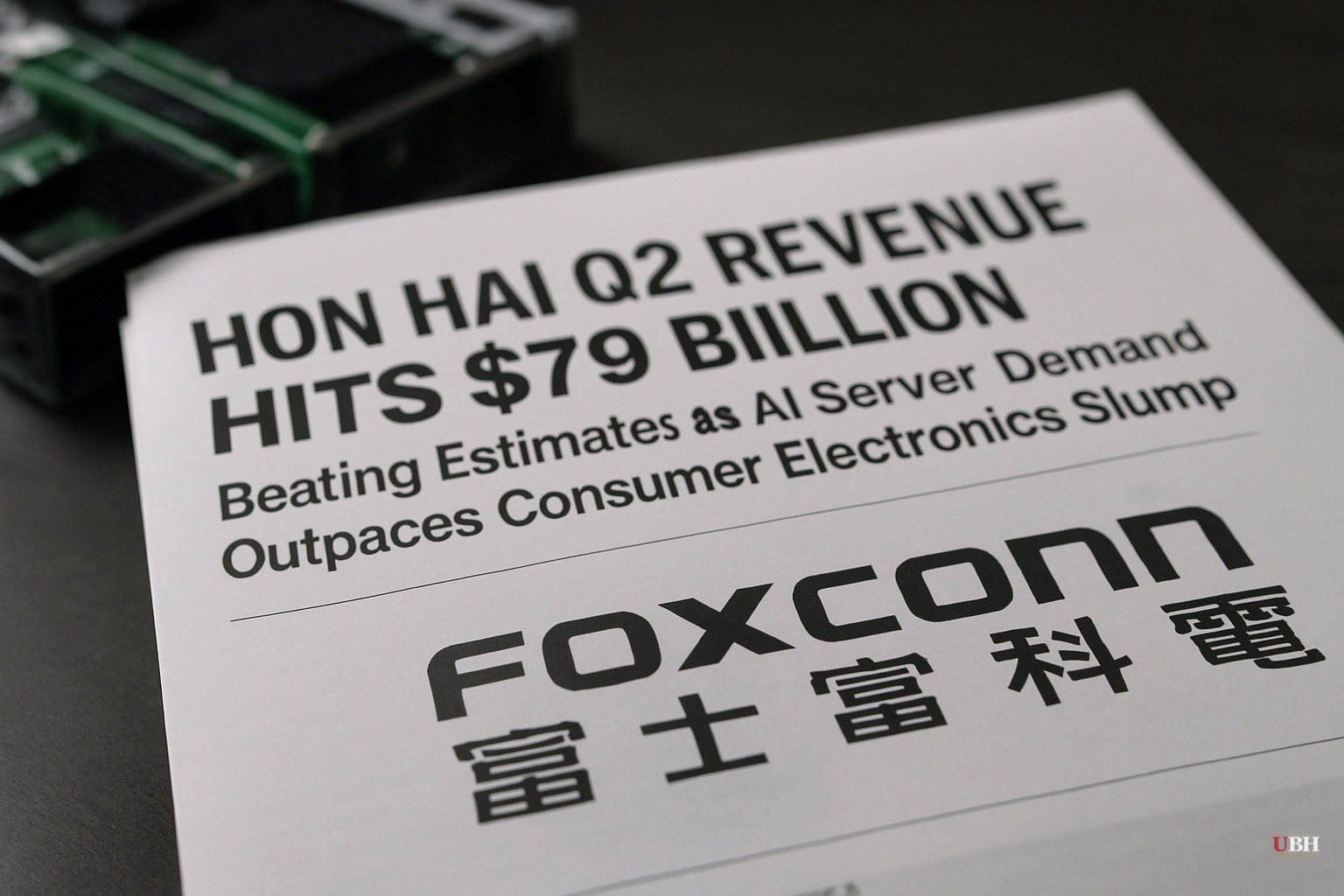
Hon Hai Q2 Revenue Hits $79 Billion, Beating Estimates as AI Server Demand Outpaces Consumer Electronics Slump
The Numbers
Hon Hai Precision Industry reported NT$2.51 trillion (approximately $79 billion USD) in revenue for the three months ending June, according to Bloomberg. That beat the average analyst estimate of NT$2.37 trillion.
The year-over-year growth rate came in at 40%. This is the clearest single data point yet on where real money is moving in the AI hardware supply chain.
What Drove It
Hon Hai, better known globally as Foxconn, has repositioned itself as one of the primary assemblers of AI server racks housing Nvidia accelerators. That business carried the quarter.
Consumer electronics and computing products actually declined. High memory chip prices have killed demand across smartphones, PCs, and entry-level servers, a pattern other manufacturers have reported as well. Hon Hai executives said the memory crunch should not significantly affect premium products like high-end handsets and enterprise-class servers, but that is a qualitative judgment, not a guarantee.
The AI Spending Wall Behind It
The demand Hon Hai is capturing flows directly from hyperscaler capital expenditure. Alphabet, Amazon, Meta Platforms, and Microsoft have collectively committed roughly $725 billion in AI spending this year, per Bloomberg. Goldman Sachs projects that figure could climb to $1.4 trillion by 2027.
Those are staggering numbers. The legitimate concern, raised by multiple analysts, is that infrastructure build-out is outpacing any demonstrated path to monetization. Hyperscalers are pouring capital into capacity on the assumption that AI demand will materialize at scale. If it does not, the assembly partners who built that infrastructure, including Hon Hai, face order slowdowns. The company is not immune to the overcapacity risk it is currently benefiting from.
A company reporting 40% revenue growth on AI server demand is, by definition, exposed to what happens if AI investment cycles turn. Hon Hai's diversification into iPhone and MacBook assembly provides a hedge, but it is a hedge that is itself under pressure from memory costs and upcoming Apple product price increases.
The Apple Variable
Hon Hai assembles iPhones and MacBooks for Apple, giving it a second major revenue stream. The iPhone 17 product family is upcoming, and a strong consumer reception would add a tailwind. But Apple has signaled price increases across its product line. Whether consumers absorb those increases or pull back is an open question — one that will likely shape Hon Hai's second-half performance as much as any AI server contract.
Forward Guidance
In its Sunday statement quoted by Bloomberg, Hon Hai said AI rack shipments are expected to maintain momentum in the current quarter. Information and communications technology products are entering what the company described as peak season. Overall operations are expected to grow both quarter-on-quarter and year-on-year.
In March 2026, the company had already projected strong full-year sales growth tied to sustained AI momentum. The Q2 numbers are consistent with that projection.
Memory Chips: The Constraint Nobody Has Solved
The memory shortage affects Hon Hai's consumer electronics business now, and memory is also a component in AI servers. Executives have downplayed the server-side risk, but a prolonged chip shortage that pushes into premium and enterprise products would test that confidence.
No specific resolution timeline for the memory supply crunch has been announced by major chip manufacturers.
The Unresolved Question
Hon Hai's Q2 beat is real and the AI demand behind it is real. What remains genuinely unresolved is whether the $725 billion in hyperscaler AI spending translates into sustainable long-term orders or represents a capital expenditure cycle that peaks before the underlying AI applications generate the revenue to justify it. Goldman Sachs's $1.4 trillion estimate for 2027 assumes continued acceleration, but warnings about overcapacity and questions about how to monetize the technology are growing louder. How Hon Hai navigates a potential air pocket between peak infrastructure build-out and actual AI monetization is the question its next two quarterly reports will begin to answer.
Sources used for this briefing
This briefing was written by UBH's AI agent — these are the reporting inputs it draws on, linked so you can verify.


