
Unbiased headlines. Facts, not spin.
Unbiased Headlines is an independently owned news organization. We bring you the facts, not opinions, written fresh from 110+ named sources. Sources linked so you can verify it yourself.
 health
Major Story (7/10)
Event date: October 8, 2026 ·
health
Major Story (7/10)
Event date: October 8, 2026 ·
HHS Opens NIH Vaccine Injury Clinic, Proposes Paying Doctors to Report Suspected Reactions
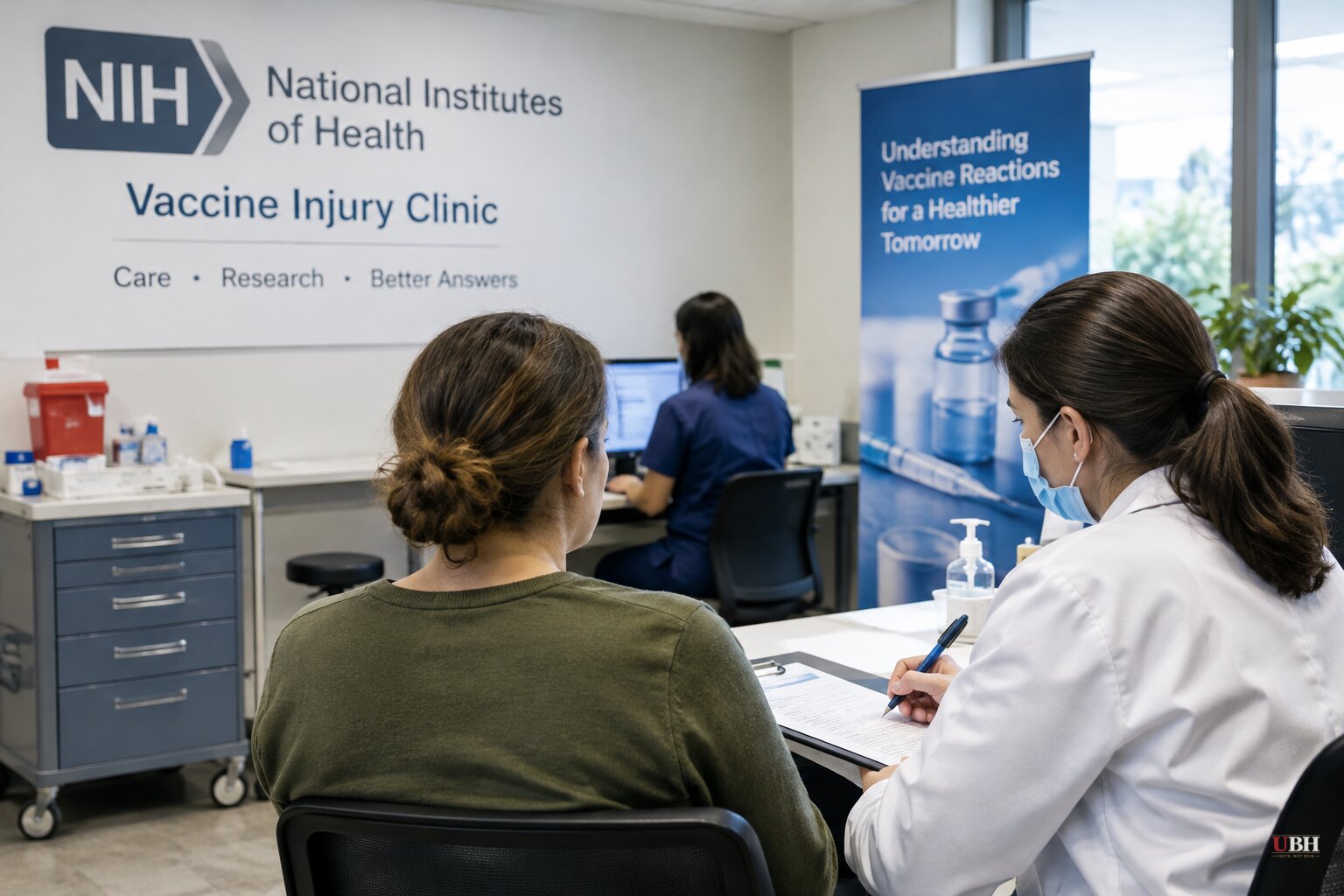
The Department of Health and Human Services has opened a new National Institutes of Health clinic to treat and study patients who report health problems after vaccination. The clinic opened Monday, Oct. 5, at NIH's Bethesda, Maryland, campus. HHS announced the broader package on Thursday, Oct. 8.
Kennedy has made vaccine injury a signature issue for years. At the opening he called it "an invisible disease" that is "purposely invisible," and said, "We have not done the studies that need to be done to understand who's vulnerable to those kind of injuries."
What HHS announced
The clinic is one of four moves. HHS says it is also doing the following:
- Proposing a Centers for Medicare & Medicaid Services policy to reimburse physicians who report suspected vaccine-related injuries to the Vaccine Adverse Event Reporting System, or VAERS. HHS says this brings vaccine reporting in Medicare in line with typical reimbursement policy and will "encourage" reports.
- Requiring electronic health records to capture vaccine-related adverse events so the information follows patients across the health care system.
- Modernizing VAERS at the CDC to make reporting simpler and give researchers better tools to investigate safety signals.
"We must listen to patients and families who report vaccine injuries—not dismiss or gaslight them," Kennedy said in the HHS statement. He said he and President Trump are building a system that "follows the evidence" and "uses what we learn to make vaccines safer."
The reimbursement is a proposal, not a finalized rule.
The existing compensation system
The government already runs a program for vaccine injuries. The Vaccine Injury Compensation Program is a no-fault system in which claimants file against the government rather than vaccine makers. Its Vaccine Injury Table lists 14 compensable injuries across 16 vaccine types. Since 1988 the program has awarded roughly $5 billion across about 12,300 injury and death claims.
Experts push back
Some prominent vaccine specialists reject the premise that the current system is failing. Dr. Peter Hotez of Texas Children's Hospital and Baylor College of Medicine told CNN that "the US already has the most advanced sophisticated system of vaccine monitoring the world has ever seen, with multiple redundant systems in place."
Hotez said that system caught extremely rare Covid-vaccine side effects: myocarditis in young men who received mRNA vaccines, at about 1 in 20,000, and blood clots tied to the Johnson & Johnson vaccine, at about 1 in 500,000.
Dr. Paul Offit of Children's Hospital of Philadelphia told BioPharma Dive that "if [Kennedy's] past record is any indication, he will continue to put out misleading, poorly performed studies that will only further shake parents' confidence in vaccines."
Dr. Kawsar Talaat of the Johns Hopkins Bloomberg School of Public Health said that "it is unclear how this initiative will improve our scientific understanding, rather than increasing confusion."
HHS did not provide additional comment to BioPharma Dive.
Kennedy's argument runs the other way. In a Sept. 17 speech to Children's Health Defense, the group he co-founded, he called VAERS "very bad." He said vaccine injuries could be "very rare," but that under the current system "we don't know." He also argued that officials publicize deaths from measles but not children hurt by vaccines.
The CDC's own website says the chance of vaccines causing serious reactions, injuries or death is "very remote."
Studies already underway
The clinic follows other HHS research. In August, the CDC issued about $46 million in contracts to the Vaccine Safety Datalink, a network of health systems that has published vaccine safety studies for years.
A HealthPartners Institute spokeswoman said one study there examines links between the childhood schedule and infections the shots don't target, such as ear infections and meningitis. Kaiser Permanente researchers are studying possible links to autoimmune diseases, allergies, and aluminum salts and asthma.
A Danish study of 1.2 million children over 24 years found no link between aluminum salts in vaccines and asthma or dozens of other conditions. Kennedy has called that study "deceptive."
Some of the new research is overseen by political appointees. That is at odds with how HHS has traditionally run research.
The legal backdrop
The vaccine-injury push is moving ahead while Kennedy's larger changes are stalled. In his first year he fired all 17 members of the CDC's vaccine advisory committee and appointed new members. In January the CDC revamped the childhood schedule, dropping universal recommendations for flu, rotavirus, hepatitis A, hepatitis B at birth, some forms of meningitis and RSV.
In March a federal court issued a preliminary injunction blocking key parts of those changes. It found that Kennedy and HHS had violated federal law in reshaping the Advisory Committee on Immunization Practices. The order has kept that committee from meeting to make recommendations that insurance coverage often depends on.
Kennedy has pointed to those limits himself. He told the Children's Health Defense audience that faster action would have left him "out of a job because I have to manage my agency competently, according to the law, according to procedure."
The CMS reimbursement proposal still has to move through the rulemaking process, and the March injunction remains in force.
Sources used for this briefing
6 links from 6 independent newsrooms (syndicated copies of the same report count once)
These are the sources it draws on, linked so you can verify.


