
Unbiased headlines. Facts, not spin.
Unbiased Headlines is an independently owned news organization. We bring you the facts, not opinions, written fresh from 110+ named sources. Sources linked so you can verify it yourself.
 health
Low Interest (4/10)
health
Low Interest (4/10)
Cambridge Team Links 15mm Hole in 75,000-Year-Old Neanderthal Shoulder Blade to Wooden Spear
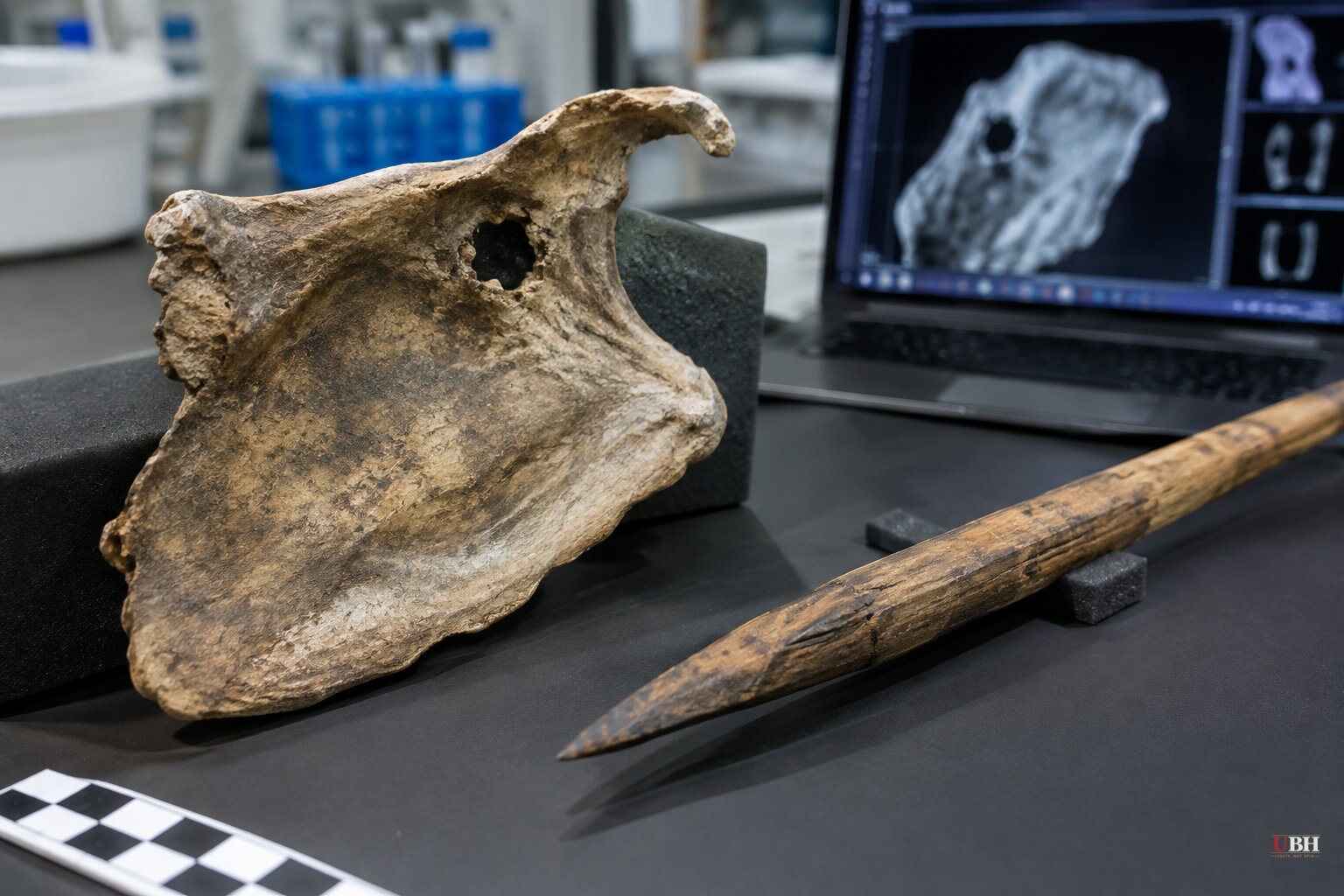
A round hole in a Neanderthal shoulder blade may be the oldest known case of lethal violence with a wooden spear, according to a study published Thursday, Oct. 15, in the journal Scientific Reports.
The remains come from Shanidar Cave in the Zagros Mountains of Iraqi Kurdistan. The Cambridge team, led by Emma Pomeroy, calls the individual Shanidar A.
What was found
Excavators recovered the bones in 2019 and 2022 from about 7.5 meters (roughly 24.6 feet) of rock and sediment. The set includes a nearly intact left shoulder blade, a mostly complete right hand, two left ribs, a right rib fragment and seven teeth. They belonged to an adult estimated to be about 45 years old. The sex could not be determined.
The shoulder blade is so thin in places that light passes through it. The team soaked it in consolidant and lifted it out in one block of sediment.
The only damage is a nearly perfect circular hole about 15 millimeters across, with small cracks running from the rim.
Why a wooden spear
The shape is the main evidence. The team says a flint or stone tip would leave a flat or angular opening. A sharpened wooden shaft, round in section, leaves a circle. Pomeroy said holes made by replica spears of that era are an "excellent fit" for the one in the bone.
Microscopy and micro-CT scans showed beveling around the hole typical of an exit wound. Tiny bone shards pushed out by the weapon indicate the spear came in from above at a downward angle.
The researchers reconstruct a thrust through the front of the left chest, through the lung and likely major arteries, and out through the shoulder blade. They say death would have been rapid. Pomeroy told the BBC the strike "may have been an intended heart shot."
Wood rarely survives from deep prehistory. Waterlogged throwing spears from Schöningen, Germany, date to about 200,000 years ago. The oldest known rounded wooden spear, a pointed tip from Clacton-on-Sea, England, is more than 400,000 years old. The team says the Shanidar A wound may be the first evidence of sharpened wooden spears in the prehistoric Middle East.
Attack or accident
The authors do not claim to have proven murder. Pomeroy told the BBC that interpersonal violence is "by no means certain" and that the wound could be friendly fire from a hunting accident. Neanderthals likely hunted large animals at close range with thrusting spears.
Chris Stringer of the Natural History Museum in London, who was not involved in the research, disagrees on the likelihood. "The researchers leave it open whether this resulted from a hunting accident or interpersonal violence, but in my view the latter seems more likely, given the positioning and extent of the wound," he told the BBC.
Pomeroy's team points to the same features. In the words of the Cambridge release, the position of the wound and the force needed to drive a spear through the body "bear the hallmarks of an intended kill shot."
The study does not identify who threw the spear or why. Archaeology Magazine's account of the paper says the simplest reading is violence between Neanderthals, but that nobody knows whether modern humans were involved.
That question has a history at the site. A Neanderthal known as Shanidar 3, excavated in the 1950s and living around 50,000 years ago, has a partly healed puncture in a rib. In 2009, Steven Churchill of Duke University and colleagues fired replica stone points into pig carcasses and judged that wound most consistent with a light, stone-tipped projectile. Early modern humans were in western Asia at about that time and may already have had throwing weapons.
A tooth that tells another story
Shanidar A's violent end was not the only injury. One lower front tooth split lengthwise, and neighboring teeth rotated inward. Heavy tartar built up along the exposed root, which shows the broken half stayed in the mouth long after the blow.
Pomeroy said surviving such a blow "and continuing to live and eat for a period of at least a year and maybe more, would have required care and support from other Neanderthals." The team suggests soft food was prepared for the injured individual.
"The remains of Shanidar A reflect the dual nature of so much of what we recognise as human," she said. "On the one hand, we have evidence of a terribly violent end. On the other, this was clearly an individual who was cared for during their lifetime."
A cave of the dead
Shanidar A lay in a burial cluster first spotted in 1960. Since 2015 the Cambridge team has found three more individuals there. They were packed into a space about 1.5 meters long, 1 meter wide and 1 meter deep behind a large boulder.
Shanidar A lay deepest, on the back with the head facing east. A later flash flood disturbed the skeleton after decay.
The paper says the repeated use of one small area within a short span, likely within generations, is "difficult to explain except in terms of intentional patterned behavior." The famous 1970s "flower burial" claim, based on pollen in a grave, has been challenged by some archaeologists who argue animal activity may explain the pollen.
What remains open
The study does not settle whether Shanidar A was killed or accidentally speared. It leaves the question of the thrower's identity unanswered. The 15mm hole is the evidence, and the replica-spear tests are the main check on it. Other researchers can now examine the paper's micro-CT and fracture analysis, and test whether comparable round perforations show up in other Neanderthal remains.
Sources used for this briefing
7 links from 7 independent newsrooms (syndicated copies of the same report count once)
These are the sources it draws on, linked so you can verify.


