
Unbiased headlines. Facts, not spin.
Unbiased Headlines is an independently owned news organization. We bring you the facts, not opinions, written fresh from 110+ named sources. Sources linked so you can verify it yourself.
 health
Notable (6/10)
Event date: October 12, 2026 ·
health
Notable (6/10)
Event date: October 12, 2026 ·
Google, Meta and Isomorphic Commit $300 Million to Virtual Cell Effort as Anthropic's Biology Claim Draws Dispute
The money is moving fast. The proof is moving slower.
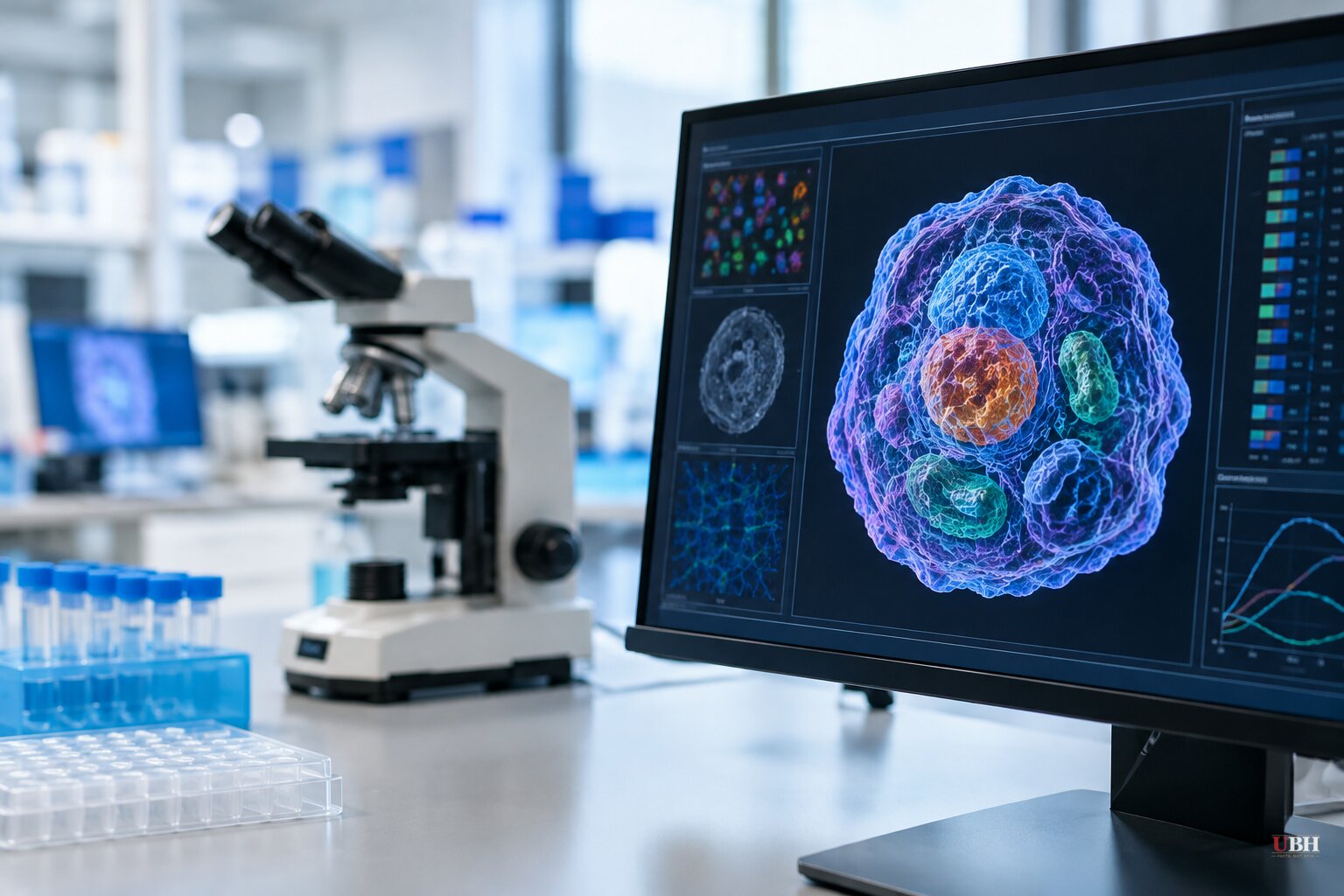
Biohub and its partners have expanded an effort to build "virtual cells," AI models meant to predict how cells respond to drugs and other interventions. The combined commitment is $1.8 billion across funding, data, computation and measurement technology.
Who is paying for the virtual cell project
The total includes Biohub's previously announced $500 million and datasets built with more than $500 million in earlier federal spending. New contributions sit on top of that.
Google DeepMind, Isomorphic Labs and Meta are jointly putting $300 million into the Virtual Biology Initiative, which Biohub announced in April 2026. That money goes to measurement technologies and datasets that combine different types of biological information.
The U.S. Department of Energy will invest more than $500 million over five years through its Genesis Mission. It will draw on supercomputers, imaging facilities and autonomous labs across the National Laboratory system. The National Institutes of Health will coordinate existing datasets and repositories, and Biohub will work with NIH to standardize them for AI training.
Biohub says $400 million of its own commitment goes to technologies that expand what researchers can measure, and $100 million to research outside Biohub. It is also building shared standards, common identifiers and a single access point, so the data from different institutions can be used together.
"An accurate predictive model of biology could dramatically accelerate scientific discovery by enabling scientists to perform experiments digitally," said Alex Rives, Biohub's Head of Science. Max Jaderberg, president of Isomorphic Labs, said solving predictive systems biology requires "scaling past the limits of what any single organization can produce today."
Part of this is federal money, meaning taxpayer money. The DOE pledge is a five-year, nine-figure commitment, and the NIH contribution is data that earlier federal spending already paid for.
Google's own scorecard
In an Oct. 12 blog post, Yossi Matias of Google Research and Pushmeet Kohli of Google DeepMind laid out the company's health AI work. They said Google teams have published 90 peer-reviewed papers on disease in the past five years, with more than 90,000 citations.
The post and the research it cites include several specific claims:
- MedGemma, an open medical model described in Nature Medicine, improved chest X-ray classification accuracy by 15.5 to 18.1 percentage points over earlier models.
- In a mammography study of 125,000 women, an AI system flagged 25% of cancers missed in routine interval screening and cut specialist reading workload by up to 40%.
- With Stanford University School of Medicine, Google's tools helped complete a genetic diagnosis in under eight hours for time-critical cases, which set a Guinness World Record.
- Using AlphaFold to screen 30,000 compounds, Google's research contributed to two FDA-approved drugs for Chagas disease.
On Oct. 15, DeepMind launched Google Antigravity, a workbench for finding antimicrobial peptides. It combines ProtNLM and AlphaFold, and early candidates are moving into wet-lab validation. The research behind it cites a projection of 10 million deaths a year from antimicrobial resistance by 2050.
These are Google's figures, drawn from its own announcements and papers. The company is also the one selling the tools.
Anthropic's claim runs into pushback
Not every announcement has held up as cleanly. Last month Anthropic said its biology lab used Claude agents to find a "novel enzyme system" in viral DNA, with "only high-level direction from our scientists." CEO Dario Amodei wrote on X that the company suspects it "could represent a new gene editing mechanism." Shares of gene-editing companies fell shortly after.
Scientists outside the company are skeptical. "These are very interesting preliminary results, but at this point they don't demonstrate gene editing or provide a mechanistic picture of exactly what's happening," said Aaron Engelhart, an associate professor of genetics, cell biology and development at the University of Minnesota.
Anthropic's own research document says the team has not determined what the viral sequences actually do. The work has not been peer reviewed.
The claim also faces a priority dispute. Mario Rodríguez Mestre, who says he used Claude extensively for his recently completed doctoral research at the University of Copenhagen, says his unpublished work describes the same viral signatures. "It is essentially the same finding," he said.
Anthropic's release quoted MIT and Broad Institute CRISPR pioneer Feng Zhang, who called the work "genuinely intriguing." Engelhart said it warrants further investigation.
Hassabis on security
Speaking at the International AI Summit in Dublin, DeepMind chairman Demis Hassabis was optimistic on science but warned on security. He said the industry should "asymmetrically power the defenders" and use advanced systems defensively, possibly before general release, to fix software vulnerabilities.
He described recent hacking incidents involving autonomous AI agents as not major, but said the "systems are not healthy yet." He called on companies and governments to build secure sandboxes for testing.
Isomorphic's valuation talks
Isomorphic Labs, the DeepMind spinout that Hassabis runs as CEO, is in early talks to raise new money at a valuation of at least $40 billion, possibly up to $50 billion, according to Bloomberg. No agreement has been reached. The company was previously valued at roughly $17.5 billion and raised $2.1 billion in a Series B in May. Alphabet remains its majority owner.
Isomorphic works with Eli Lilly, Novartis and Johnson & Johnson and is developing treatments for cancer and immune disorders. It has not yet tested any of its own drug candidates in humans. The company is targeting its first clinical trials by the end of 2026, which leaves a little over two months to show that the technology can turn predictions into medicine.
Sources used for this briefing
7 links from 7 independent newsrooms (syndicated copies of the same report count once)
These are the sources it draws on, linked so you can verify.


