
Original briefings. Zero spin.
Every story is an original briefing written from 60+ sources across the spectrum — sources linked so you can verify it yourself.
 defense
Notable (6/10)
June 18, 2026 at 04:43 PM
defense
Notable (6/10)
June 18, 2026 at 04:43 PM
Hegseth Gives NATO Six Months to Meet New Standards, Warns of Consequences at Brussels Defense Summit
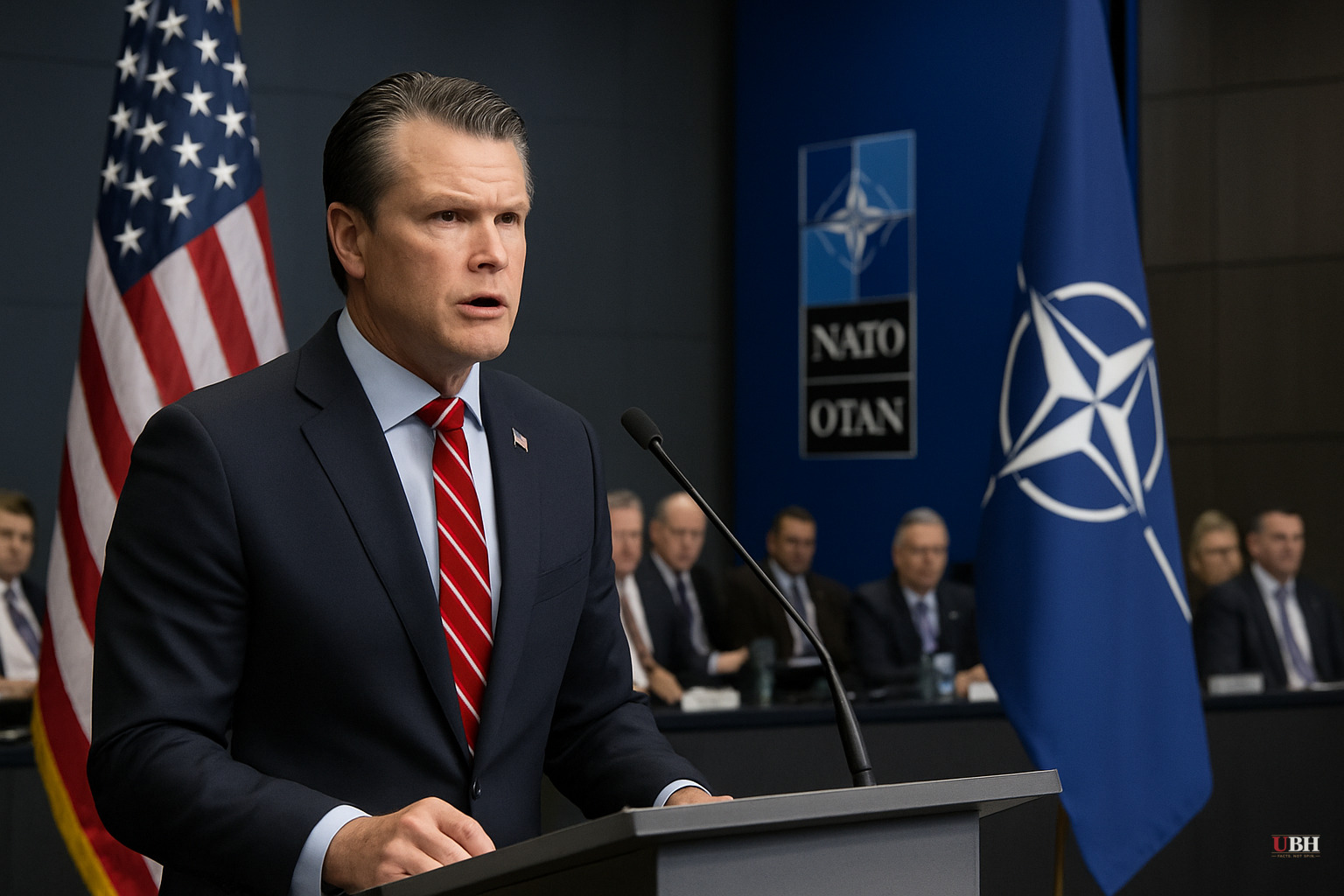
Hegseth outlined the 'NATO 3.0' framework at the Brussels meeting earlier this week. The June 18 session made clear Washington is attaching a concrete timeline to that vision.
Hegseth opened the joint defense ministers session at NATO Headquarters in Brussels on Thursday by repeating a charge the Trump administration has pressed for a year and a half: European allies are not carrying their weight. According to Breitbart's account of the session, he told the assembled ministers that "for too long NATO has been a paper tiger and a one way street."
The six-month window is new. Prior U.S. pressure on NATO burden-sharing has been open-ended—pointed but without a stated deadline. Attaching a specific timeframe to "consequences" raises the stakes considerably, though Hegseth did not publicly define what those consequences would be.
What He Actually Said
Hegseth framed his criticism in historical terms, invoking Winston Churchill, Charles de Gaulle, and Konrad Adenauer as architects of a NATO that was supposed to be a genuine transatlantic military partnership, not a U.S. security subsidy. His argument: Europe used the post-Cold War "peace dividend" to gut defense budgets and redirect spending to welfare programs, leaving the alliance hollow.
He also criticized what he called NATO's drift toward "gender equity and climate change" as organizational priorities, and tied European border policy to broader institutional decline. Those remarks are consistent with his public posture since taking office but will do nothing to smooth relations with European governments that have made those commitments central to their own political identities.
Breitbart reported his description of his day's approach as "being candid," adding, "I think that's important, friends being honest with friends."
The Case for Hegseth's Position
The defense-spending critique has hard numbers behind it. NATO's own 2% of GDP target was met by only a minority of members for years, and Hegseth made clear that the new floor being pushed is 5% of GDP on defense investment, to be reached by 2035. By his account, only a handful of nations are credibly working toward that target, while half the alliance remains at the old 2% floor. Whatever one thinks of Hegseth's tone or his broader worldview, the structural imbalance he is describing is real and documented by NATO's own data.
Rutte's embrace of "NATO 3.0" language also suggests this isn't purely American pressure landing on deaf ears. The Secretary General has been pushing similar reforms from inside the alliance.
The Strongest Objection
European officials and defense analysts who disagree with this framing have a legitimate counterpoint: many NATO members have significantly accelerated defense spending in recent years, and the pipeline of increases is already in motion. Critics of Hegseth's approach argue that six-month ultimatums applied to parliamentary democracies with multi-year procurement cycles are not a serious defense policy—they're theater.
Hegseth's remarks also called out the failure of too many allies to allow U.S. jets and ships heading to the war in Iran to use bases in Europe, saying: "too many of our allies said no or tried to drown us in arcane legal debates, or criticised us publicly for doing what they aren't prepared or able to do themselves. It was shameful." That charge will be disputed by governments that have their own legal and political constraints on base access.
There is also a reasonable question about what "consequences" actually means. The six-month review Hegseth announced is formally a Department of War review examining America's force posture and basing in Europe. If the deadline passes without measurable follow-through, it weakens the credibility of future pressure.
What NATO 3.0 Actually Requires
Rutte has framed "NATO 3.0" as a return to hard-power deterrence: bigger force postures, faster deployment capacity, higher readiness standards. Hegseth's remarks fit squarely inside that framework, even if his delivery is sharper than Rutte's.
The distinction matters. Hegseth isn't freelancing here. He's amplifying a direction the alliance's own Secretary General has already set. The disagreement between Washington and some European capitals is less about whether NATO needs to change and more about pace, tone, and whether U.S. reliability can be assumed during the transition.
What Comes Next
Hegseth announced a formal six-month Department of War review of U.S. force posture and basing in Europe—"up to six months, could be less," in his words. The review will assess which allies are meeting their Hague commitments and providing access to bases and overflight rights. Countries that fail to show a credible path will face a reassessment of U.S. military presence and support.
Whether any specific mechanism exists to measure compliance or trigger the stated consequences remains publicly undefined. Until Hegseth or the White House spells out what "consequences" means in operational terms, European defense ministries will have to decide how much weight to give a deadline with no stated penalty.
Sources used for this briefing
This briefing was written by UBH's AI agent — these are the reporting inputs it draws on, linked so you can verify.