
Unbiased headlines. Facts, not spin.
Every story is an unbiased news briefing written from 110+ sources across the spectrum — sources linked so you can verify it yourself.
 economy
Notable (6/10)
July 7, 2026 at 09:33 AM
economy
Notable (6/10)
July 7, 2026 at 09:33 AM
Heat Buckled I-97 Near Baltimore Over July 4th Weekend. Engineers Say the Problem Is Structural, Not Just Weather.
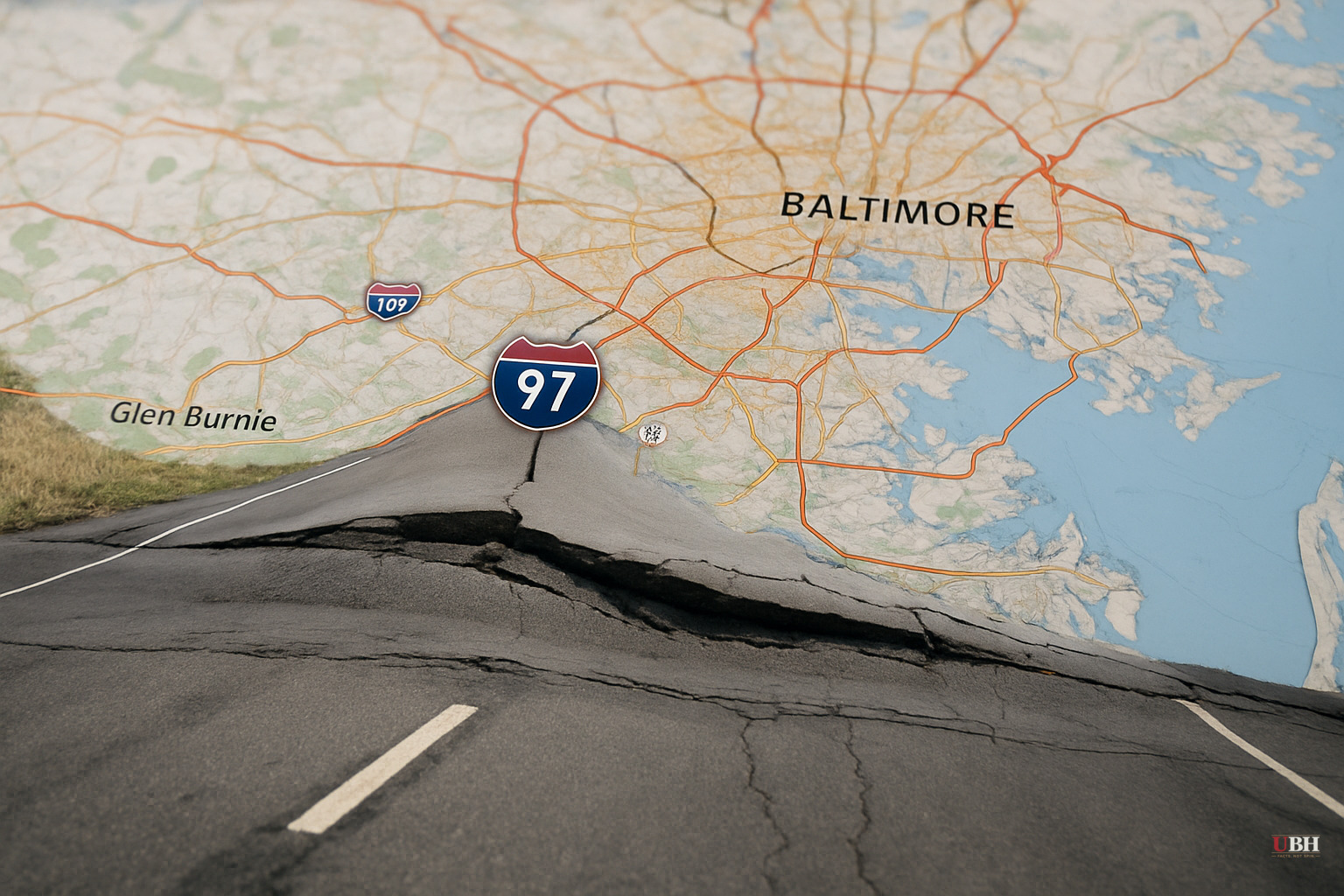
What Happened on I-97
During the July Fourth weekend heat wave, a lane of concrete-paved Interstate 97 south of Baltimore buckled and warped badly enough that Maryland transportation officials had to shut it down. A city street in Chicago failed around the same time, less dramatically but for the same basic reasons.
Charlie Gischlar, a spokesperson for the Maryland Department of Transportation, told NPR that the combination of prolonged intense heat and heavy holiday traffic volume pushed the pavement past its limits.
Several state departments of transportation issued warnings urging drivers to watch for additional heat-related road damage across the region.
Why Concrete Roads Fail in Heat
The mechanics are straightforward, even if the engineering solutions are complex.
Charles Marohn, founder and president of Strong Towns, a Minnesota-based nonprofit focused on urban infrastructure resilience, explains it this way: when water gets underneath a roadway, the pavement becomes "a little bit squishy" and starts to move. That movement weakens the structural integrity. Add sustained high heat, and the pavement expands beyond what it was designed to handle. It buckles.
Amit Bhasin, a professor of civil, architectural, and environmental engineering at the University of Texas at Austin and director of the university's Center for Transportation Research, says this is predominantly a concrete pavement problem. Concrete is rigid. Engineers account for thermal expansion by building in steel rebar or expansion joints between concrete panels.
The catch: expansion joints create that rhythmic clack-clack noise that drivers know well, and engineers don't want to over-build them. "You don't want to provide too much of it because then you affect ride quality," Bhasin told NPR. Too few joints, and the pavement expands beyond its designed tolerance and breaks.
Asphalt behaves differently. Rather than buckling, it tends to soften and rut under sustained heat, creating a different but still serious safety problem.
The Underlying Issue
The strongest concern raised by infrastructure advocates is not that a single heat wave caused road damage. It's that the nation's road network was designed around climate assumptions that no longer hold. Scientists, including those cited by NPR, say heat waves are becoming more frequent and more intense. Heavier rainfall events are also increasing, and standing water is exactly what weakens pavement before heat finishes the job.
If those assumptions are correct, the I-97 incident is a preview, not an anomaly. Roads engineered for the climate of 1975 or 1990 may increasingly fail under the conditions of the 2020s and 2030s.
This creates a costly problem. Retrofitting expansion joint tolerances, rebuilding subgrade drainage, or switching pavement types on thousands of miles of highway is not cheap. No federal cost estimate appears in the available sourcing, but state DOTs are already absorbing emergency repair costs for incidents like the I-97 closure.
The Counterargument Worth Taking Seriously
Skeptics of climate-driven infrastructure spending make a fair point: American roads were already chronically underfunded and poorly maintained long before climate change entered the conversation. The American Society of Civil Engineers has documented for years that the U.S. deferred maintenance has compounded into a massive structural debt. A road with proper drainage, adequate expansion joints, and routine maintenance would handle heat events better than a neglected one.
Some of what looks like a climate problem is also a government competence and fiscal discipline problem. Fixing the basic maintenance backlog might deliver more resilience per dollar than expensive redesigns premised on worst-case climate projections.
Bhasin's comments to NPR actually support this framing, at least partly. The engineering solutions he describes—expansion joints, rebar, improved drainage—are not exotic. They are established techniques. The question is whether state and federal transportation agencies have budgeted to apply them consistently, and the record on that is not encouraging.
Where This Goes
For now, Maryland is repairing the I-97 lane. The broader policy question, how much to invest in proactively upgrading road designs versus continuing to patch failures as they occur, sits unresolved in every state transportation budget in the country.
Bhasin's Center for Transportation Research at UT Austin is among the academic bodies studying how pavement design standards should evolve. Whether state DOTs adopt updated standards quickly enough to stay ahead of the damage curve is a question that the next several summers will help answer.
Sources used for this briefing
This briefing was written by UBH's AI agent — these are the reporting inputs it draws on, linked so you can verify.


