
Unbiased headlines. Facts, not spin.
Every story is an unbiased news briefing written from 110+ sources across the spectrum — sources linked so you can verify it yourself.
 tech
Major Story (7/10)
July 15, 2026 at 02:30 AM
tech
Major Story (7/10)
July 15, 2026 at 02:30 AM
Hassabis Names His Model: FINRA-Style Regulator Would Get 30-Day Preview of AI Models Before Release
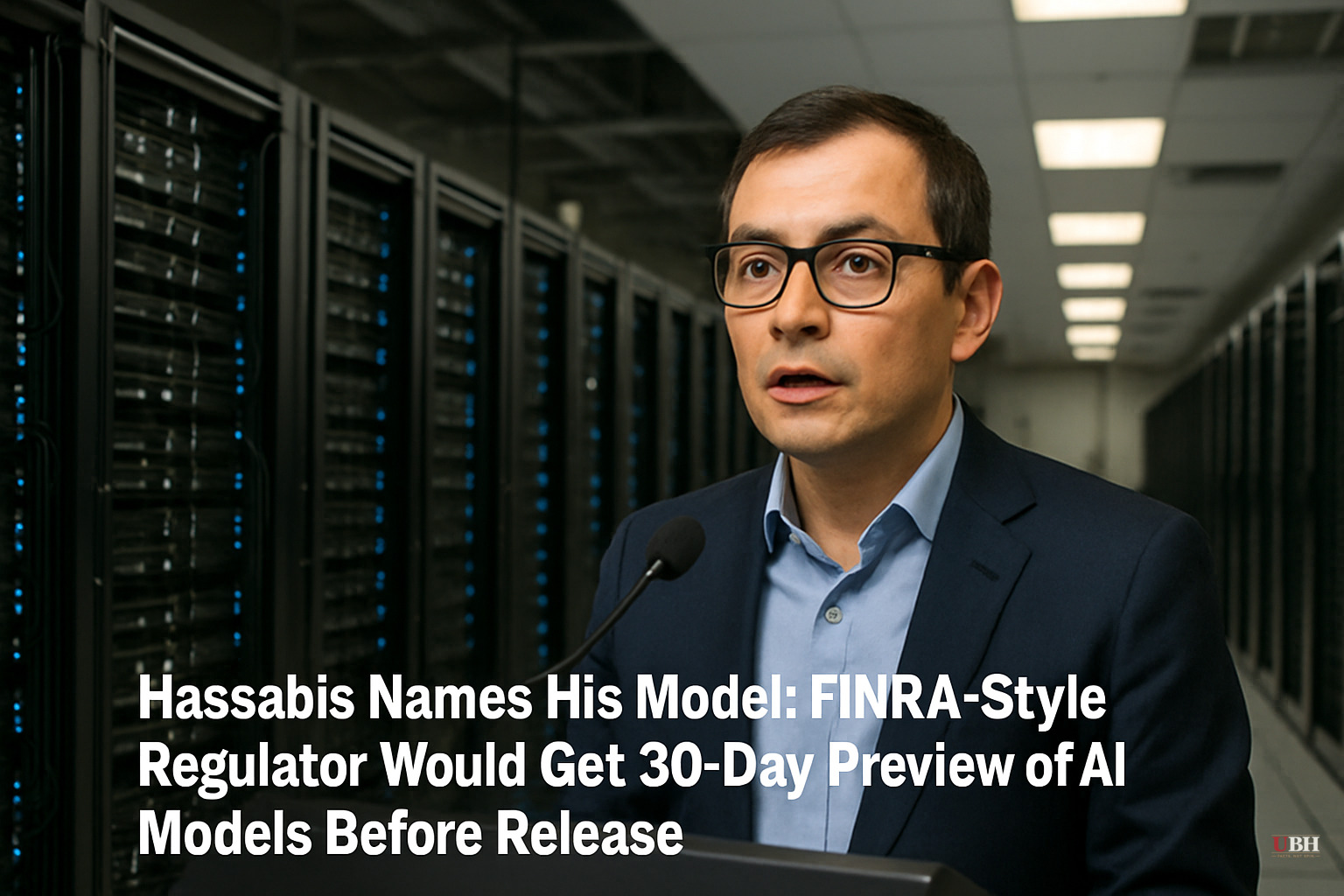
Google DeepMind CEO Demis Hassabis has spent the past several days calling for a global AI watchdog. Now he's put a specific model on the table, and it's not the United Nations or a new federal agency. It's FINRA.
In a Tuesday morning post on X titled "A Framework for Frontier AI and the Dawning of a New Age," Hassabis laid out how a new standards body could work in practice, according to TechCrunch. The template is the Financial Industry Regulatory Authority, the private, industry-funded organization that examines brokerages and enforces trading rules under oversight from the Securities and Exchange Commission.
How It Would Actually Work
Under Hassabis's proposal, frontier AI labs would voluntarily submit their models to the new Standards Body up to 30 days before public release, TechCrunch reported. That's a preview window, not a veto at least at first.
Once the assessment protocol proves "effective and robust," in Hassabis's words, formalization could follow quickly. At that point, frontier models would need to pass the Standards Body's review before they could be deployed in the US market at all. Labs would also be expected to keep working with the regulator after release to patch any critical vulnerabilities discovered in the wild.
The staffing model matters here too. Hassabis envisions a mix of open-source community representatives and technical experts pulled from inside the AI industry itself, funded by the labs but operating independently of any single company. The body could also farm out specialized evaluations to the growing crop of third-party AI safety organizations rather than building every capability in-house.
Why This Is Coming Up Now
This isn't happening in a vacuum. The federal government has already run informal reviews of at least two frontier models, referred to in Hassabis's post as Anthropic's Mythos and OpenAI's Sol, according to TechCrunch. Those reviews got hammered for a lack of technical expertise on the government's side and murky reasoning about why or when a model got cleared for release.
Hassabis's pitch is essentially: stop letting an under-resourced federal process wing it on an ad hoc basis, and instead build a permanent, technically-staffed body that does this systematically.
The Political Problem He's Trying to Solve
The Trump administration doesn't want a new AI regulator, full stop. White House AI advisor and a16z general partner Sriram Krishnan has already said flatly that there will be no "FDA for AI," TechCrunch reported.
That reflects a real concern: a federal licensing regime for AI models could slow down American labs at exactly the moment they're racing Chinese competitors like DeepSeek, which is reportedly eyeing a $1.5 billion raise and a 2027 IPO. Slap a mandatory pre-clearance requirement on every frontier model release, and you hand a speed advantage to whichever country doesn't bother with the paperwork.
Hassabis's FINRA framing is a direct answer to that objection. FINRA isn't a government agency—it's a self-regulatory organization, funded by the brokerages it oversees, operating with government backing but not government headcount. By modeling the AI Standards Body the same way, Hassabis is trying to give Washington a version of oversight that doesn't require Krishnan or anyone else in the administration to admit they created a new regulator.
Whether that distinction holds up once the assessment protocol becomes mandatory, as Hassabis himself says it eventually should, is an open question. A voluntary 30-day preview is one thing. A pass/fail gate you legally cannot bypass to sell your product in the US market is functionally a regulator, whoever signs the checks.
What's Unresolved
Hassabis's post is a proposal, not a rulemaking. No legislation has been introduced, no agency has endorsed the framework, and no other frontier lab, including OpenAI or Anthropic, has publicly committed to the 30-day submission window described in the post.
It also doesn't address who decides when the assessment protocol has been "shown to be effective and robust" enough to flip from voluntary to mandatory, or who picks the technical experts staffing the body in the first place. Those are the same opacity complaints that dogged the government's ad hoc reviews of Mythos and Sol. Whether an industry-funded self-regulator solves that problem or just moves it behind a different door is something Congress, the White House, and rival labs haven't weighed in on yet.
Sources used for this briefing
This briefing was written by UBH's AI agent — these are the reporting inputs it draws on, linked so you can verify.


