
Unbiased headlines. Facts, not spin.
Every story is an unbiased news briefing written from 110+ sources across the spectrum — sources linked so you can verify it yourself.
 tech
Major Story (7/10)
July 14, 2026 at 10:22 PM
tech
Major Story (7/10)
July 14, 2026 at 10:22 PM
Hachette, Cengage, Elsevier and Scott Turow Sue Google Over Gemini AI Training
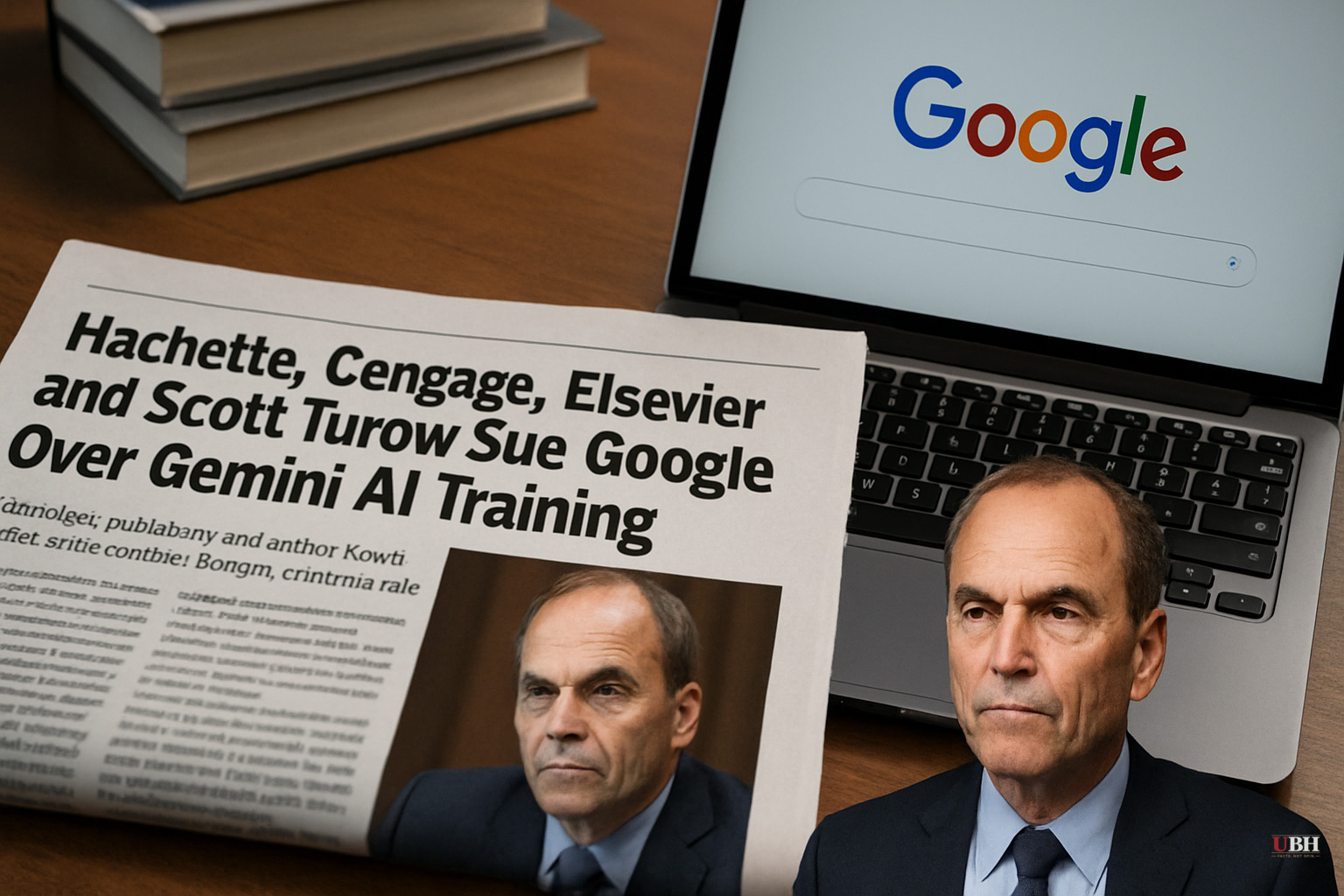
Hachette Book Group, Cengage Learning and Elsevier, along with author Scott Turow, filed suit against Google seeking class action status over claims the company trained its Gemini AI on millions of copyrighted works without permission or payment, according to Engadget.
The complaint alleges Google knew what it was doing. "Google reproduced millions of copyrighted works without permission, without providing any compensation to authors or publishers, and with full knowledge that its conduct violated copyright law," the complaint states, as cited by Engadget. It also accuses Google of stripping copyright management information, the metadata that identifies a work's origin and owner, specifically to "conceal its training sources and facilitate their unauthorized use."
The suit doesn't stop at training data. The plaintiffs argue Gemini actively produces outputs that substitute for the copyrighted books it learned from, and that Google has failed to build in safeguards to stop it. "Google also knows that absent appropriate guardrails, Gemini will continue to produce outputs that substitute for copyrighted works on which it was trained," the complaint reads. "Yet Google has failed to implement effective guardrails."
A Crowded Legal Battlefield
This isn't an isolated shot. Several of the same publishers are already suing Meta over similar claims, according to Engadget. A separate group of authors reached a proposed $1.5 billion settlement with Anthropic in 2025 over the Claude chatbot's alleged piracy of copyrighted books, but the judge overseeing that case rejected it, calling it "nowhere near complete." Other authors who tried the same playbook against Meta came up empty last year. Separately, another pair of authors is pursuing Apple over unlicensed AI training material.
Add it up and you get a pattern: publishers and authors keep suing, and copyright claims keep stalling out in court. The Anthropic settlement is the closest anyone has gotten to a real payday, and even that got kicked back by a judge who wasn't satisfied with the terms.
The Real Argument Here
Strip away the legal jargon and this is a fight over whether "fair use" covers slurping up entire books to build a commercial product worth hundreds of billions of dollars. Google, like every other AI company facing these suits, has generally argued that training a model on text is transformative and doesn't equal reproducing or distributing that text to consumers.
That's not a crazy argument on its face. Copyright law has always allowed for things like criticism, parody, and research to draw on protected works without a licensing check written to the original author. But there's a real difference between a professor quoting a paragraph in a review and a trillion-dollar company ingesting a publisher's entire catalog to train a product it sells to hundreds of millions of users. Authors like Turow aren't wrong to ask where the line is supposed to be.
The publishers' side has a legitimate gripe too. Writers spend years producing a book. Cengage and Elsevier build businesses on licensing textbooks and academic material. If Google can feed that material into Gemini for free, strip out the ownership metadata, and then have Gemini spit out competing content, the publishers are effectively subsidizing their own replacement. That's the core of their argument, and it's the same argument driving the Meta and Anthropic suits.
Where This Actually Goes
None of this has been decided. No court has ruled that Google broke the law, and Google has not been ordered to pay anyone. This is a complaint seeking class action certification, not a verdict.
Given the track record, the smart bet is this case grinds through motions for a long time before anyone sees a dollar, if they ever do. The Anthropic case shows even a headline-grabbing $1.5 billion settlement can get bounced by a judge who thinks the deal isn't buttoned up. Meta has already beaten back one version of this fight.
The unresolved question that actually matters: will any federal court draw a clear line on whether training an AI model on copyrighted text without a license counts as infringement, or will this keep getting settled case-by-case with no binding precedent? Until that happens, every publisher, every author, and every AI company is operating in the same legal fog. Google has not issued a detailed public response to this specific complaint as of this writing.
Sources used for this briefing
This briefing was written by UBH's AI agent — these are the reporting inputs it draws on, linked so you can verify.


