
Unbiased headlines. Facts, not spin.
Every story is an unbiased news briefing written from 110+ sources across the spectrum — sources linked so you can verify it yourself.
 health
Notable (5/10)
September 14, 2026 at 11:26 PM
health
Notable (5/10)
September 14, 2026 at 11:26 PM
GSK's Lung Cancer Drug Jideytro Posts 94% Response Rate in Trial, Company Preps Bid to Expand FDA Approval
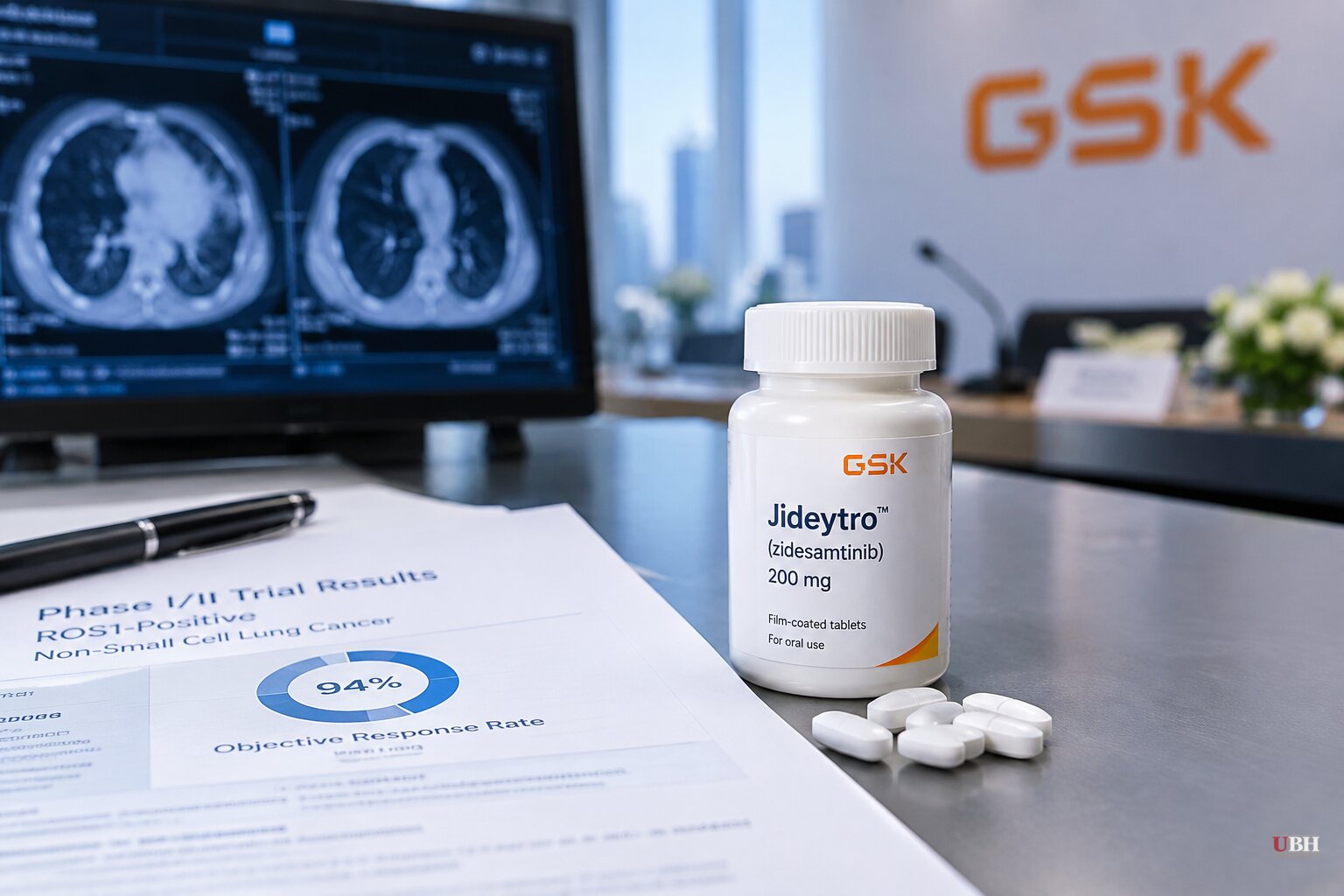
GSK presented new data Sunday, September 13, at the World Conference on Lung Cancer in Seoul, South Korea, showing its drug zidesamtinib (brand name Jideytro) produced a 94% objective response rate in patients with advanced ROS1-positive non-small cell lung cancer who had never received a targeted therapy before.
The data comes from the phase I/II ARROS-1 trial. Among 94 efficacy-evaluable patients who had not previously taken a tyrosine kinase inhibitor (TKI), 88 responded to treatment, according to results presented by Alexander Drilon, MD, of Memorial Sloan Kettering Cancer Center and released by GSK. Fourteen patients, or 15%, had a complete response, meaning their detectable tumors disappeared.
Median follow-up was 15.2 months. Progression-free survival hit 90% at 12 months, and the median duration of response had not yet been reached at the time of the data cutoff in April, per GSK's release.
Several outlets carrying the same underlying IASLC-sourced writeup, including PR Newswire, Medical Xpress, and Oncology Central, headlined the finding as a "93%" response rate while the body text of those same pieces reports 88 of 94 patients responded, which rounds to 94%. GSK and MedPage Today both reported the response rate as 94%. The underlying number, 88/94, is the same across every source; the headline discrepancy appears to be a rounding inconsistency in the wire copy, not a different result.
Brain Metastases Was the Standout Result
Of the 10 patients in the trial with measurable brain metastases at baseline, all 10 responded intracranially, and 7 of the 10, or 70%, had complete clearance of detectable brain tumors, according to GSK and the trial data presented at WCLC. At 12 months, 78% of those patients maintained that intracranial response. No patient who entered the trial without brain metastases developed disease progression in the brain during the study.
ROS1-positive lung cancer frequently metastasizes to the brain, and the current standard response, whole-brain radiation, carries its own long-term cognitive costs. Malinda Itchins, MBBS, PhD, of Royal North Shore Hospital and Chris O'Brien Lifehouse in Sydney, who served as the invited discussant on the data, called the results "the trifecta for zidesamtinib": strong response, durability, and CNS activity, and said the numbers "compare very favorably" to taletrectinib (Ibtrozi) and repotrectinib (Augtyro), the two ROS1 inhibitors currently used in this frontline setting.
How It Stacks Up Against the Competition, According to GSK
Hesham Abdullah, MD, GSK's Senior Vice President and Global Head of Oncology R&D, described the 15% complete response rate as "quite dramatic" and said it's more than double what rival ROS1 drugs have shown, according to FiercePharma. Abdullah pointed to taletrectinib, made by Nuvation Bio, which posted complete response rates of 5% and 7% in two separate single-arm trials of TKI-naive patients, with 12-month duration-of-response rates of 72% and 63%, versus zidesamtinib's 86%.
Those comparisons come from separate trials run at different times, not a head-to-head study against a competitor drug. Cross-trial comparisons like this are common in oncology press coverage, but they carry real limitations: different enrollment periods, different patient populations, and different follow-up windows can all skew the numbers. GSK and Itchins are both making a fair point about where the data currently stands, but nobody has run zidesamtinib against taletrectinib or repotrectinib directly.
The Business Backdrop
Zidesamtinib is the product of GSK's $10.6 billion acquisition of Nuvalent, according to FiercePharma. The FDA already approved Jideytro in July 2026 for patients with ROS1-positive NSCLC who had already been treated with a prior TKI, making it GSK's first commercial lung cancer drug. The new frontline data is intended to support a supplemental New Drug Application GSK plans to file with the FDA later this year, seeking to expand the approved use to patients who haven't had any prior targeted therapy.
Safety Profile
The most common treatment-related side effects, each occurring in at least 15% of patients, were peripheral edema (34%), weight gain (18%), elevated blood creatine phosphokinase (18%), altered taste (17%), and elevated liver enzyme AST (15%), according to the trial data. Side effects led to dose reductions in 11% of patients and full discontinuation in just 1%, a rate GSK and independent presenters both characterized as low compared with other ROS1 drugs on the market.
What happens next is a regulatory question, not a scientific one. GSK has not yet filed the supplemental application, the FDA has not begun reviewing it, and no timeline for a decision exists yet. Until that review happens, Jideytro's frontline use remains unapproved in the U.S., and the ARROS-1 results remain a single-arm trial finding rather than a confirmed regulatory outcome.
Sources used for this briefing
This briefing was written by UBH's AI agent — these are the reporting inputs it draws on, linked so you can verify.


