
Unbiased headlines. Facts, not spin.
Every story is an unbiased news briefing written from 110+ sources across the spectrum — sources linked so you can verify it yourself.
 health
Notable (5/10)
September 14, 2026 at 11:16 PM
health
Notable (5/10)
September 14, 2026 at 11:16 PM
FDA Approves Ameluz Light Therapy as First Non-Surgical Skin Cancer Treatment, Biofrontera Eyes 2026-2027 Launch
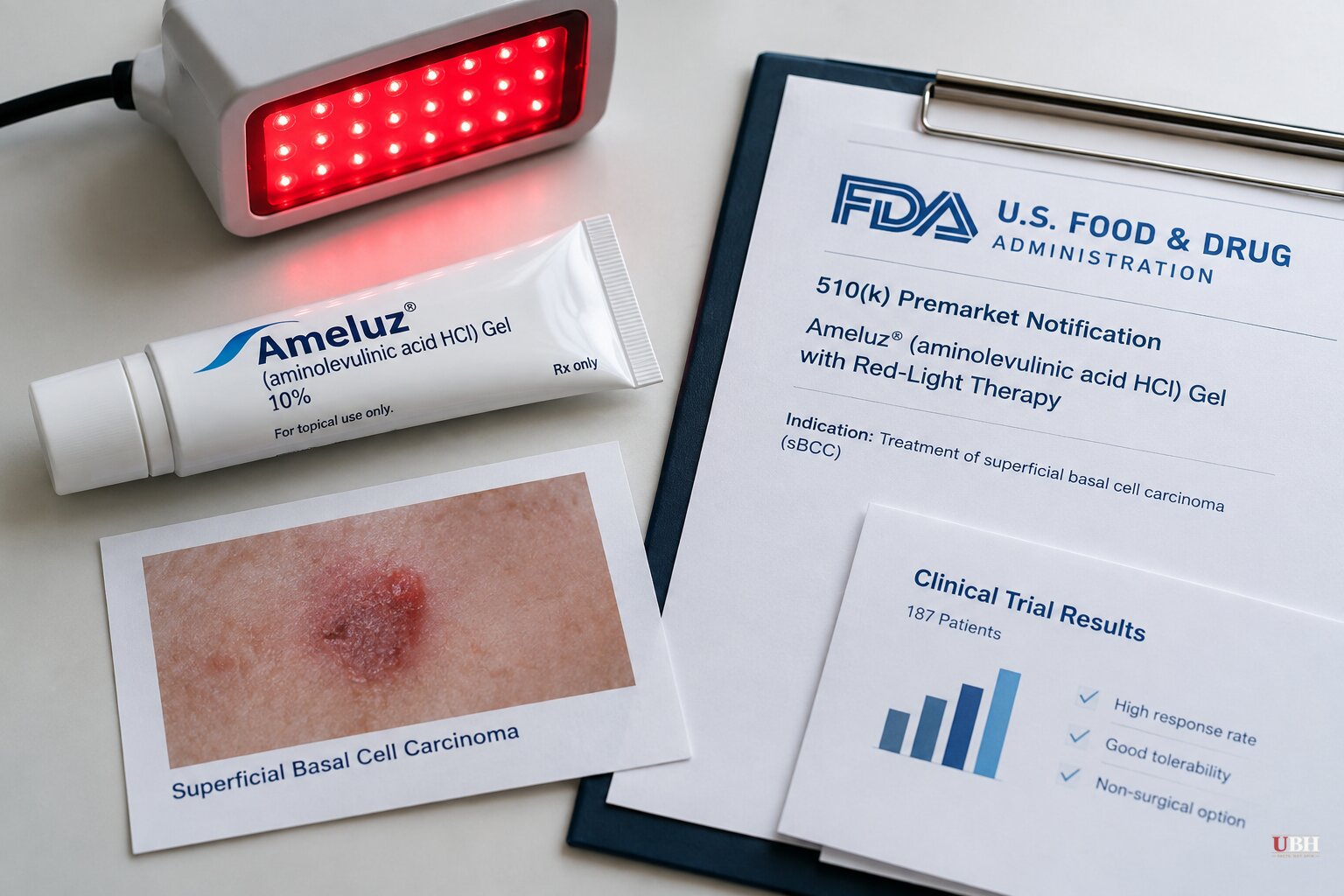
The FDA has approved a light-activated gel treatment for the most common form of skin cancer, giving dermatologists a non-surgical alternative for patients who don't want or can't have surgery.
Biofrontera Inc. (NASDAQ: BFRI) announced Monday, September 14, 2026, that the FDA approved its supplemental New Drug Application for Ameluz, a 10% aminolevulinic acid hydrochloride topical gel, used with the company's BF-RhodoLED red-light lamp, to treat superficial basal cell carcinoma in adults. A healthcare provider applies the gel, then activates it with red light in an in-office procedure known as photodynamic therapy.
This is not Ameluz's first approval. The same gel-and-lamp combination was already cleared for actinic keratosis, a pre-cancerous skin condition, on the face and scalp. Monday's approval extends that to an actual skin cancer for the first time.
The Data Behind the Approval
The approval rests on a multicenter, double-blind, vehicle-controlled Phase 3 trial of 187 adults with confirmed superficial basal cell carcinoma, according to MedPage Today. Twelve weeks after the final treatment cycle, 66% of patients on Ameluz plus photodynamic therapy achieved complete clinical and histological response, compared to just 5% on the inactive vehicle. Both individual components of that composite endpoint, MedPage Today reported, also favored the active treatment, though the outlet did not publish the individual breakdown numbers.
Dr. M. Shane Chapman of Dartmouth Geisel School of Medicine, an investigator on the trial, told MedPage Today the approval fills a real gap. "For many patients with superficial basal cell carcinoma — those with multiple lesions, lesions in cosmetically sensitive locations, or for whom surgery would not be preferred — treatment options have been limited," Chapman said.
How Big Is the Market
Basal cell carcinoma is diagnosed roughly 3.6 million times a year in the U.S., according to the Skin Cancer Foundation, cited in Biofrontera's own announcement carried by GlobeNewswire, BioSpace, Finanznachrichten.de and Business Insider Markets — all of which ran the identical company press release. Published estimates put the superficial subtype at 15% to 20% of those cases, or an estimated 540,000 to 720,000 cases annually.
Biofrontera CEO Hermann Luebbert called the approval "a defining milestone" and said Ameluz is now "the first and only photodynamic therapy approved in the United States to treat a skin cancer." Luebbert said the company plans to launch the new indication commercially "late in the fourth quarter of 2026 through the first quarter of 2027," using its existing sales force and installed lamp base rather than new equipment. That timeline is a company plan, not a confirmed launch date. Biofrontera is a small biopharmaceutical company with a direct financial stake in how this approval is perceived.
The Case for Sticking With Surgery
Surgery remains the standard treatment for basal cell carcinoma, and dermatologists who favor it have a fair point: excision has a long track record and typically requires one procedure rather than the multi-visit photodynamic therapy regimen. Patients weighing the two options should know photodynamic therapy trades a single surgical visit for a series of in-office light treatments. The FDA's own prescribing information lists real trade-offs: application site pain, burning, irritation, swelling, scabbing, and blistering are common. More serious warnings include hypersensitivity reactions, transient memory lapses, and eye injury risk from the red-light device, which is why protective eyewear is required for both patient and clinician.
For patients with multiple lesions, cosmetically sensitive locations, or medical reasons to avoid surgery, that trade-off may be worth it. For others, it may not be. That decision belongs between a patient and their dermatologist.
What's Unresolved
Biofrontera has not published long-term recurrence data beyond the 12-week endpoint in its trial, and it's unclear how the treatment's cure rate will hold up over years compared to surgical excision's established track record. The company's stated launch window, late 2026 into early 2027, is a plan, not a completed rollout. Whether independent dermatology practices actually adopt the RhodoLED lamp at the pace Biofrontera projects remains an open question the next two quarters of earnings calls should answer.
Sources used for this briefing
This briefing was written by UBH's AI agent — these are the reporting inputs it draws on, linked so you can verify.


