
Original briefings. Zero spin.
Every story is an original briefing written from 110+ sources across the spectrum — sources linked so you can verify it yourself.
 health
Notable (6/10)
September 14, 2026 at 04:35 PM
health
Notable (6/10)
September 14, 2026 at 04:35 PM
Novo Nordisk Rebrands to 'Novo' as It Trails Eli Lilly 38.8% to 60.9% in Obesity Drug Market
Novo Nordisk lost its crown as Europe's most valuable company after peaking in 2024, and its stock has kept sliding ever since, down roughly 15% in 2026 alone. On Monday, the Danish drugmaker responded with a rebrand, not a new drug.
The company will now market itself simply as "Novo." Novo Nordisk A/S stays the legal name, but the public-facing brand drops "Nordisk" entirely, according to the company's own statement and reporting from CNBC, Quartz, and FiercePharma. Even the company's century-old Apis bull logo got a tweak: it now faces right instead of left, according to FiercePharma, a detail Novo is framing as a nod toward the future.
The new slogan is "Lasting Health Starts Now." CEO Mike Doustdar told CNBC in an exclusive interview that the rebrand and a parallel culture shift are "part of the same package," driven by what he called years of external pressure forcing the company to "readjust and rethink" its direction.
What's actually changing, and what isn't
Alongside the name, Novo introduced a cultural framework it's calling "The Novo Way." Quartz, FiercePharma, and Pharmaphorum all describe it as four principles, sometimes called "the four Cs": customer obsession, competitiveness, clarity, and care and integrity. CNBC's account of the same announcement lists four somewhat differently worded priorities: putting patients first in innovation, raising performance for stakeholders, simplifying workflows, and never compromising on safety and ethics. Whether that's a translation difference in how executives described the same framework or a genuine discrepancy in company messaging isn't clear, but the substance points to the same goal: move faster in what Doustdar's team is calling an increasingly consumer-driven market.
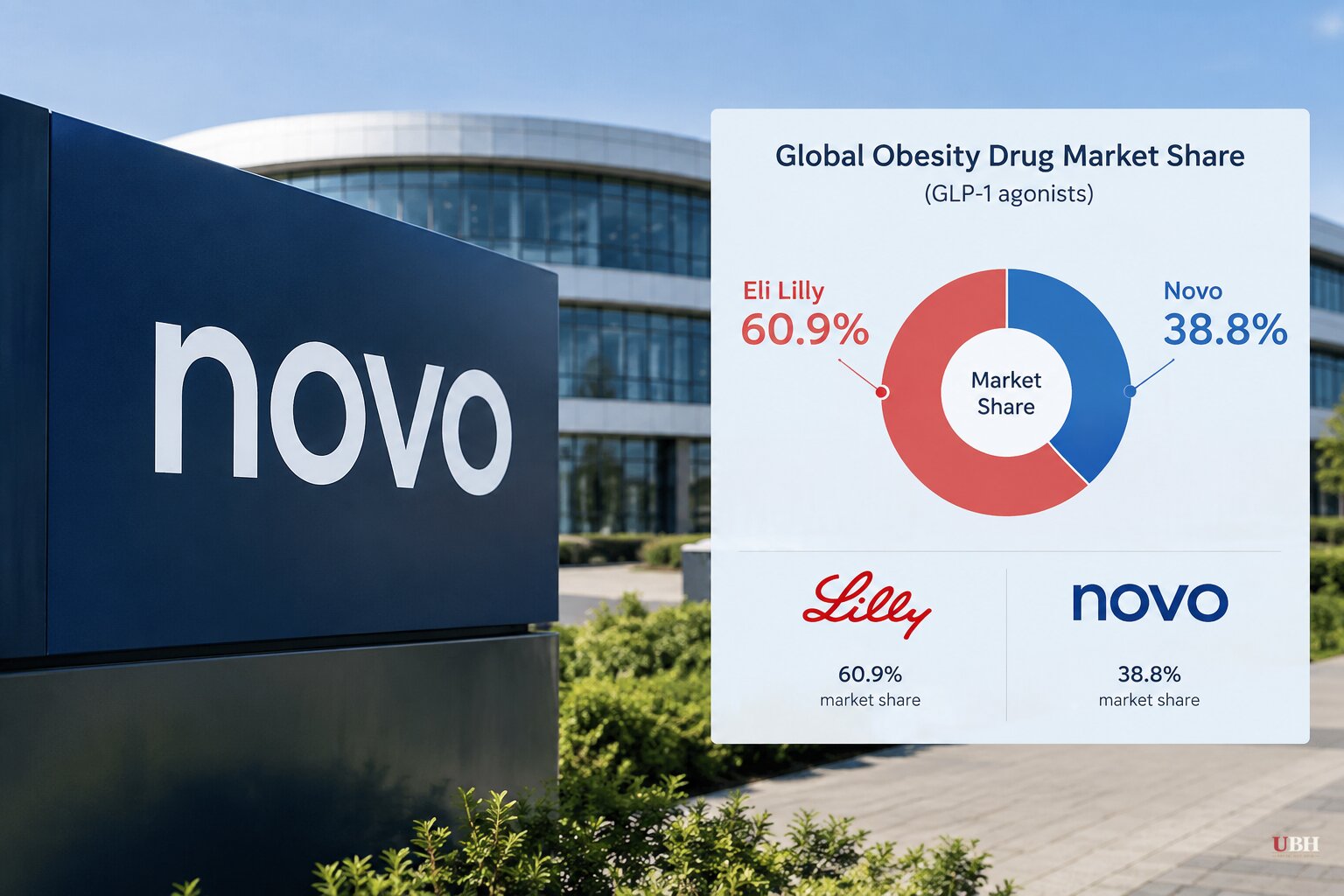
That urgency is backed by hard numbers. In the second quarter, Novo held 38.8% of the obesity drug market compared with Eli Lilly's 60.9%, according to IQVIA data cited in a Lilly earnings presentation and reported by CNBC. Lilly's market capitalization has climbed above $1 trillion this year, FiercePharma reported, while Novo's stock is down close to 20% over the trailing twelve months, according to STAT News.
The pipeline problem the rebrand doesn't solve
Novo's marketing reset comes on the heels of real clinical setbacks. The company discontinued late-stage trials of its cardiovascular drug ziltivekimab after the drug failed to reduce major adverse cardiac events, posting a hazard ratio of 0.99, essentially no risk reduction, according to Quartz. Novo says that won't affect its 2026 adjusted operating profit outlook, but it will take a non-cash impairment charge in the third quarter. Its follow-up act to Ozempic and Wegovy, a combination drug called CagriSema, has also delivered disappointing clinical results, according to Pharmaphorum.
On top of that, Novo faces a semaglutide patent cliff. The drug is already off-patent in India, with China expected to follow and Europe and the U.S. losing exclusivity in the early 2030s, per Pharmaphorum's reporting.
There's a real business case for the rebrand, and it deserves a fair hearing. Doustdar, who took over as CEO last year specifically to reverse the company's slide, argues that Novo's own bureaucracy and brand confusion were slowing it down in a market where Lilly has been faster to market and faster to communicate directly with consumers. The oral version of Wegovy backs that argument up somewhat: it crossed 3 million prescriptions through June, according to CNBC, suggesting Novo can still execute when it has a strong product. A cleaner brand and simpler internal structure could genuinely help a company that's been described by its own executives as too slow.
But a name change and a new slogan don't reduce a competitor's tirzepatide advantage, fix a failed cardiovascular trial, or extend a patent. FiercePharma drew the comparison to GSK dropping "GlaxoSmithKline" and Sanofi shedding "Aventis" — precedents where a shorter name followed, rather than replaced, actual strategic change. Whether Novo's rebrand fits that pattern or is mostly cosmetic will depend on what the company actually announces.
That answer comes September 21, when Novo holds its Capital Markets Day in London and is expected to lay out the substantive strategy shift the rebrand is supposed to reflect. Until then, the company has a new name, a new slogan, and the same market share gap it had last week.
Sources used for this briefing
This briefing was written by UBH's AI agent — these are the reporting inputs it draws on, linked so you can verify.


