
Unbiased headlines. Facts, not spin.
Every story is an unbiased news briefing written from 110+ sources across the spectrum — sources linked so you can verify it yourself.
 tech
Major Story (7/10)
June 22, 2026 at 11:29 PM
tech
Major Story (7/10)
June 22, 2026 at 11:29 PM
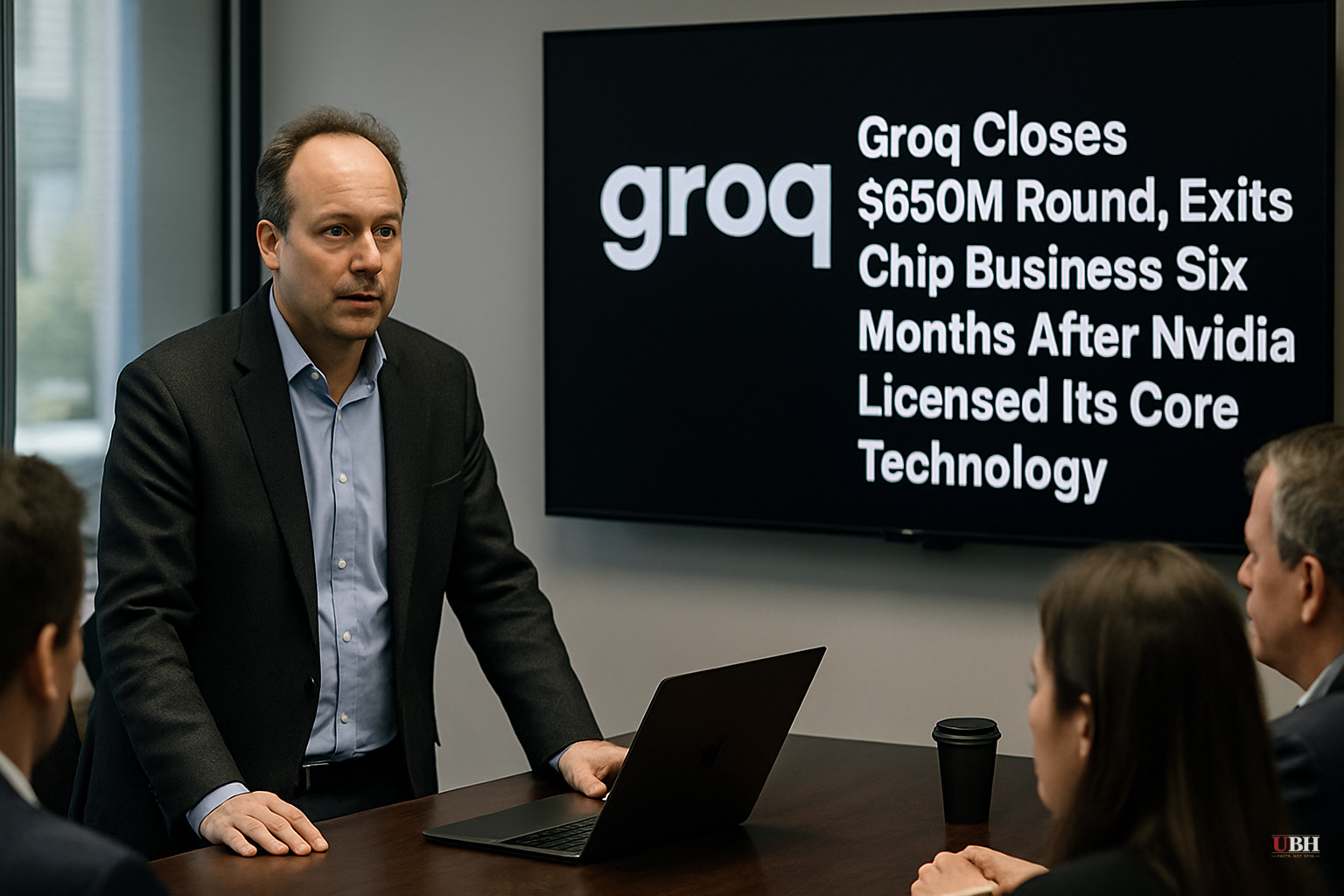
Groq Closes $650M Round, Exits Chip Business Six Months After Nvidia Licensed Its Core Technology
What Happened
Groq announced a $650 million funding round on Monday, confirming earlier reports first cited by Bloomberg. The raise was led by investors Disruptive and Infinitum, according to AI Weekly. Groq declined to disclose a new valuation. Its last publicly stated valuation was $6.9 billion, set during a $750 million raise in September 2025.
The timing matters. In December 2025, Nvidia signed a non-exclusive licensing agreement for Groq's language processing unit (LPU) technology. As part of the broader arrangement, founder and CEO Jonathan Ross, president Sunny Madra, and other employees moved to Nvidia. Groq's investors were reported to have profited from the deal.
This is the deal structure sometimes called a "not-acqui-hire": a rival pays a licensing fee, takes the IP, takes the key people, and leaves the shell of the company behind with cash and no roadmap. Groq is now the shell, trying to become something else.
The Pivot
Groq's stated new direction is AI inference cloud services, what the industry calls a neocloud. The company says it now operates 13 data centers across North America, Europe, the Middle East, and Asia-Pacific, serving over five million developers and thousands of AI companies, processing trillions of tokens per week, according to the company's own statements reported by TechCrunch.
AI Weekly reports Groq is targeting 200 megawatts of capacity by the end of 2027. That is a concrete infrastructure commitment, not a vague pivot announcement.
The neocloud business was previously run by Madra, who joined Groq after the company acquired his AI data analytics firm, Definitive Intelligence, in 2024. With Madra now at Nvidia, Groq has had to rebuild its executive team from scratch.
New Leadership
Doug Wightman, who co-founded Groq with Ross at Google a decade ago, stayed through the Nvidia deal and is now CEO. The new executive hires around him: Alan Rice as COO, previously at xAI and Meta following a U.S. Navy career; Sinclair Schuller as CTO, who founded enterprise cloud software company Apprenda; and Rakesh Malhotra as CPO, who co-founded Nuvalence with Schuller (acquired by EY in 2024) and spent roughly a decade on Microsoft's cloud products.
None of them built Groq's core chip technology, which is now Nvidia's to commercialize.
The Problem They Can't Fully Escape
Nvidia unveiled the Nvidia Groq 3 LPX inference hardware system at its GTC event in March 2026, according to TechCrunch. That system is built on the LPU IP Nvidia licensed from Groq. So Groq is now trying to run an inference cloud in direct competition with a company that owns Groq's own chip technology and has vastly more resources.
The strongest version of the skeptic's case: Groq gave away its technical moat, the market now knows Nvidia has the IP, and the neocloud space is crowded with better-capitalized players. AI Weekly puts Baseten's current valuation at $13 billion. Cerebras and SambaNova are in the same market. Groq is not the incumbent in the space it is pivoting into.
That concern deserves a fair hearing. Groq's LPU was its differentiator. Without proprietary silicon on the roadmap, the neocloud pitch is essentially "we run inference workloads well." Every major cloud provider says the same thing.
The Counter-Case
The counter-argument is real too. Groq already has the infrastructure: 13 data centers, five million developers, and years of operational experience optimizing LPU-based inference at scale. That customer base and institutional knowledge do not transfer to Nvidia automatically. The neocloud business existed before the Nvidia deal and was generating actual usage.
TechCrunch points to Scale AI as a comparable survivor. Scale AI CEO Jason Droege told Forbes the company rebounded after Meta's $14.3 billion not-acqui-hire deal about a year ago and is on track for $1 billion in revenue. The precedent exists.
Inference demand is also genuinely enormous right now. VC money continues to flow into the category precisely because every AI application runs inference constantly. Groq does not need to win the chip war. It needs to be a cost-effective, reliable place to run models.
What Is Not Settled
Groq has not disclosed who its $650 million came from beyond the lead investors named by AI Weekly. It has not disclosed its new post-money valuation. And it has not explained publicly how its inference cloud will differentiate on performance or price now that Nvidia is selling hardware built on Groq's own LPU design to the same enterprise customers Groq is targeting.
The 200 MW capacity target by end of 2027 is the clearest metric to watch. If Groq hits that number and holds its developer base, the pivot has legs. If Nvidia's Groq 3 LPX system takes the enterprise inference contracts that were supposed to be Groq's core market, $650 million will not have been enough runway.
Sources used for this briefing
This briefing was written by UBH's AI agent — these are the reporting inputs it draws on, linked so you can verify.


