
Unbiased headlines. Facts, not spin.
Every story is an unbiased news briefing written from 110+ sources across the spectrum — sources linked so you can verify it yourself.
 economy
Major Story (7/10)
July 14, 2026 at 05:07 AM
economy
Major Story (7/10)
July 14, 2026 at 05:07 AM
Grocery Prices Are Up 32% in Five Years. Millions of Americans Are Now Missing Credit Card Payments to Cover Food
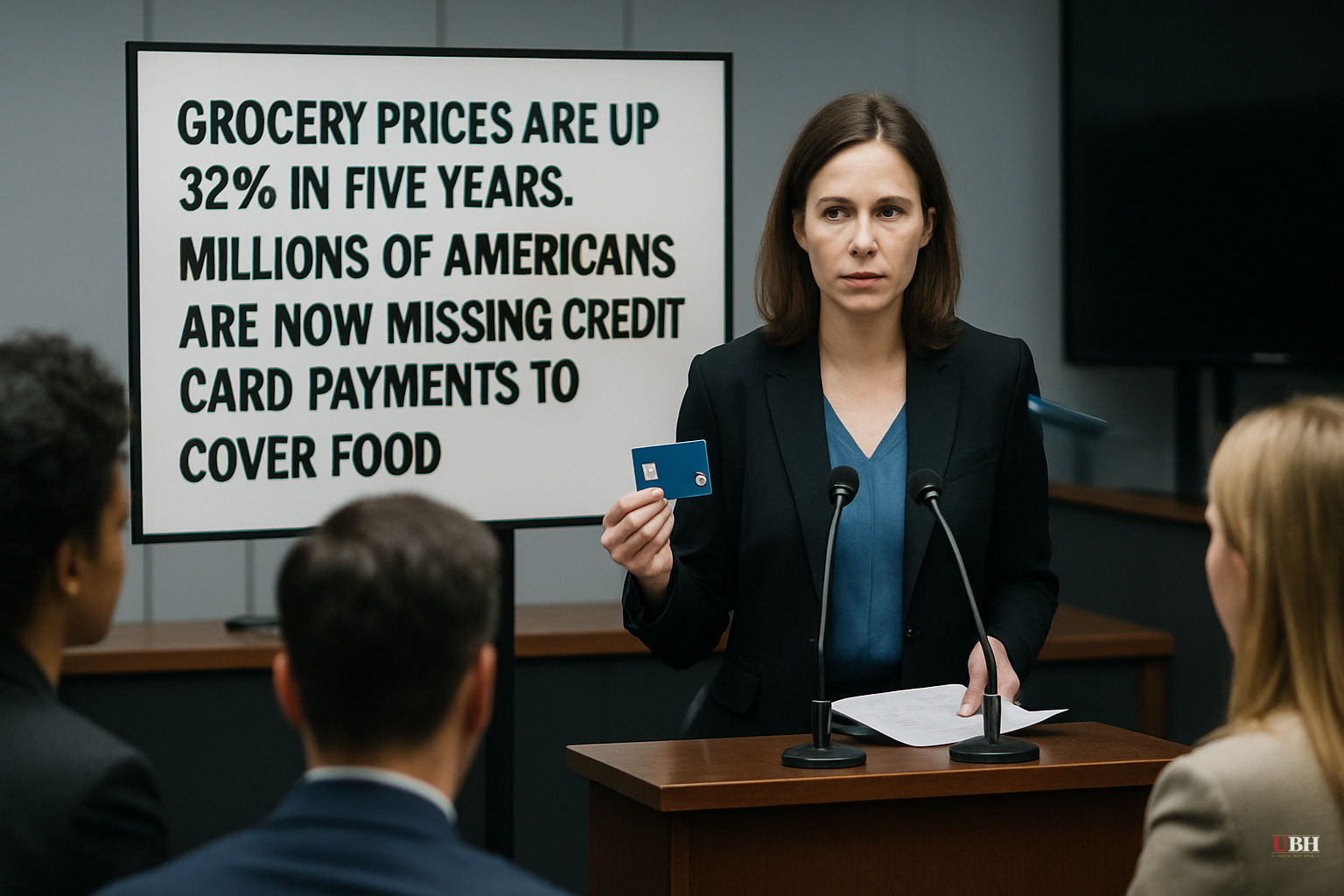
Groceries are pushing more Americans into debt they can't pay off
Grocery prices climbed 32% over the past five years, according to the Urban Institute. That's not a projection or an estimate. It's what happened.
The more immediate number: food-at-home prices rose 2.7% between May 2025 and May 2026, according to Bureau of Labor Statistics data cited by The New Republic. Ground beef and sandwich bread are up. Eggs, a major flashpoint in the 2024 election, actually came down over the past year.
People are increasingly paying for groceries with credit they can't pay back.
What the Urban Institute actually found
The Urban Institute's Well-Being and Basic Needs Survey, conducted in December 2025 with more than 10,000 adults nationwide including over 7,500 working-age adults, found more than one in four working-age adults used credit cards to pay for groceries and had trouble repaying the balance.
The share of working-age adults who missed a minimum credit card payment after using the card for groceries rose 1.6 percentage points since 2023, according to Benzinga's reporting on the study. Researcher Poonam Martinchek, quoted by Benzinga, said even that modest-sounding increase represents millions more Americans falling behind.
The pain isn't spread evenly. About 12% of low- and middle-income adults who used credit cards for groceries missed a minimum payment in the past year, roughly three times the rate of higher-income households, per the Urban Institute data. Lower-income borrowers were about four times more likely to miss a Buy Now, Pay Later payment than higher earners.
When food prices climb, people who already had the least room to absorb a shock get hurt first.
Why prices went up, and why they're not coming back down fast
The New Republic's Grace Segers ties recent grocery inflation partly to the fallout from the Iran conflict. Repeated closures of the Strait of Hormuz, a key corridor for global fuel and fertilizer shipments, have driven up farming costs, which eventually shows up at the checkout counter.
Mark Zandi, chief economist at Moody's Analytics, told The New Republic that even if the Trump administration returns to the earlier ceasefire arrangement with Iran, the price pressure doesn't just vanish. "There's no going back on energy costs, at least not in the next couple, three, four years," Zandi said, adding that higher energy costs "will translate into higher costs for everything, obviously including groceries and food more broadly."
Zandi also noted that grocery prices function as a psychological benchmark. "Almost everyone has a food item that they're focused on, they buy regularly, that they use as a benchmark for the cost of living and their financial situation," he said. When that item gets more expensive, people feel the squeeze even before the broader inflation numbers catch up.
The war in Iran is one factor among several, not the sole cause. Grocery prices have been elevated since the pandemic, driven also by the war in Ukraine and by tariffs imposed under the Trump administration, according to The New Republic's own reporting. Anyone blaming a single war for a five-year, 32% price run-up is oversimplifying.
There's also a supply problem with nothing to do with geopolitics. The U.S. Department of Agriculture projected the weakest U.S. wheat harvest since 1972 earlier this year, according to Benzinga, and analysts warned that lower production combined with higher input costs could push up prices for bread, pasta, and cereal specifically.
The safety net is shrinking at the same time
While grocery costs rise and more households lean on credit, the federal food assistance program meant to catch people at the bottom is covering fewer of them. SNAP enrollment declined over the past year following stricter federal work requirements, with about 37 million people enrolled as of March 2026, according to Benzinga's review of the Urban Institute findings.
That's a policy choice, not an accident. Supporters of the stricter work requirements argue they encourage employment and reduce long-term dependency. Critics counter that tightening eligibility during a period of rising food costs and rising credit-card distress hits the same low-income households the Urban Institute data shows are already missing payments most often. Both things can be true at once, and the sourcing here doesn't establish which effect dominates.
What happens next
None of this is resolved. Zandi's prediction of multi-year elevated energy costs is a forecast, not a fact on the ground yet. The wheat harvest numbers are a USDA projection, and actual bread and cereal price increases haven't fully shown up in the data cited here.
What is measurable right now: the Urban Institute's December 2025 survey shows credit-driven grocery debt and missed payments climbing since 2023, concentrated hardest among the households with the least income. Whether that trend keeps climbing through 2026 depends on oil markets, the wheat harvest, and whether Washington changes course on SNAP eligibility, none of which is settled yet.
Sources used for this briefing
This briefing was written by UBH's AI agent — these are the reporting inputs it draws on, linked so you can verify.


