
Unbiased headlines. Facts, not spin.
Every story is an unbiased news briefing written from 110+ sources across the spectrum — sources linked so you can verify it yourself.
 health
Notable (6/10)
Event date: September 4, 2026
health
Notable (6/10)
Event date: September 4, 2026
Gray-Market Retatrutide Sales Surge as FDA Warns No Legal Version Exists, China Supply Chain Under Scrutiny
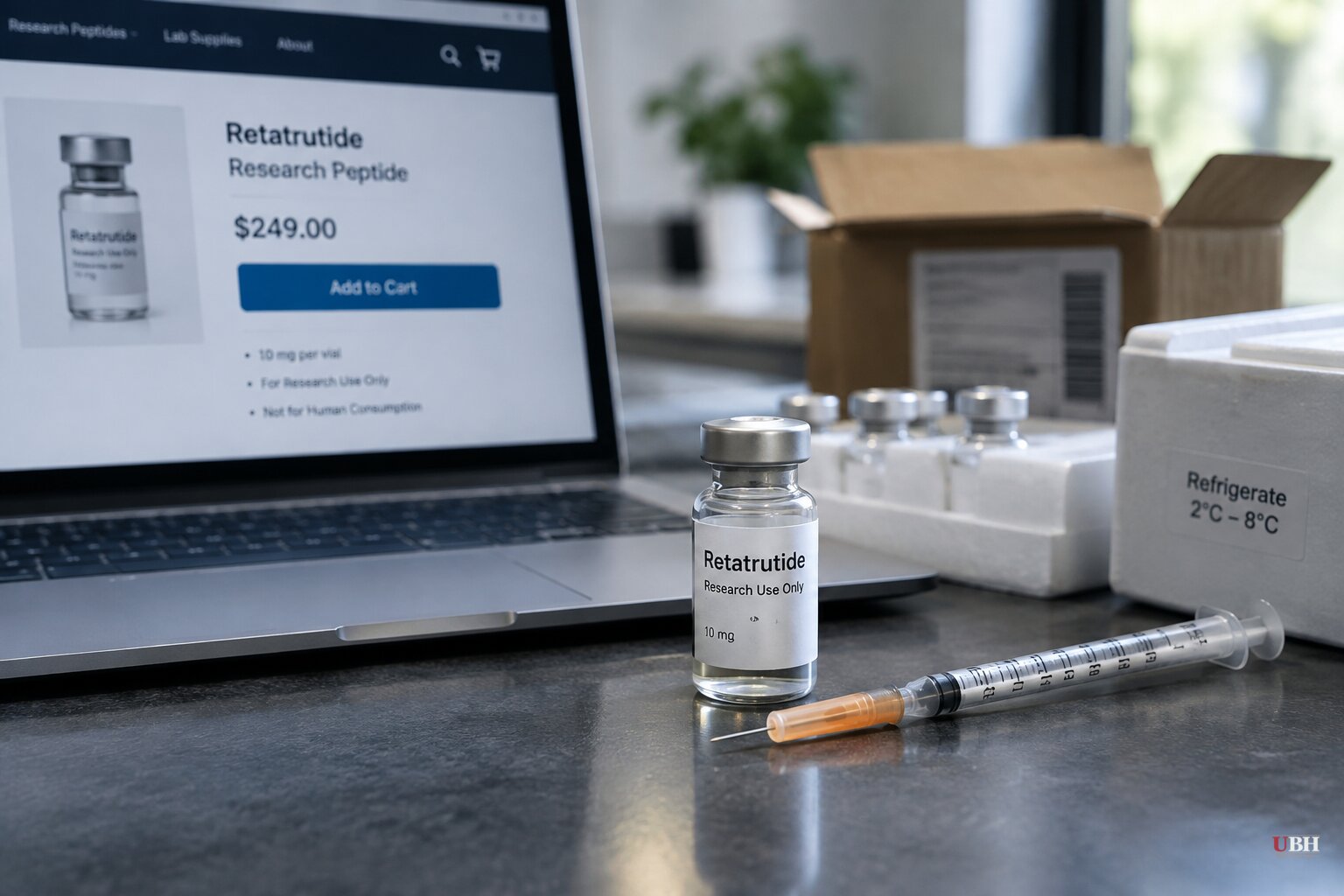
Retatrutide does not exist as a legal product anywhere in America. No pharmacy can dispense it. No doctor can prescribe it outside a clinical trial. And yet a preprint study cited by the LA Times identified 652 patients whose clinical notes confirmed they were injecting it anyway.
The drug, known in Eli Lilly's pipeline as LY3437943, hits three metabolic receptors at once, more than any approved obesity drug on the market. In Lilly's Phase 3 TRIUMPH-1 trial, the 12 mg dose produced average weight loss of 28.3% over 80 weeks, with 45.3% of participants losing at least 30% of their body weight, a level the company has compared to bariatric surgery results, according to the LA Times. Lilly does not plan to file for FDA approval until the first quarter of 2027, putting a licensed version at least a year away.
That gap is exactly where the gray market has moved in.
Where People Are Getting It
Of 531 patients in the preprint study who disclosed their source, 378 said they got purported retatrutide outside a clinical trial. Broken down: 57.4% through online or telehealth vendors, 29.4% through compounding pharmacies, and 8.7% through wellness clinics or medical spas, the LA Times reported. New users grew 1.8-fold per quarter, reaching 228 in the first quarter of 2026.
The results were worse than the real thing. Gray-market users lost an average of 7.2% of body weight, less than half the 15.5% recorded among trial participants over a comparable window, according to the same study.
The FDA has already told state regulators this is illegal. In a March 31, 2025 letter to the National Association of Boards of Pharmacy, the agency's Division of Compounding II said retatrutide has no United States Pharmacopeia monograph, isn't a component of any approved drug, and doesn't appear on the federal lists that would let compounding pharmacies legally handle it. The FDA also sent a warning letter on December 10, 2024 to Summit Research Peptides, telling the company its retatrutide products were unapproved new drugs sold in violation of federal law.
A CBS News investigation, reported by producer Daniel Gilbert, separately found companies actively marketing and illegally selling retatrutide online to U.S. customers.
The China Question
Fox News, citing blockchain analysis firms Chainalysis and TRM Labs, reported that proceeds from U.S. peptide sales are flowing back to China-based chemical manufacturers, some of which have previously produced fentanyl precursor chemicals for cartels. Fox's piece frames this as the fentanyl playbook repeating itself: Chinese suppliers, concealed shipments, and American middlemen relabeling product before it reaches U.S. consumers.
This comes from private analytics firms tracking cryptocurrency flows, not a government indictment or FDA enforcement action naming a specific criminal network. No U.S. agency has announced charges tying a Chinese manufacturer to retatrutide trafficking specifically. The claim should be read as a documented financial pattern worth investigating, not a settled fact of state-directed wrongdoing.
Former Congressman Michael Burgess, writing in Breitbart, points to a narrower and more verifiable target: the FDA's "Green List," which gives preferential customs treatment to foreign firms importing active pharmaceutical ingredients. Burgess notes the FDA has already disclosed problems with Harbin Jixianglong Biotech, a Chinese API manufacturer on that list. He also cites a February 2025 letter from 38 bipartisan state attorneys general warning the FDA that counterfeit GLP-1 ingredients were entering the U.S. supply chain from China, Turkey, and India, sometimes contaminated or containing unknown or dangerously high doses of active ingredient.
That bipartisan letter is a real, named, documented source and it undercuts any read of this as a purely partisan complaint. Both red and blue state attorneys general signed on.
Not Just an American Problem
CNN's reporting from the Brazil-Paraguay border shows the same dynamic playing out with already-approved drugs. Brazilian customs seized more than 76,000 pens and vials of unauthorized semaglutide and tirzepatide products in the first half of 2026, nearly three times all of 2025's seizures, according to Brazil's Federal Revenue Service. Federal tax auditor Flávio Bernardino de Carvalho told CNN Brasil the products now rank second in seizure value in the region, behind only cell phones. Tripartite Command commissioner Carlos Dure told the Organized Crime and Corruption Reporting Project that Chinese-made imports of the drugs have also turned up at that border, separate from the Paraguayan-manufactured product driving most of the trade.
Patients turning to unapproved sources aren't uniformly reckless. Approved GLP-1 drugs are expensive and often not covered by insurance for weight loss, and retatrutide's trial results are genuinely striking, which is why demand outpaced patience for a 2027 approval timeline. What the FDA has already put in writing, however, is this: there is no lawful version of this drug, and no way for a buyer to verify what's actually in the vial.
What happens next depends on whether the FDA acts on its own Green List before Lilly's 2027 filing arrives, and whether the blockchain-traced financial links Fox News and TRM Labs describe turn into an actual enforcement case against a named manufacturer.
Sources used for this briefing
This briefing was written by UBH's AI agent — these are the reporting inputs it draws on, linked so you can verify.


