
Unbiased headlines. Facts, not spin.
Every story is an unbiased news briefing written from 110+ sources across the spectrum — sources linked so you can verify it yourself.
 health
Notable (6/10)
Event date: September 16, 2026
health
Notable (6/10)
Event date: September 16, 2026
FDA Adds New Warning to Kybella Fat-Dissolving Shots After 129 Adverse Events From Off-Label Use
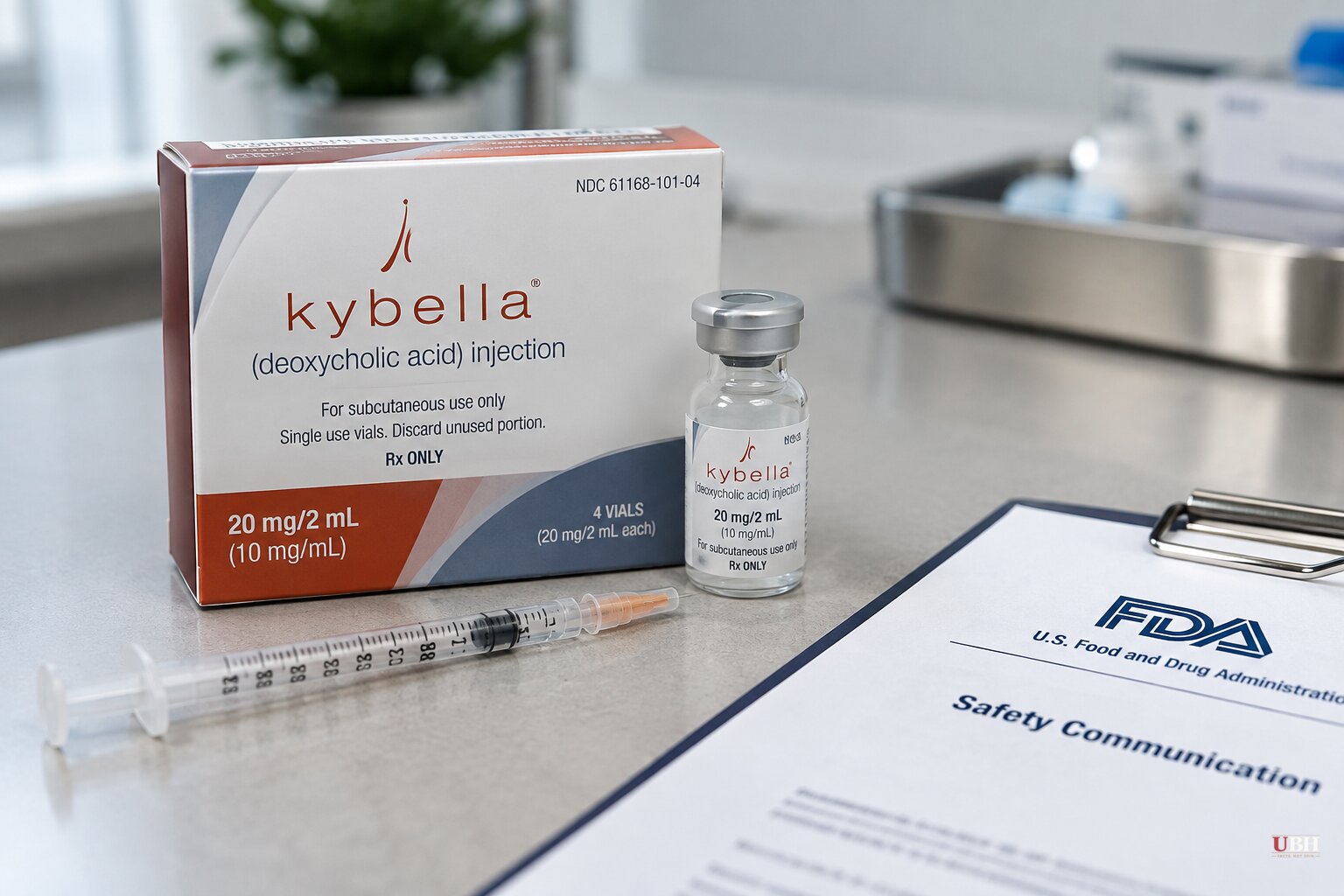
The FDA approved a new safety warning for Kybella on September 15, 2026, after a review of adverse event reports tied to using the double-chin fat dissolver in places it was never approved to treat.
Kybella, generic name deoxycholic acid, has been FDA-approved since 2015 for one specific purpose: reducing moderate-to-severe fat under the chin. A generic version of the drug is also approved. The agency has never signed off on using it anywhere else on the body, and it said so again in this latest communication, recommending against off-label use in plain terms.
What the FDA found
The agency's review of its Adverse Event Reporting System, now called the FDA Adverse Event Monitoring System, turned up 129 cases of adverse events linked to deoxycholic acid injections given outside the submental (under-the-chin) area since the drug's 2015 approval, according to the FDA's drug safety communication and reporting by MedPage Today.
Some of those cases were serious. The FDA listed blurred or reduced vision and involuntary eye contractions in patients who received injections near the eyes, along with muscle and nerve damage, facial paresis, paresthesia, weakness, numbness, and difficulty walking.
Separately, the same FAERS review identified 117 cases of injection-site nodules or masses, defined as 3 centimeters or smaller for nodules and larger than 3 centimeters for masses, that had not resolved after an average of 143 days. Unlike the neuromuscular injuries, these lumps showed up both in patients who got the shots off-label and in patients who received them exactly as approved, under the chin. The FDA said persistent nodules and masses may require medical intervention to resolve.
How the drug is supposed to be used
Under its approved labeling, Kybella is meant to be administered only by health care providers, in up to six treatment sessions spaced at least a month apart, with a maximum of 50 injections per session. The FDA's original 2015 approval already warned that some clinical trial patients developed nerve injury in the jaw, causing facial muscle weakness, asymmetrical expressions, and trouble swallowing, even when the drug was used as intended.
The case for off-label use, and why the FDA says no here
Off-label prescribing is legal and common across American medicine. Physicians routinely use FDA-approved drugs for conditions or body sites outside the specific approval, relying on clinical judgment when they believe the benefit outweighs the risk. That's a real and legitimate feature of how doctors practice, not a loophole.
But the FDA's position here is that it looked at actual outcomes data, not theory, and found a specific safety signal when this particular drug is injected outside the chin: vision problems, facial nerve damage, and difficulty walking that weren't part of the approved-use risk profile in the same way. The agency isn't arguing off-label use is inherently illegitimate. It's arguing this drug, in these unapproved locations, produced serious injuries in a meaningful number of documented cases.
What this doesn't cover
This labeling update is separate from a 2023 FDA warning about unapproved fat-dissolving substances sold online, which covered counterfeit or unregulated injectables marketed for the chin, back, thighs, upper arms, and stomach, and which the agency linked to painful knots, permanent scars, and serious infections. MedPage Today referenced that 2023 warning alongside this new communication, but it involved different, non-FDA-approved products entirely, not off-label use of an approved drug like Kybella. Readers shouldn't conflate the two: one is about misuse of an approved medicine, the other is about people buying unregulated knockoffs.
What happens next
No recall has been issued. No investigation or enforcement action against specific clinics or providers has been announced by the FDA. The change is limited to the drug's labeling, adding the neuromuscular risk language and the nodule-and-mass warning to the Warnings and Precautions section.
The FDA's guidance to patients is direct: if you experience these symptoms after a deoxycholic acid injection, anywhere on the body, seek medical attention. Whether medical spas and cosmetic clinics offering off-label body-contouring injections change their practices in response to this label update is, for now, an open question the agency hasn't addressed.
Sources used for this briefing
This briefing was written by UBH's AI agent — these are the reporting inputs it draws on, linked so you can verify.


