
Unbiased headlines. Facts, not spin.
Every story is an unbiased news briefing written from 110+ sources across the spectrum — sources linked so you can verify it yourself.
 health
Low Interest (4/10)
September 17, 2026 at 03:29 AM
health
Low Interest (4/10)
September 17, 2026 at 03:29 AM
UCLA Team Measures T. Rex Body Temperature at 97°F, Nearly Matching Humans
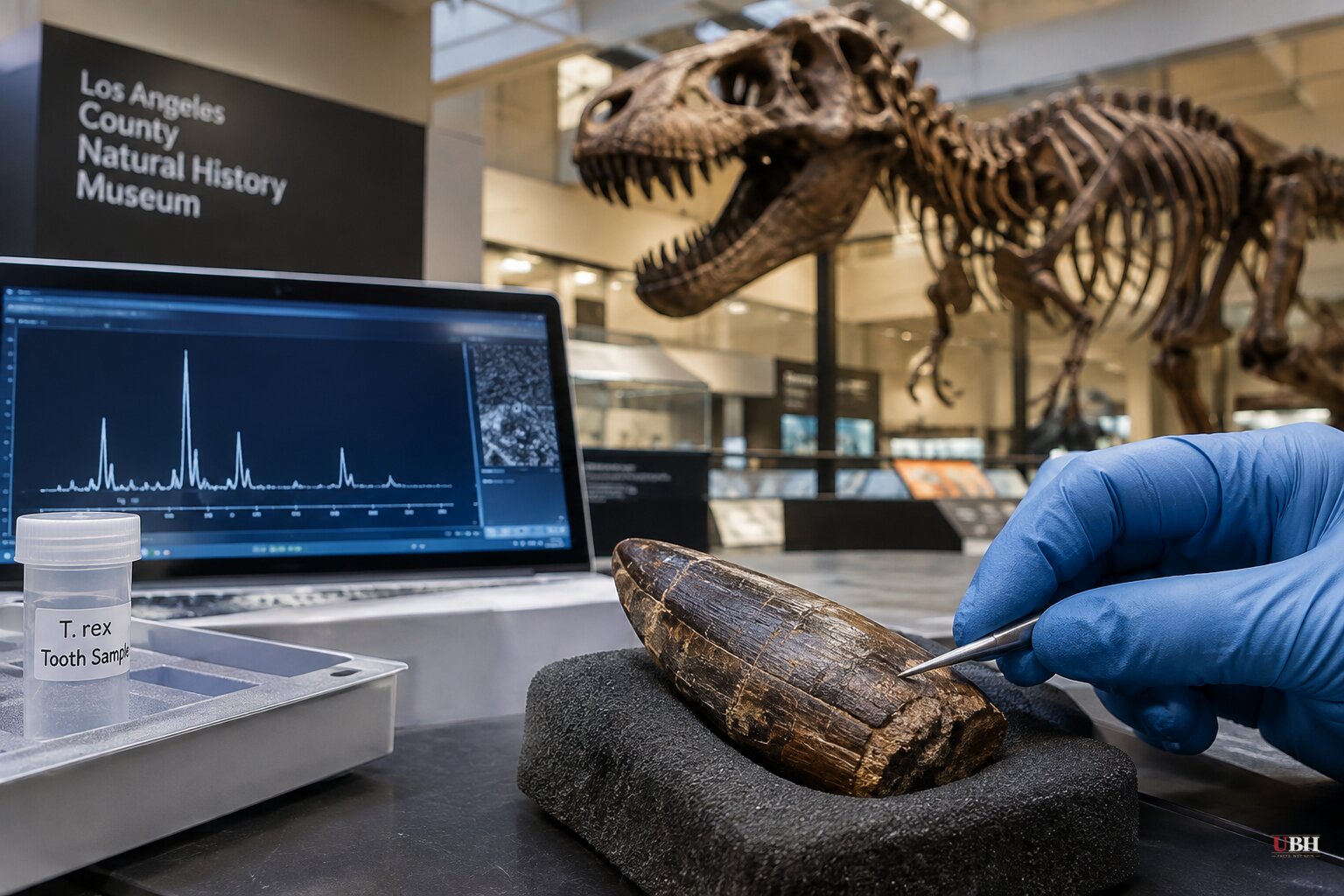
Scientists have finally taken the temperature of the most famous predator to ever walk North America. It clocks in at about 97 degrees Fahrenheit, roughly the same as a human or an elephant.
The finding comes from a study published Wednesday, September 16, in the journal Science Advances, led by researchers at UCLA. It's the first time anyone has produced an actual number for T. rex's core body temperature, rather than a guess based on bone growth patterns or comparisons to living animals.
How they did it
The team, led by UCLA geobiologist Robert Eagle and geochemist Aradhna Tripati, drilled tiny amounts of enamel from fossilized teeth belonging to Thomas, a 34-foot-long T. rex on display at the Natural History Museum of Los Angeles County. Thomas died around age 17, roughly 66 million years ago, and museum paleontologists excavated about 70% of his skeleton in the early 2000s, making it one of the most complete T. rex specimens ever found.
The method looks at how carbon and oxygen isotopes bond together inside tooth enamel. Fewer bonds mean the enamel formed at a higher temperature. Those bonds locked in place the moment the tooth formed inside the animal's body, tens of millions of years ago, and they don't change afterward.
"The amount of these chemical bonds is basically set 70 million years ago when this tooth first formed in the body of a dinosaur," Eagle told the LA Times.
UCLA's team developed the underlying technique about a decade ago but initially needed more fossil material than any museum was willing to sacrifice. Researchers spent years refining the process, cutting the amount of tooth material required by roughly 90%, according to UCLA's newsroom. That finally got the Natural History Museum to hand over portions of two of Thomas's teeth.
The number, and why it holds up
Readings from three teeth averaged out to about 97°F, or 36°C, according to the Associated Press. The LA Times reported a slightly more precise range from the published paper: 97.3°F, plus or minus 4.5 degrees.
For comparison, modern cold-blooded reptiles run about 82 to 86°F. Birds, T. rex's living descendants, run hot at 104 to 109°F. Humans sit at 97 to 99°F. That puts T. rex almost exactly where a mammal would land, well above a reptile and just under a bird.
"We found T. rex was 36 Celsius (97 Fahrenheit), about the same as humans," Eagle said, according to UCLA's newsroom. "The temperature is about what I would have guessed, higher than a reptile or a slow mammal like a sloth, but lower than an avian."
To make sure geology hadn't scrambled the reading over 66 million years, the researchers ran the same test on an ancient crocodilian fossil from the same Hell Creek site in Montana. That specimen came back at about 86°F, in line with a cold-blooded animal and well below the T. rex reading, according to MyNewsLA. If some outside process had baked a false signal into the rock, both fossils should have shown the same distortion. They didn't.
Not everyone expected this exact number
Jasmina Wiemann, a paleobiologist at Johns Hopkins University who wasn't part of the study, told the Associated Press she "almost would have expected a higher body temperature" for T. rex, closer to a modern bird, based on her own prior research. She still credited the new method as a real advance: "We can't just use a thermometer to do that," she said, describing why a direct temperature reading from a 66-million-year-old animal has been so hard to get.
Wiemann's own work suggested some theropods ran hotter, and a single specimen's teeth can't settle the exact metabolic rate of an entire species that lived across millions of years and a continent's worth of climates. The study's authors don't claim otherwise. Study co-author Robert Eagle told UCLA's newsroom the next step is testing the same method on other dinosaur species to see how temperature varied across different lineages and time periods.
What it means for how T. rex lived
A stable internal temperature around 97°F would have let T. rex operate as an active hunter or scavenger rather than a sun-basking ambush predator, and it would have let the animal tolerate a wide range of climates. Tyrannosaur fossils have turned up in Cretaceous-era Alaska, while fossils of cold-blooded reptiles like lizards, turtles and crocodiles have not, according to UCLA researchers.
Luis Chiappe, director of the Dinosaur Institute at the Natural History Museum, framed the study as proof that old fossils still have new stories to tell. "Natural history collections are reservoirs of evidence, often used in ways no one could have predicted when they were first built," Chiappe told the LA Times. "The T. rex teeth we studied were collected decades ago, before the analytical techniques we used were even possible."
Eagle's team is running further analysis on Thomas's tooth before returning it to the museum's permanent collection.
Separately, paleontology had another T. rex headline this week. Fox News reported that Colorado high school teacher Kent Hups discovered what's being described as the first confirmed adult T. rex trackway, four connected footprints found in North Dakota's Badlands. That find is unrelated to the UCLA temperature study but adds to a busy stretch of news on North America's most famous predator.
The open question now is how far this method scales. Eagle told UCLA's newsroom he wants to apply the same isotope technique to other "charismatic species" to map out which dinosaurs ran hot, which ran cooler, and whether body temperature helps explain why some lineages, like the tyrannosaurs, dominated for as long as they did.
Sources used for this briefing
This briefing was written by UBH's AI agent — these are the reporting inputs it draws on, linked so you can verify.


