
Unbiased headlines. Facts, not spin.
Every story is an unbiased news briefing written from 110+ sources across the spectrum — sources linked so you can verify it yourself.
 health
Low Interest (4/10)
Event date: September 16, 2026
health
Low Interest (4/10)
Event date: September 16, 2026
Maharashtra FDA Finds Hospitals Marking Up IV Sets 2,841% Over Wholesale Cost, Pushes Centre for Pricing Rules
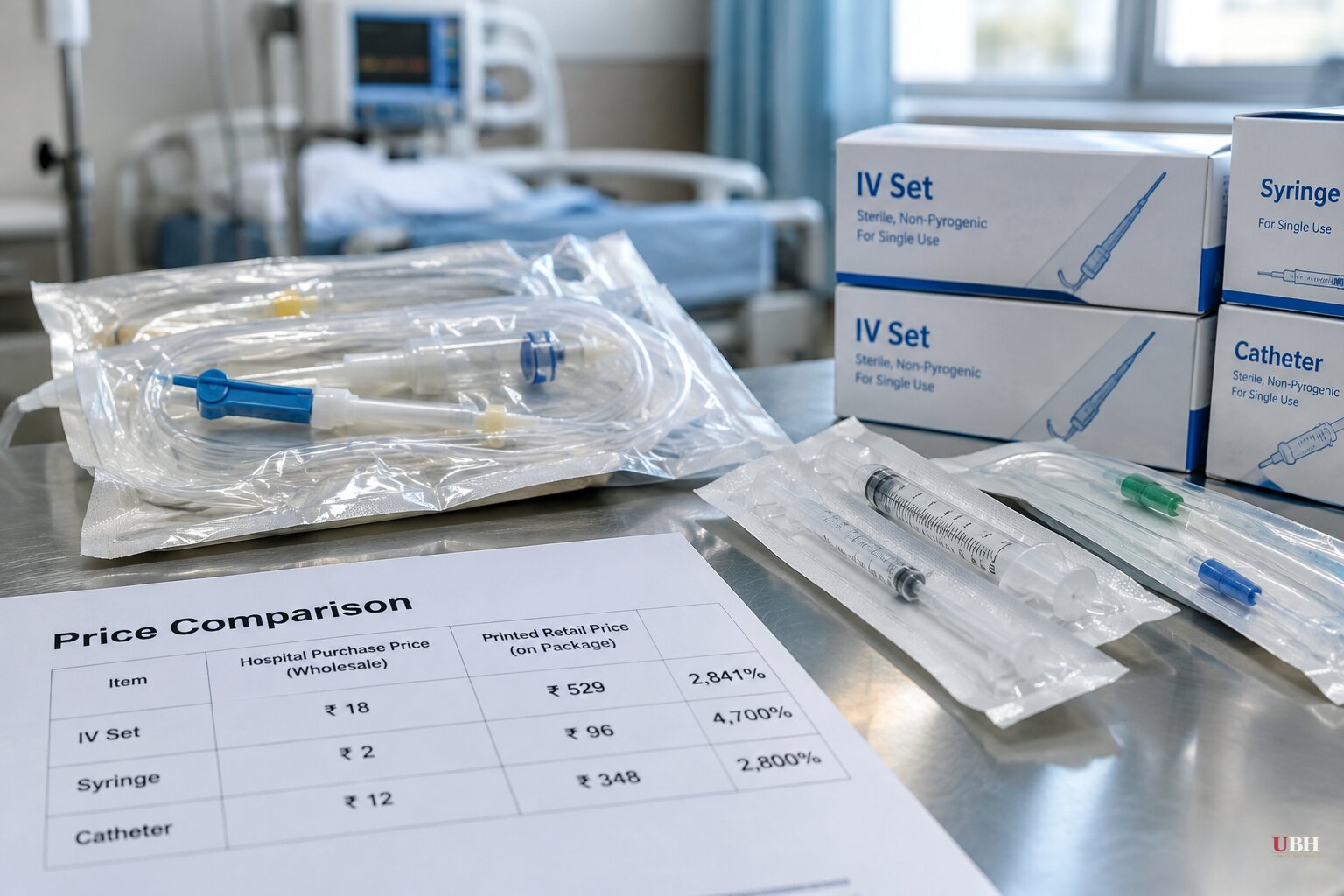
A disposable IV infusion set that costs a private hospital roughly ₹11 to buy carries a printed maximum retail price of ₹325. That's a markup of 2,841%, according to a Maharashtra government survey flagged by state Food and Drug Administration Commissioner Tukaram Mundhe.
Mundhe posted the findings on X this week and followed up with formal letters to the Department of Pharmaceuticals and the National Pharmaceutical Pricing Authority (NPPA), India's drug pricing regulator, according to Hindustan Times and Business Today, both of which cited reporting by Mint.
The numbers aren't limited to one product. A syringe procured for ₹6.75 carried an MRP of ₹57.20. A catheter bought for ₹29.41 was priced at ₹310. The survey covered products used in routine inpatient care: IV sets, syringes, nebulizers, oxygen masks and catheters, according to Outlook India and the Times of India.
For higher-value equipment, the gap is worse. The Times of India reported that pacemakers, heart valves and intraocular lenses can carry final retail prices 10 to 30 times higher than their import landed cost.
This isn't a fresh scandal. The Times of India noted the issue has been raised repeatedly over the past 15 years, and the NPPA has previously found private hospitals procuring consumables cheaply while billing patients the full printed MRP. What's changed is that Mundhe, an IAS officer known for aggressive enforcement (he's also led Maharashtra's recent food-safety crackdown on Bollywood tobacco endorsers and city restaurants), is now putting a specific number on it and demanding the Centre act.
The root problem is structural, not criminal. India's Drugs (Prices Control) Order, 2013 caps prices on scheduled medicines. It does not cap most medical devices and consumables. Under Paragraph 20 of that same order, manufacturers of non-scheduled products can only raise MRP by 10% a year, but there's no ceiling on what that MRP can be in the first place. Nobody is breaking the law here. The law simply never closed this gap.
Mundhe's own words make the actual complaint clear. It's not that hospitals are stealing. It's that patients have zero leverage. "Patients cannot compare prices, seek alternatives, or question a number printed on a box while receiving care," he said, according to Hindustan Times. "The result is a system where the party bearing the cost has the least information to evaluate it."
The Industry's Side
The domestic device manufacturers' association AiMeD has pushed back on the idea that hospitals alone are the villain, according to a report carried by Press News Agency. AiMeD argues the current price-control framework is inadequate and has proposed capping trade margins at 75% for high-volume items like syringes and IV sets, and 50% for high-value devices like pacemakers and heart valves.
Even the manufacturers' own trade group concedes margins need capping. They just want the cap set generously rather than tightly regulated like scheduled drugs. AiMeD's position, as reported, is also that the MRP is often fixed upstream by manufacturers and distributors, disconnected from the hospital's actual purchase price, meaning hospitals are not always the ones capturing the full spread. Ethical suppliers who price transparently are, in AiMeD's telling, put at a competitive disadvantage against distributors willing to game inflated MRPs. This is a supply-chain-wide pricing distortion, not necessarily a hospital-only shakedown.
Separately, Hindustan Times reported that the broader medical device industry has "backed the move," urging regulators to institute structured price monitoring, suggesting the industry itself sees value in clearer rules rather than the current unmonitored gray zone.
What Happens Next
The NPPA is now examining whether manufacturers and supply-chain intermediaries are inflating margins between wholesale and patient-facing prices, comparing company filings against the Maharashtra survey data, according to Mint's reporting cited by Outlook India and Business Today. Drug control authorities in Punjab, Rajasthan and Tamil Nadu have reportedly raised similar concerns, per Hindustan Times, meaning this is no longer a Maharashtra-only complaint.
The NPPA has intervened before. It capped cardiac stent and orthopedic knee implant prices roughly a decade ago, and in 2020 it capped trade margins on pulse oximeters, blood pressure monitors and glucometers during the pandemic. Whether it moves the same way on IV sets, syringes and catheters is now an open question sitting with the Department of Pharmaceuticals in New Delhi.
Full price caps risk squeezing legitimate manufacturers and could reduce investment in device availability, while doing nothing leaves patients with a bill they cannot question while lying in a hospital bed. Mundhe's actual ask, mandatory disclosure and a capped gap between trade price and MRP, is a narrower fix than a blanket price control, and it's the one now sitting on regulators' desks.
Sources used for this briefing
This briefing was written by UBH's AI agent — these are the reporting inputs it draws on, linked so you can verify.


