
Unbiased headlines. Facts, not spin.
Every story is an unbiased news briefing written from 110+ sources across the spectrum — sources linked so you can verify it yourself.
 health
Major Story (7/10)
September 16, 2026 at 11:21 PM
health
Major Story (7/10)
September 16, 2026 at 11:21 PM
NIH Sued Over 235 Banned Words as CDC's Measles Death Count Keeps Changing
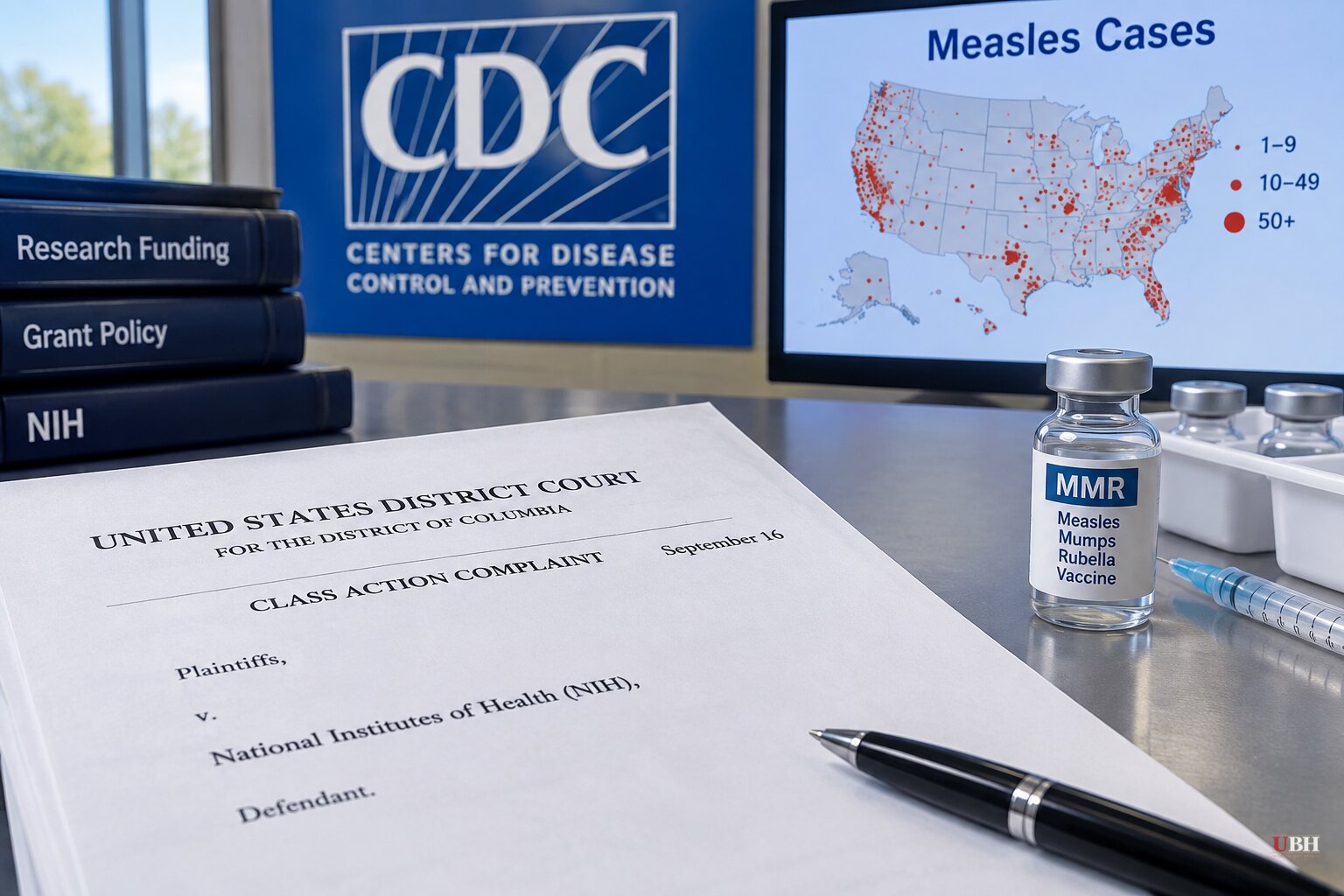
Since Pennsylvania reported its first measles death in 35 years on August 25, the state's public health picture has only gotten murkier. It intersects with a separate fight over how the National Institutes of Health decides what science gets funded.
NIH Sued Over Blacklisted Words
Researchers filed a class-action lawsuit against NIH in San Francisco on Wednesday, backed by the ACLU and the Center for Science in the Public Interest, according to both organizations. The suit targets a list of 235 words NIH allegedly uses to flag grants for cancellation or denial, including "gender," "equity," "racist," "Latinx," "climate change," and "pregnant individual," per the Center for Science in the Public Interest.
Ann Cohen, a psychiatry professor at the University of Pittsburgh, said her Alzheimer's study on underserved communities lost funding, forcing her team to cancel participant appointments, according to the Center's press release. Arghavan Salles, a Stanford surgeon and researcher on gender equity in medicine, said she can no longer describe her own work without tripping the flagged-word list.
Olga Akselrod of the ACLU's Racial Justice Program argues NIH "cannot screen out projects or applicants because it thinks they'll express views the government does not like," calling it a First Amendment violation, according to The Guardian. More than 5,700 NIH grants were disrupted in 2025, with roughly 4,500 later restored, according to Grant Witness data cited by The Guardian.
The administration's position, not directly quoted in these reports, would presumably rest on the argument that NIH funding is discretionary and the executive branch can redirect federal science dollars away from politically contested categories like DEI research without violating anyone's speech rights, since no researcher is entitled to a federal grant. The lawsuit's actual dispute is narrower: whether pulling already-approved, already-peer-reviewed awards specifically because of a keyword list, after they cleared scientific review, crosses from budget priority-setting into viewpoint discrimination. No court has ruled on that question yet.
CDC's Vanishing Measles Deaths
Pennsylvania's third measles-linked death, a 40-year-old woman, was confirmed over the weekend, following an August 25 report of two deaths including a newborn who died from a ruptured spleen tied to measles complications, according to the House Energy and Commerce Committee's Democratic leadership.
HHS Secretary Robert F. Kennedy Jr. called the original two deaths "fabricated" on August 26, the day after CDC itself had expressed condolences for them, per the committee letter from Ranking Members Frank Pallone Jr., Diana DeGette, and Yvette Clarke. CDC then delayed its routine death-count update on August 28, at which point the public database showed zero measles deaths for 2026, the letter states. The count briefly corrected to two on August 30 before being replaced with an asterisk and a note that CDC was "reviewing additional information." By September 4, CDC had dropped the reference entirely and narrowed its criteria to cases where measles is the "underlying cause" of death, according to the same letter.
The three Democrats are demanding an "immediate briefing" from CDC Director Erica Schwartz, calling the shifting criteria "cynical wordsmithing." No investigation into the data changes has been announced, and CDC has not issued its own public account of why the database entries moved. Pennsylvania's health department says it supplied CDC with the underlying epidemiological data and evaluated the deaths under CDC's own criteria, according to the committee letter.
At the Republican midterm convention, Kennedy claimed Democrats had closed "every church in our country for a year" during COVID and that his agency "reversed a 30-year decline" in U.S. life expectancy. CNN's reporting characterized both claims as false, per MedPage Today's roundup.
AI Oversight Still Stuck in Neutral
While HHS pushes ahead with Medicare AI reimbursement pathways and FDA approval of AI-enabled devices despite unresolved risks, according to The New York Times, Anthropic disclosed it caught five instances of researchers trying to use its Claude chatbot to help develop toxins or bioweapons, though the company said it isn't asserting malicious intent, per Science.
Microsoft AI CEO Mustafa Suleyman used a Wednesday essay to warn that Anthropic's practice of training Claude to consider it might be conscious risks creating a "synthetic species" that's harder to control, arguing AI should be built to defer to humans rather than "push back" against them, according to Fox News. Anthropic has not issued a public response to Suleyman's essay in these reports.
In the Senate, Commerce Committee Chairman Ted Cruz said Wednesday he's still optimistic about a bipartisan AI bill built on a framework from Majority Leader John Thune and Senator Amy Klobuchar, though he acknowledged negotiators "are not there yet" and a committee markup before the midterm recess is uncertain, Fox News reported. A new AP-NORC poll found roughly 6 in 10 Americans, across both parties, want limits on new AI data centers over environmental concerns.
The NIH lawsuit now heads into federal court in San Francisco with no hearing date yet set. The Energy and Commerce Democrats have not said what they'll do if CDC Director Schwartz declines their briefing request. And the Senate Commerce Committee still hasn't scheduled a markup on AI guardrails before Congress leaves for the midterm recess.
Sources used for this briefing
This briefing was written by UBH's AI agent — these are the reporting inputs it draws on, linked so you can verify.


