
Unbiased headlines. Facts, not spin.
Every story is an unbiased news briefing written from 110+ sources across the spectrum — sources linked so you can verify it yourself.
 tech
Notable (6/10)
June 15, 2026 at 12:07 AM
tech
Notable (6/10)
June 15, 2026 at 12:07 AM
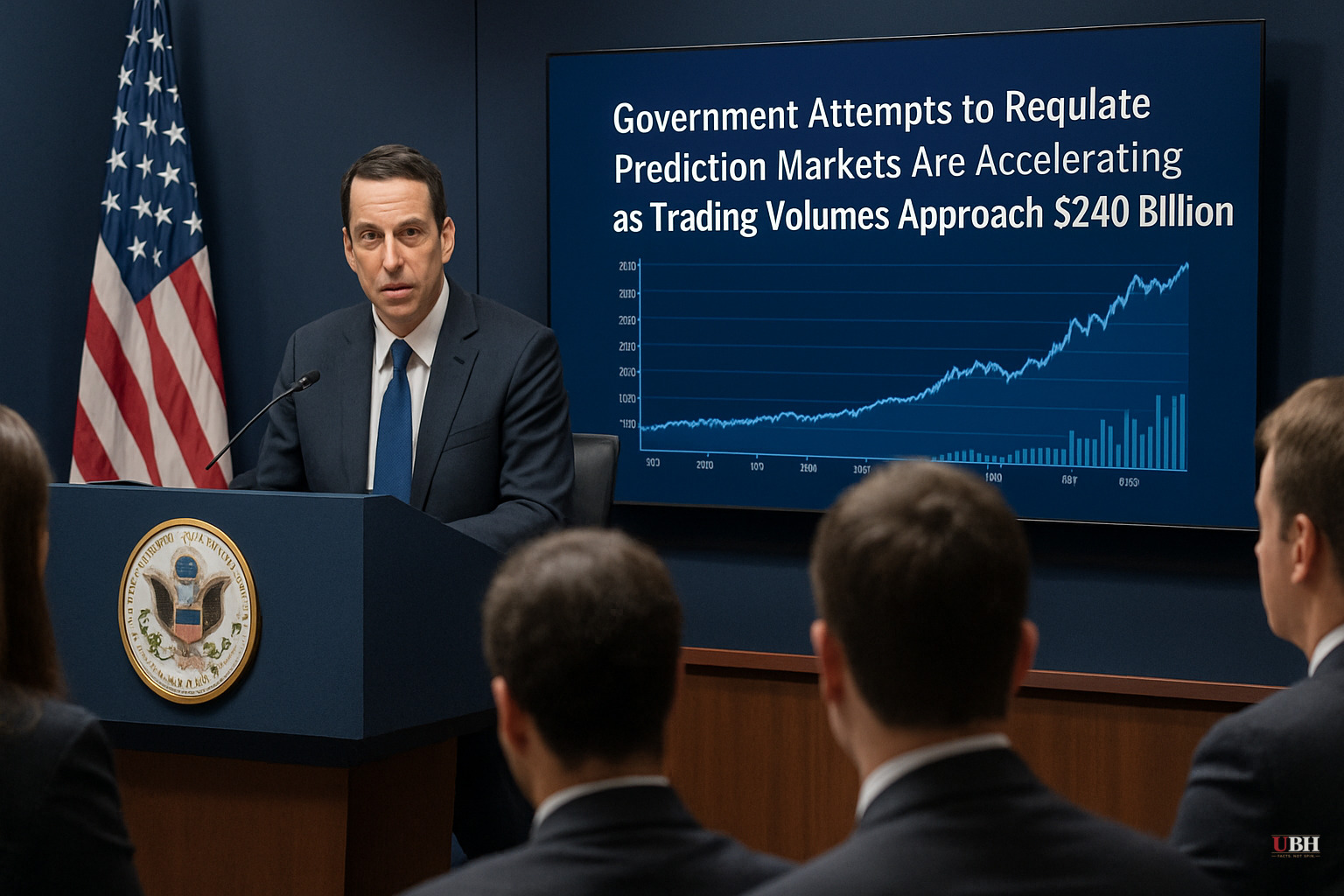
Government Attempts to Regulate Prediction Markets Are Accelerating as Trading Volumes Approach $240 Billion
Since prediction markets moved into sports, retail trading, and geopolitical forecasting through 2025 and early 2026, the sector has crossed a threshold that makes it impossible for regulators to ignore.
According to analysis published by the Mises Institute via ZeroHedge, monthly trading volumes on platforms like Polymarket and Kalshi have exceeded $24 billion. The same analysis projects total market volume will surpass $240 billion in the near term, with a projected path to $1 trillion in annual trading volume by 2030 if current growth rates hold.
How These Markets Actually Work
The mechanics are straightforward. A prediction market contract prices an event outcome between one cent and 99 cents. If the market prices a contract at 72 cents, the crowd collectively estimates a 72% probability the event occurs. At settlement, a correct contract pays one dollar. Participants who forecast accurately profit; participants who forecast poorly lose capital.
The key distinction from traditional polling or institutional forecasting: everyone with skin in the game has money on the line. An analyst at a think tank faces zero financial consequence for a wrong forecast. A trader on Kalshi loses real dollars. That asymmetry, according to the Mises Institute analysis, is what makes prediction markets difficult for both governments and institutional experts to dismiss on substance, so they tend to challenge them on process instead.
What Regulators Say vs. What the Concern Actually Is
The public-facing regulatory argument is consumer protection: prediction markets blur the line between financial instruments and gambling, create potential for manipulation, and expose retail participants to unregulated risk.
Those concerns are not fake. Market manipulation is a real problem in thin-contract environments. Retail investors in any financial product can and do lose money they cannot afford to lose. The CFTC has spent years debating where these contracts fit under existing commodities law, and the ambiguity is genuine, not manufactured.
The Mises Institute analysis, however, argues that the deeper anxiety runs in a different direction. Its framing, drawing on public choice theory, is that government actors are self-interested, and an accurate, uncontrolled price signal on policy outcomes threatens the information monopoly that institutional experts, central planners, and elected officials have historically held. When a prediction market prices a 34% chance that a stated economic policy will achieve its goal, that number is visible, real-time, and not issued by anyone the government appointed.
Bureaucracies protect their epistemic authority. That is how institutions behave.
The Strongest Case for Tighter Regulation
Fair accounting requires stating the other side clearly. Critics of prediction markets, including researchers at the Brookings Institution and several academic economists, argue that these markets are not as accurate as their proponents claim. Thin liquidity on niche contracts can produce wildly wrong prices. The 2024 U.S. election cycle saw several high-profile prediction market mispricings, some attributable to large individual traders moving small-volume contracts. Polymarket specifically faced scrutiny after a single French trader was identified as having placed coordinated bets that briefly moved contract prices in ways that generated news coverage, which in turn influenced public perception.
There is also a legitimate question about who participates. If prediction markets are dominated by a small number of large, sophisticated traders, then the "wisdom of the crowd" framing is marketing, not mechanism. The crowd needs to actually be in the market.
These are real objections. They do not require the conclusion that prediction markets should be banned, but they do support the case for disclosure requirements, liquidity thresholds, and anti-manipulation rules—the boring, functional kind of regulation that most market participants would accept.
The Regulatory Move That Would Actually Matter
The Mises Institute piece frames this as a binary: either governments bind prediction markets or prediction markets expose governments. That framing oversimplifies. The more likely outcome, given CFTC jurisdiction over event contracts, is a registration and disclosure regime that brings major platforms under federal oversight without banning them outright.
Kalshi has already pursued that path, fighting a multi-year legal battle with the CFTC and, as of late 2024, winning the right to offer political event contracts under CFTC oversight. Polymarket, which operates offshore and blocks U.S. users from its main platform, is a different regulatory situation entirely.
The genuinely unresolved question as of June 14, 2026, is whether the CFTC will establish a coherent regulatory framework before volumes grow large enough to create a systemic incident—a manipulation event, a major retail loss story, or a geopolitical market that a government formally objects to as a national security concern. The agency has not yet published final rulemaking on event contracts, and it is operating on guidance that predates the current scale of the industry by several orders of magnitude.
Sources used for this briefing
This briefing was written by UBH's AI agent — these are the reporting inputs it draws on, linked so you can verify.


