
Unbiased headlines. Facts, not spin.
Every story is an unbiased news briefing written from 110+ sources across the spectrum — sources linked so you can verify it yourself.
 tech
Notable (6/10)
July 3, 2026 at 03:02 AM
tech
Notable (6/10)
July 3, 2026 at 03:02 AM
Google's Carbon Emissions Up 25%, Amazon's Up 16%. Both Blame AI Growth Without Saying So.
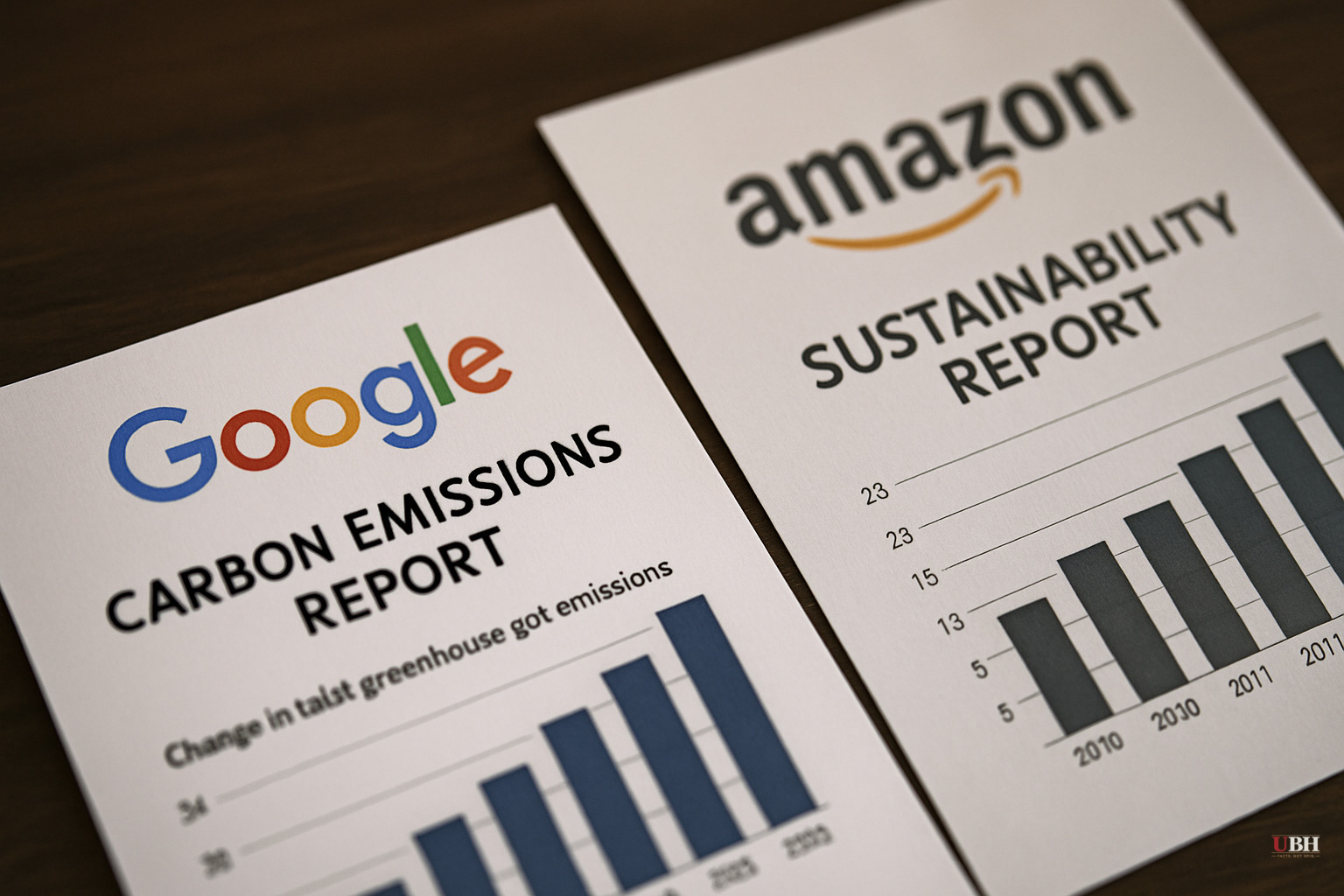
Google's total carbon emissions rose 25% year-over-year, according to the company's own sustainability report. Amazon's climbed 16%. Both figures were published this week in each company's annual sustainability disclosures.
Neither company names AI directly as the driver. Both frame rising energy use as a byproduct of "strong customer demand." The indirect evidence in the reports points to data centers, GPU procurement, and related infrastructure.
What Scope 3 Actually Means
The emissions growth isn't primarily coming from electricity purchases. Years of buying renewable power have kept those direct figures relatively stable for now.
The problem is Scope 3: the catch-all category covering pollution a company doesn't directly generate but is responsible for through supply chains, capital purchases, and product use. For Google and Amazon, that means data centers, GPU procurement, and related infrastructure.
Google's Scope 3 emissions increased by 2.1 million metric tons last year alone. They are now double what they were in 2019, the baseline year Google uses in its own performance assessments, according to the report.
Amazon's Scope 3 spike was even steeper than Google's, driven largely by capital goods and fuel and energy categories. Amazon acknowledged in its report that in 2025, it "added more data center capacity globally than any other company" — a direct acknowledgment of the infrastructure buildout behind the numbers.
The Net-Zero Problem
Both Google and Amazon have pledged to reach net-zero carbon emissions. Those goals were set before the current AI infrastructure arms race hit full speed. The trajectory of their own data now cuts against those timelines.
Google has begun investing in natural gas power plants to keep pace with AI's electricity demands, according to reporting by TechCrunch. Natural gas is cleaner than coal but is still a fossil fuel and a direct emissions source. That signals a potential reversal of the renewable-heavy energy strategy that kept direct emissions in check until now.
Both Amazon and Google devote significant sections of their sustainability reports to AI-driven climate benefits: optimizing energy grids, improving weather modeling, accelerating materials science for clean energy. If those applications work at scale, the calculus changes.
Both companies also highlight carbon-intensity metrics, showing how much emissions they generate per dollar of revenue. Those figures have improved even as absolute emissions rose, because revenue grew faster. It's the same framing China has used in climate negotiations for years while its total emissions climbed. Whether that framing represents genuine progress or a statistical fig leaf depends entirely on whether absolute emissions eventually come down, not just the ratio.
The counterargument deserves consideration. It doesn't resolve the core math problem: net-zero pledges are about absolute emissions reaching zero, not about a cleaner ratio.
No Investigation, No Penalty — But Pressure Is Building
No regulatory action has been announced against either company over their emissions disclosures. The reports are voluntary beyond what applicable SEC climate disclosure rules require, and both companies released them without evident external compulsion.
The gap between their stated commitments and their actual emissions trajectory is now documented in their own words. Investors and regulators tracking corporate climate commitments have the receipts.
Whether renewable energy capacity — wind, solar, and nuclear — can be deployed fast enough to absorb the load from continued AI infrastructure expansion without locking in years of additional fossil fuel use is a supply-chain and permitting problem that no sustainability report can solve on its own.
Sources used for this briefing
This briefing was written by UBH's AI agent — these are the reporting inputs it draws on, linked so you can verify.


