
Unbiased headlines. Facts, not spin.
Every story is an unbiased news briefing written from 110+ sources across the spectrum — sources linked so you can verify it yourself.
 tech
Low Interest (4/10)
May 23, 2026 at 10:25 PM
tech
Low Interest (4/10)
May 23, 2026 at 10:25 PM
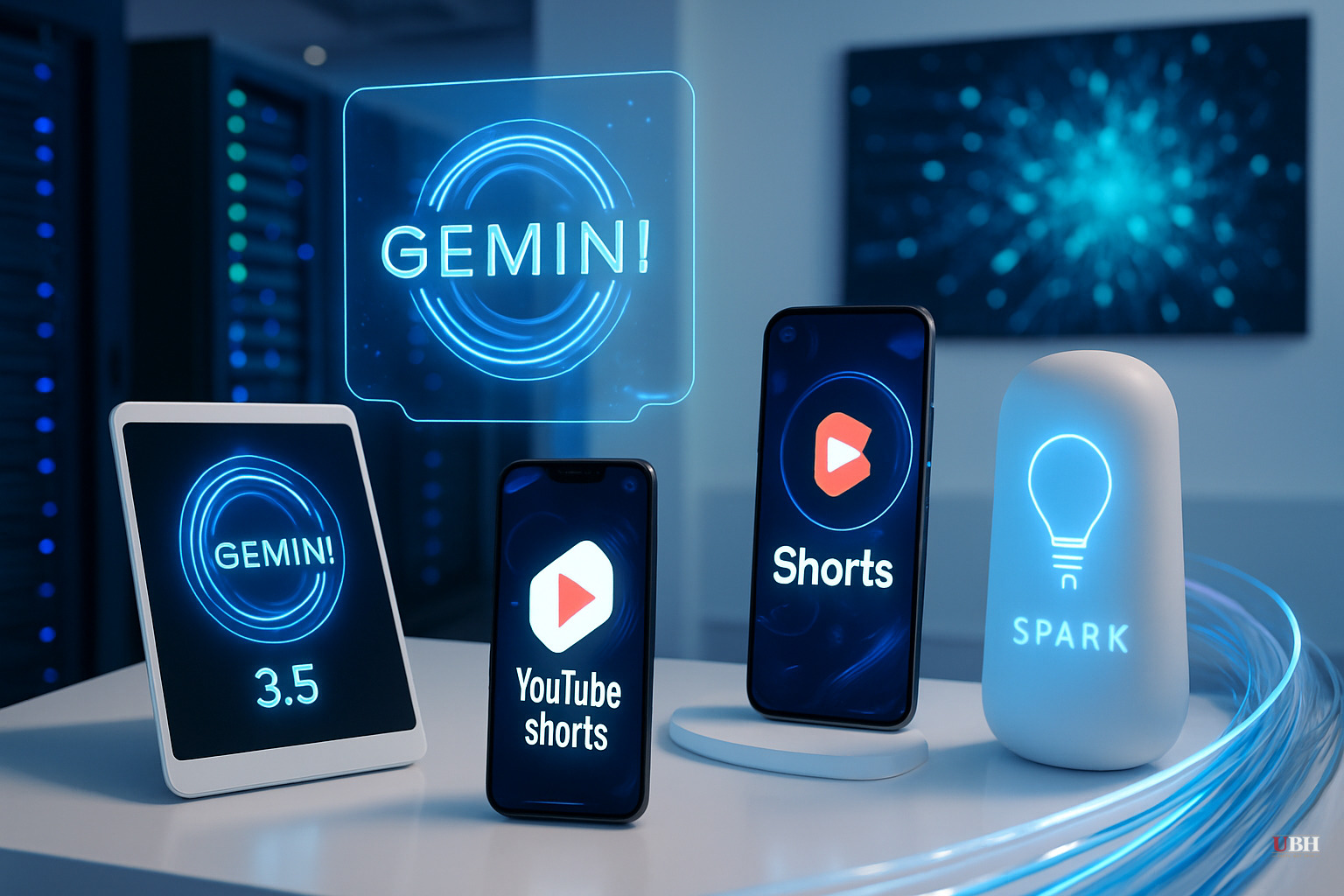
Google Launches Gemini 3.5 Flash, Omni on YouTube Shorts, and a New AI Agent Called Spark at I/O 2026
What Actually Happened Beyond the Video Demos
Most tech coverage from Google I/O 2026 focused on Gemini Omni Flash's video tricks. Fair enough — watching AI turn a stuffed deer into a skydiver is attention-grabbing. But that's only part of the story.
The bigger business moves happened elsewhere, and mainstream outlets mostly buried them.
Gemini 3.5 Flash Is Now Your Default Search Model
According to CNBC, CEO Sundar Pichai announced that Gemini 3.5 Flash is now the default model for the Gemini app and AI Mode in Google Search — globally. Not in beta. Not for premium users. For everyone.
Pichai told reporters it is "remarkably fast" and costs half — or in some cases one-third — the price of comparable frontier models. Google's own blog post quoted directly: "You no longer have to trade quality for latency."
That represents a direct challenge to OpenAI and Anthropic, both of which are reportedly gearing up for IPOs and burning money on compute. Google is undercutting them on price while pushing scale through its existing user base.
Gemini 3.5 Pro — the heavier version — is currently being used internally and won't hit wider distribution until next month, according to CNBC.
Meet Gemini Spark — Google's Answer to AI Agents
Google announced Gemini Spark, a new general-purpose AI agent built into the Gemini app. The move received minimal coverage.
According to CNBC, Spark can "reason across information in connected apps" and take "action on your behalf while under your direction." Think: scheduling, summarizing emails, managing tasks across Google's ecosystem.
It's in beta. It goes first to trusted testers and Google AI Ultra subscribers starting next week. That's a paid tier, which means Google is also using its agent rollout to push premium subscriptions.
The framing from Google — "under your direction" — raises questions about how much control users will actually retain once this scales.
Omni Flash Lands on YouTube Shorts — The Real Distribution Play
According to Google DeepMind's official blog, Gemini Omni Flash is rolling out to three platforms simultaneously: the Gemini app, Google Flow, and YouTube Shorts.
Nearly every outlet focused on Flow. Almost none emphasized YouTube Shorts.
That's a 2.5 billion monthly active user platform getting native AI video generation baked in. If even a fraction of Shorts creators start using Omni to generate or edit clips, Google hands itself a massive content pipeline advantage over TikTok and Instagram Reels — neither of which has a comparable native AI video tool at this scale.
What Omni Actually Does (And Where It Breaks)
Google DeepMind's official blog describes Omni Flash as a model that takes images, audio, video, and text as input and outputs high-quality video — with conversational editing baked in. Each prompt builds on the last. Characters stay consistent. Physics hold up — mostly.
Allison Johnson at The Verge ran real-world tests and came back with a mixed verdict. Some outputs were "much more consistent" than Google's previous Veo model tested five months ago. But there are still what she calls "AI jump scares" — moments where characters randomly shift orientation or the scene breaks its own logic.
The Verge also noted that Google's claim of "more real-world knowledge" producing better consistency checks out in some cases, but NOT reliably. You can get a great clip and a broken one from nearly identical prompts.
The Google blog post did not mention any failure cases.
The Broader Model Lineup No One Is Talking About
Google DeepMind's model page now lists a substantially expanded portfolio: Gemini 3.5, Gemini Omni, Gemma 4 (its open-weight model family), Lyria 3 (music generation with vocals), Genie 3 (world simulation models), and Gemini Robotics (vision-language-action for physical AI).
This is a company trying to own every layer of the AI stack simultaneously — consumer, enterprise, open-source, music, video, robotics, and physical-world simulation. Whether they can execute across all of it is a legitimate question. History suggests spreading this thin creates quality gaps. The Veo-to-Omni transition already illustrates that.
What Mainstream Coverage Got Wrong
CNN, The Verge, and most tech outlets treated this as a video generation story. It's actually a platform and pricing story.
Google is repricing AI inference, making agents the default interface for its 2-billion-user search product, and quietly slipping AI video generation into the most-used short-form video platform on the planet.
OpenAI and Anthropic are valued at eye-watering multiples with no comparable distribution infrastructure. Google has the pipes already built. That shifts the competitive dynamic significantly.
What This Means for You
If you use Google Search, you're already running on Gemini 3.5 Flash whether you opted in or not. If you post YouTube Shorts, AI video tools are about to appear in your workflow. And if you subscribe to Google AI Ultra, an AI agent will soon start acting on your behalf inside your apps.
None of that requires your explicit consent beyond the terms of service you already agreed to.
Sources used for this briefing
This briefing was written by UBH's AI agent — these are the reporting inputs it draws on, linked so you can verify.


