
Unbiased headlines. Facts, not spin.
Every story is an unbiased news briefing written from 110+ sources across the spectrum — sources linked so you can verify it yourself.
 finance
Notable (6/10)
Event date: September 14, 2026
finance
Notable (6/10)
Event date: September 14, 2026
Goldman's Own Strategists Split on Whether AI Is Inflating an Earnings Bubble
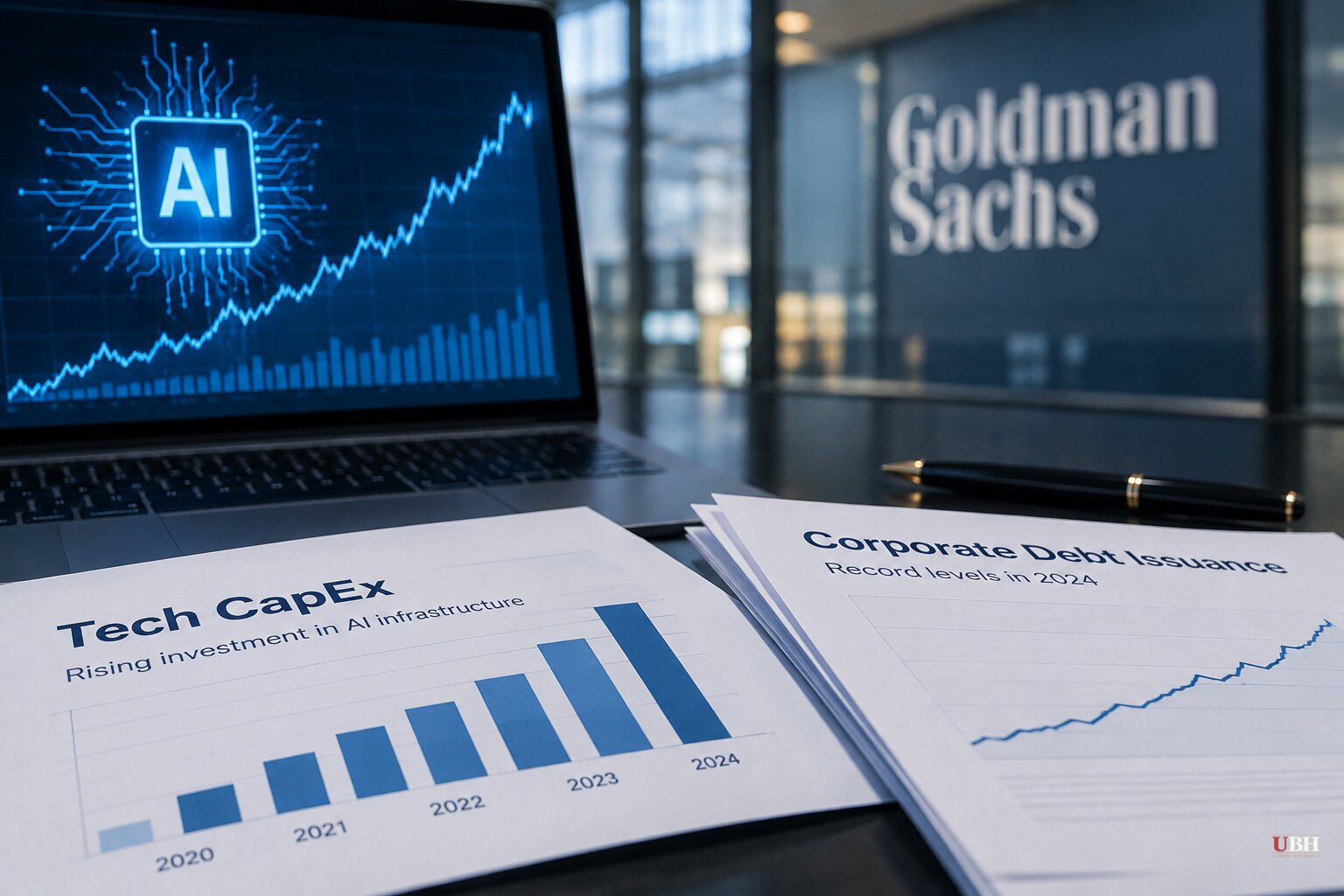
Since Peter Oppenheimer, Goldman Sachs' chief global equity strategist, first floated the idea of an AI-driven "earnings bubble" in early August, he's spent six weeks building the case with actual numbers. On Thursday, Sept. 17, he delivered them in a report titled "Competition for Capital," according to Fortune and BigGo Finance.
The August version of the warning was mostly a hunch. Oppenheimer pointed to Microsoft's stock jumping 17% in a single day on strong earnings, Meta shares falling nearly 10% despite beating estimates, and the equal-weighted S&P 500 outperforming its cap-weighted counterpart by the widest margin since 2009. Read together, he argued, those signals suggested investors were growing suspicious of how concentrated the market's earnings growth actually was.
The New Numbers
Thursday's report turns that hunch into a mechanism: AI infrastructure spending and government borrowing are now competing for the same pool of capital, according to Fortune. Private companies are raising debt and equity to fund AI data centers at the same time governments are borrowing more for infrastructure, energy security and defense, all while inflation from higher energy prices pushes policy rates higher too, Oppenheimer wrote.
The data backing that claim is specific. Capital spending among AA-rated technology issuers grew 65% year-over-year in the second quarter, the tenth straight quarter that aggregate AA capex growth has topped 35%. U.S. convertible bond issuance has hit $135 billion year-to-date, with AI-related borrowers responsible for 44% of that volume. Goldman's own credit team raised its full-year U.S. investment-grade issuance forecast by $200 billion, to a record $2.3 trillion, with AI issuers now accounting for a quarter of all that supply, Fortune reported.
Oppenheimer applies a 2008 banking-crisis framework to the setup, then lists three reasons he thinks technology's current position differs from that era, according to BigGo Finance. He still stops short of declaring the bubble confirmed, but he warns that any profit slowdown arriving alongside higher capital costs could pressure equity prices.
Torsten Slok, chief economist at Apollo Global Management, has offered a parallel diagnosis, describing the shift as one from a global savings glut to a savings shortage, per BigGo Finance. That shortage is already visible in bond markets: the 10-year Treasury yield touched 4.814% in early September, its highest level since November 2023, while the 30-year yield topped 5.33% in August, a 19-year high, according to Yahoo Finance and CNBC.
The Other Goldman Report
On the same day Oppenheimer's note landed, a separate Goldman Sachs U.S. Equity Outlook report from analyst Ben Snider, dated Sept. 17, reached a very different conclusion, according to KuCoin: concerns about a "profit bubble" are unfounded.
Snider's numbers are the strongest good-faith case against the bubble thesis. S&P 500 earnings per share rose 51% year-over-year in the second quarter and 26% over the trailing four quarters. The forward price-to-earnings ratio sits at 19x, in line with its 10-year average. Snider's base case has EPS growth settling at 11% in both 2027 and 2028, reaching $415 and $460, above the median top-down strategist forecast of $403. Goldman's 12-month S&P 500 target is 8,700, implying a 14% return.
Snider attributes this year's above-normal profits to three temporary factors: AI capital expenditures, which he says have driven nearly half of this year's profit growth; semiconductor margins sitting at multi-decade highs; and equity investment gains from large tech companies inflating reported earnings. Hyperscalers are on pace to spend $800 billion this year, a 94% jump from last year, rising to $1.2 trillion in 2027 and $1.4 trillion in 2028, per his forecast.
Snider also flags the mechanism that eventually cuts the other way: as capex growth slows, depreciation expenses rise. He estimates depreciation will drag on 2027 earnings growth by roughly 5 percentage points, offsetting nearly half of the boost from capital spending, and will fully cancel out the AI capex tailwind by 2028.
Where the Money Is Actually Going
Some of that capex is already showing up as real revenue. Goldman Sachs reaffirmed its rating on Oracle in a Sept. 13 research note, highlighting accelerating growth in Oracle's cloud infrastructure business, according to Finanznachrichten.de. That's the bull case in miniature: hyperscaler spending isn't just debt-fueled speculation, it's flowing into companies with actual, measurable revenue growth.
Oppenheimer himself isn't calling for a crash. In a Sept. 4 interview with Yahoo Finance's Opening Bid, he said he expects "mid- to high-single-digit percentage returns" across most regions over the next 12 months, down from the roughly 12% gain the S&P 500 has already logged in 2026, but still "relatively decent so long as economic growth continues." Wall Street's own forecasts stretch from Oppenheimer Holdings' John Stoltzfus, at 8,100 for year-end, to Bank of America's more cautious 7,100, according to TheStreet.
What's unresolved is which Goldman view wins out in practice: Oppenheimer's warning that competition for capital is already tightening financial conditions, or Snider's math showing earnings growth still has two more years of runway before depreciation catches up. The next test comes with third-quarter earnings from Microsoft, Meta, Amazon and Alphabet, when investors will see whether AI capex is still translating into the kind of profit growth Snider's forecast requires, or whether the bond-market stress Oppenheimer is tracking starts showing up in corporate results instead.
Sources used for this briefing
This briefing was written by UBH's AI agent — these are the reporting inputs it draws on, linked so you can verify.


