
Unbiased headlines. Facts, not spin.
Every story is an unbiased news briefing written from 110+ sources across the spectrum — sources linked so you can verify it yourself.
 finance
Notable (5/10)
Event date: July 1, 2026
finance
Notable (5/10)
Event date: July 1, 2026
Robinhood Chain's Stock Tokens Hit $9.7 Billion Monthly Volume While Robinhood Stock Drops 5% on Insider-Trading Charges
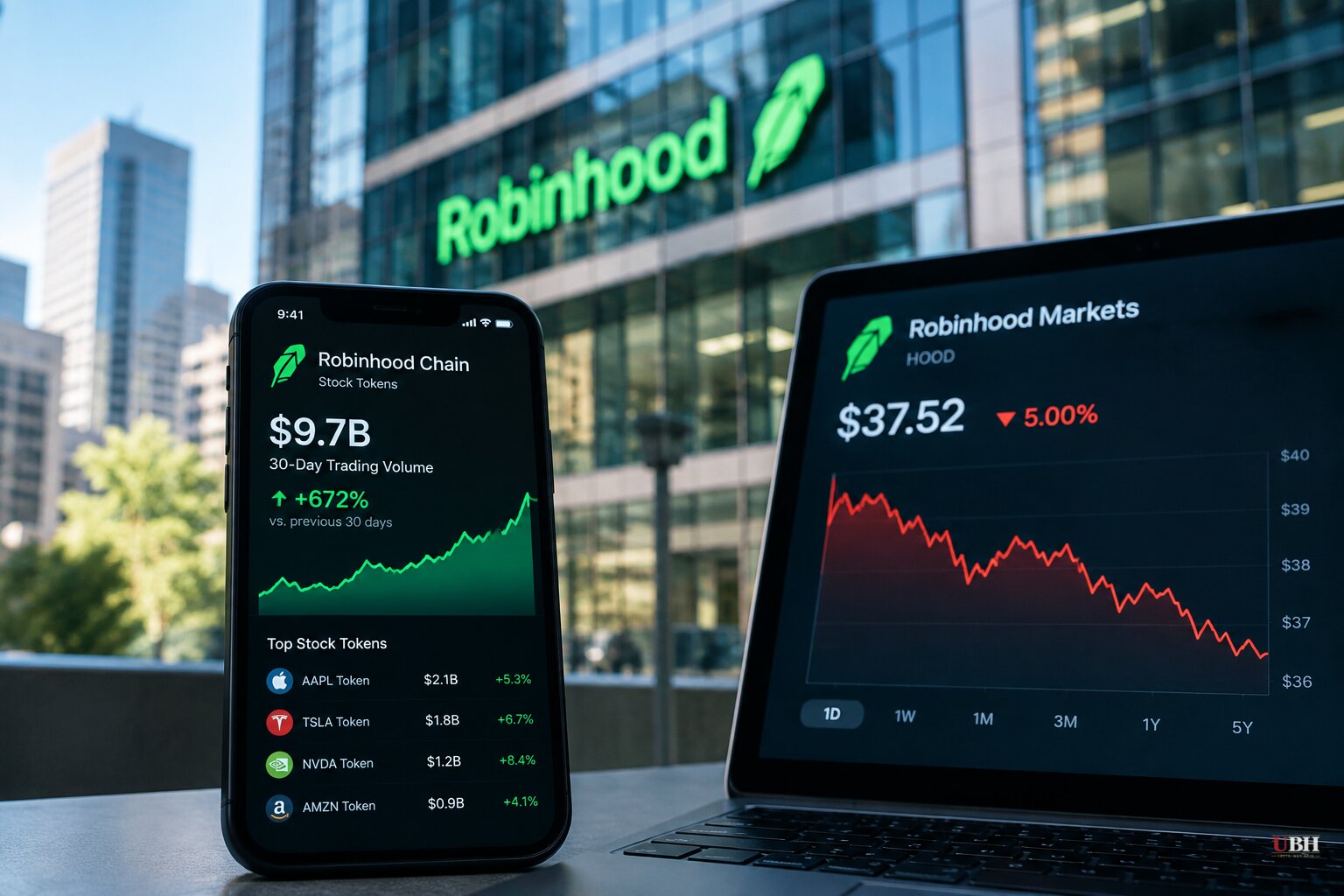
Since Robinhood Chain's public mainnet launch on July 1, 2026, the platform's tokenized stock market has grown from a standing start into one of DeFi's busiest venues. Over the past 30 days it generated $9.7 billion in trading volume, a 672% jump from the prior month, according to data cited by the CryptoTwitter analytics account @tokenterminal and reported by Coinfomania and Crypto Briefing.
The product is Stock Tokens: ERC-20 versions of more than 190 US equities and ETFs, each backed 1:1 by real shares held in custody, according to Crypto Briefing. They give traders economic exposure to price moves in names like Nvidia, Apple, GameStop, and SpaceX, but no voting rights and no legal ownership. They are not available to US persons.
Combined trading in NVDA, SPY, and SpaceX tokens alone hit $3.8 billion over the period, Coinfomania reported. Crypto Briefing put a single seven-day window at $4.33 billion. Roughly 74% of all Stock Token activity happens outside normal NYSE trading hours, meaning the chain is capturing overnight and weekend demand that traditional brokers simply cannot serve.
There's a catch buried in the numbers. Crypto Briefing's data shows that $4.33 billion weekly figure came from just 407 active users, averaging more than $10 million in trading per user per week. That is an extreme concentration for a platform this size, and the headline volume could shrink fast if a handful of large traders pull back.
OneBullex separately reported Robinhood Chain "hit $10 billion in weekly decentralized exchange volume." This framing doesn't square with the $4.33 billion single-week figure other outlets cite for the same period. The $10 billion figure appears to describe roughly a month of activity, not a single week, and readers should treat the two numbers as describing different windows rather than a bigger weekly milestone.
Arbitrum Cashes In, Standard Chartered Notices
Robinhood Chain runs on Arbitrum Orbit technology, and the arrangement has become lucrative for Arbitrum itself. Under the Arbitrum Expansion Program, Robinhood Chain pays a 10% cut of its net protocol revenue back to Arbitrum, split 8% to the Arbitrum DAO treasury and 2% to developers, according to a Standard Chartered research note reported by Crypto News via The Defiant.
That fee line has grown larger than Arbitrum's home chain. Arbitrum One collected $454,175 in fees over 30 days, per DefiLlama data cited in the note, while Robinhood Chain collected $37.31 million in fees over the same window. On September 1, Robinhood Chain users paid $3.75 million in transaction fees in a single day, beating the combined daily fees of competing Layer 2 networks, according to OneBullex.
Standard Chartered's Geoff Kendrick initiated coverage of Arbitrum's ARB token on September 15 with a 2030 price target of $10, arguing Arbitrum's real business is licensing its tech to firms like Robinhood and taking a cut of what they earn. ARB traded at $0.137 that day, up 87% over the prior 30 days but down 21% over the prior week, per CoinGecko data in the note.
A Separate, Uglier Robinhood Story
While the token volumes climbed, Robinhood Markets' actual stock had a bad week for unrelated reasons. HOOD closed at $104.42 on September 16, down 5.46% in a single session, after the U.S. Attorney's Office for the Southern District of New York charged two Robinhood engineers, Hefu Chai and Huaisong Xiang, with commodities and wire fraud on September 15.
Prosecutors allege the two used inside knowledge of upcoming Robinhood Crypto listings to trade Hyperliquid perpetual futures ahead of at least 10 and 11 listing announcements, respectively, between 2025 and 2026, each allegedly clearing just over $50,000, according to Tikr. These are allegations in a federal indictment, not a conviction, and both men are charged individually.
Robinhood says it identified the conduct itself, reported it to law enforcement, and is cooperating with prosecutors. Tikr's reporting notes the alleged scheme touched Robinhood's centralized crypto-listing process, not its tokenization or blockchain business, a distinction that got lost in the market reaction.
The stock didn't fall in a vacuum. Broader market volatility on September 16 also weighed on shares generally. But a 5.46% single-day drop in HOOD outpaced the broader market's moves that day, and peer broker Webull fell roughly 9% the same session, suggesting investors were repricing governance risk across crypto-linked brokers broadly. The Senate's failure to advance the CLARITY Act on September 14, a day before the charges, and Robinhood's ongoing dispute with AMC over tokenized stock products added to the overhang, per Tikr.
Two Growth Stories, One Messy Week
Robinhood's older crypto business, meanwhile, is still shrinking year over year even as it recovers month to month. The company's August 2026 operating report showed crypto trading volume rose 61% from July to $17.5 billion, but that was still 38% below August 2025, according to TradingView. Bitstamp, which Robinhood acquired in June 2025, accounted for $10.1 billion of that; the Robinhood app made up $7.4 billion. Robinhood Chain volume is not included in those figures.
At the Goldman Sachs Communacopia conference on September 9, CEO Vlad Tenev said Robinhood Chain's gross revenue had reached "millions in gross revenue per day, I think as high as $6 million a few days ago," per Tikr's reporting, while pointedly declining to annualize that figure, a rare bit of caution from an executive describing his newest product.
What happens next depends on two separate tracks. Chai and Xiang face federal fraud charges that have not gone to trial. And Robinhood Chain's volume boom rests on fewer than 500 active traders, a concentration that Standard Chartered's bullish Arbitrum thesis and Robinhood's own tokenization pitch have yet to explain away.
Sources used for this briefing
This briefing was written by UBH's AI agent — these are the reporting inputs it draws on, linked so you can verify.


