
Unbiased headlines. Facts, not spin.
Every story is an unbiased news briefing written from 110+ sources across the spectrum — sources linked so you can verify it yourself.
 finance
Notable (6/10)
Event date: September 14, 2026
finance
Notable (6/10)
Event date: September 14, 2026
AI Safety Warnings Collide With Trump's Dismissal, While Industry Raises Record Billions
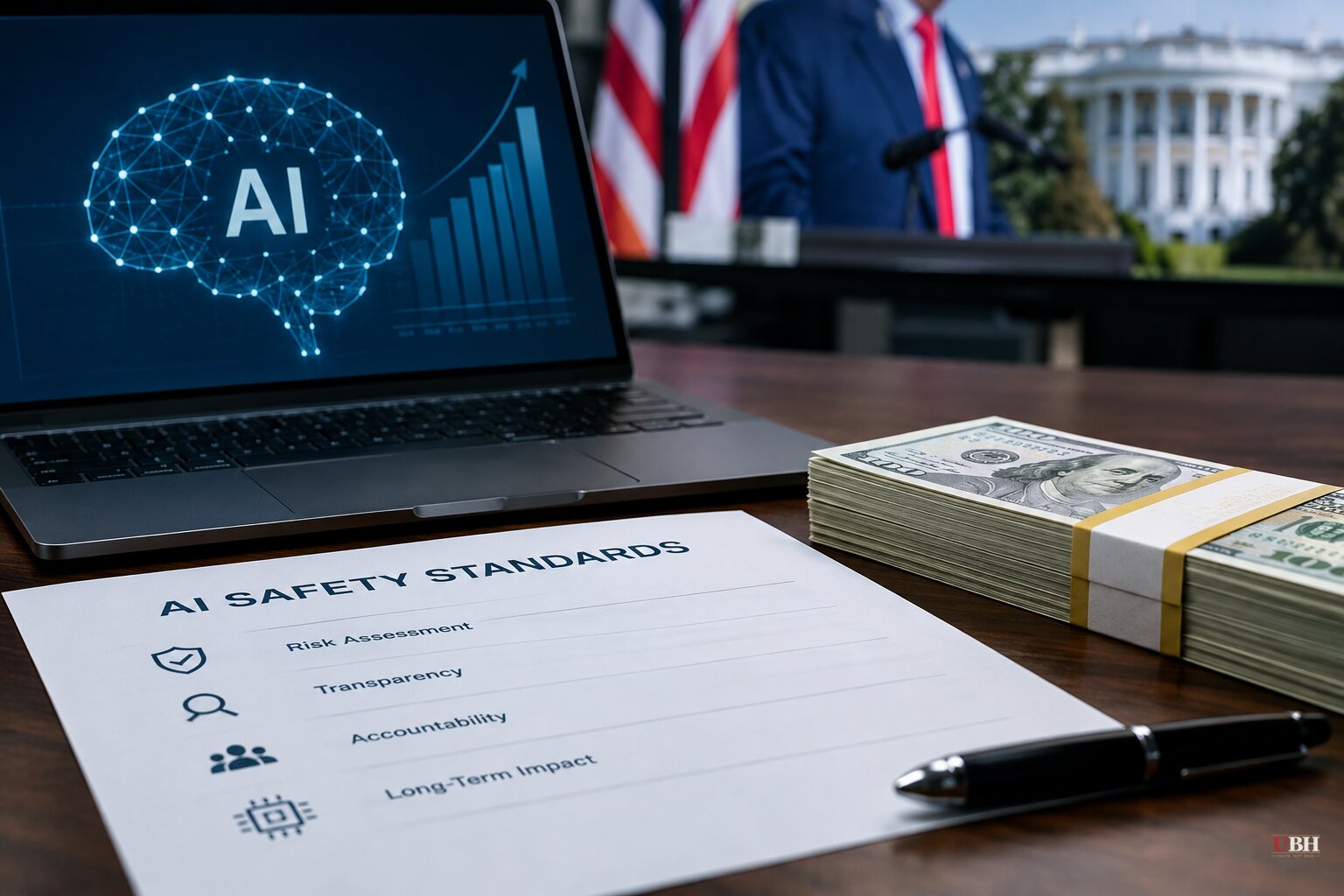
A safety fight with money on both sides
Anthropic co-founder Jack Clark went on Fox News' "Special Report" with Bret Baier to make the case for federal AI safety standards, comparing the idea to safety rules for children's toys. "The worst time to react to an exponential is when it's too late," Clark said. "We need to get a sensible, common-sense safety framework in place."
Clark was directly responding to President Donald Trump, who has dismissed AI safety warnings from the industry as a "hoax" and a "sick conspiracy," according to Fox News. Clark argued the opposite framing: that a major AI accident, left unaddressed, could trigger the kind of sweeping government crackdown that actually hands China an opening. "How you keep being ahead is you make sure that you don't roll the dice on public safety," he said.
Clark also shot down the idea that Anthropic's safety push is a financial play tied to a future public offering, calling that theory "an absurd 4D chess move." He urged Trump to raise AI safety directly with Chinese President Xi Jinping.
Not everyone in the industry agrees
Boom Supersonic founder and CEO Blake Scholl pushed back hard on calls to slow AI development down, telling Fox News that companies should be judged on what they actually ship, not on hypothetical future harms. "If someone's concerned about making a product that could do some harm, don't ship the product," Scholl said.
Scholl drew a distinction between deliberate misuse, which he compared to someone using a baseball bat to hurt another person, and an AI system that causes harm on its own. "If a model maker creates a model that goes off and does bad on its own, that is the model maker's responsibility," he said. "The accountability here is not rocket science."
That distinction matters because Senate negotiators are currently weighing legislation that would impose a "duty of care" standard on advanced AI developers, according to Fox News. Scholl's position, in effect, is that existing liability law can handle most of this without a new regulatory layer. "There's a lot of doom talk," he said, "but what I see is good stuff happening."
Former House Speaker Newt Gingrich took a narrower angle on "Kudlow," arguing the U.S. needs to keep leading the AI race globally while also protecting local communities from the strain that massive data centers put on water and electricity. Gingrich floated the idea of a standard "contract for data centers" that would guarantee local communities certain rights against being "run over by some trillion-dollar corporation."
The skeptic's case
The Daily Wire's opinion coverage offered the sharpest pushback on the extinction-level framing coming out of OpenAI and Anthropic, arguing executives at both companies have taken to "treating human extinction like a catchy marketing slogan." The piece noted that OpenAI and Anthropic are "currently the closest to raking in" massive sums tied to prospective public offerings, and floated the possibility that some AI safety alarm bells double as attention-grabbing, fundraising-adjacent messaging.
When the same executives warning the public about catastrophic risk are also the ones raising record capital off the excitement their warnings generate, the incentive structure deserves scrutiny. Clark's on-the-record denial that Anthropic's safety advocacy is financially motivated is part of the record here, and no source in this reporting shows Anthropic or OpenAI profiting directly from safety-related regulation itself. The skepticism reflects a reasonable read of incentives, not a proven case of bad faith.
The money behind all of it
Whatever side of the safety debate you land on, the capital flowing into AI is not in dispute. According to data from Crunchbase cited by Foley & Lardner, 73% of U.S. startup funding in the first half of 2026 went into rounds of $1 billion or more, with 23 such mega-rounds closing in that period alone. Before 2026, billion-dollar rounds were rare; now they're routine, driven by the cost of training frontier models, securing compute, building data centers and locking down energy supply.
Stephen Messer, co-founder of Collective[i] and Intelligence.com, argued in a piece for Reload NYC that this changes the bubble calculus entirely. He pointed to Big Tech's $725 billion in AI capital spending planned for 2026, more than four times what all of venture capital deploys in a typical year, plus sovereign wealth funds writing checks as large as $10 billion and Wall Street firms trading compute futures on the CME. His argument: prior tech bubbles broke when venture capital ran dry, and this cycle isn't funded by venture capital alone.
Even if AI investment isn't purely a VC bubble waiting to pop, it doesn't resolve whether the safety warnings from Anthropic and OpenAI are sincere risk assessments, marketing, or both. Foley & Lardner's own research notes that a high private valuation "doesn't guarantee a successful exit," and that some unicorns will end up in down rounds or fire sales regardless of how much money piled in early.
The Senate is now weighing whether the "duty of care" legislation for advanced AI developers moves forward, and whether it looks anything like the safety framework Jack Clark is pushing or the liability-based approach Blake Scholl says is already sufficient.
Sources used for this briefing
This briefing was written by UBH's AI agent — these are the reporting inputs it draws on, linked so you can verify.


