
Unbiased headlines. Facts, not spin.
Every story is an unbiased news briefing written from 110+ sources across the spectrum — sources linked so you can verify it yourself.
 finance
Major Story (7/10)
Event date: September 16, 2026
finance
Major Story (7/10)
Event date: September 16, 2026
Yen Falls Past 156 to the Dollar Amid Fed Rate Hike and Narrowing Yield Gap
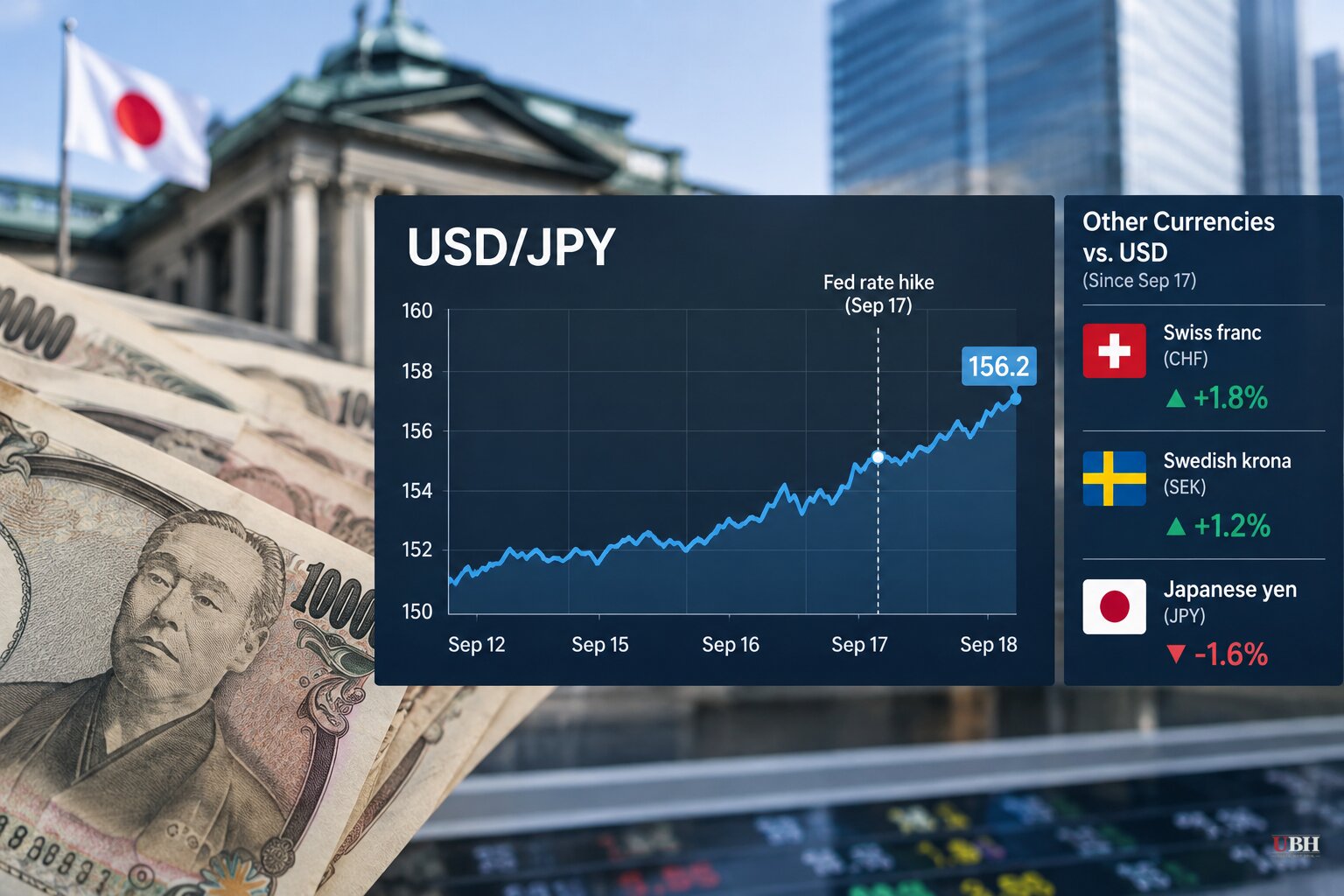
The yen took a sharp step backward on Thursday, September 17, falling past 156 to the dollar in Tokyo trading after the Federal Reserve raised interest rates and paired the move with a hawkish outlook, according to Retail News Asia. The US Dollar Index climbed above 100 as Asian currencies retreated broadly.
The reversal undoes weeks of yen strength that had traders across Wall Street and Tokyo rethinking one of the oldest trades in global finance.
The Trade Everyone's Been Watching
The yen carry trade is simple in concept. Borrow yen at rock-bottom rates, convert it into higher-yielding currencies like the dollar, the Mexican peso or the New Zealand dollar, park the proceeds in bonds or other assets, and pocket the spread, according to the Bangkok Post. When it's time to close out, convert back to yen and repay the loan.
The modern version of the trade dates to 2013, when Prime Minister Shinzo Abe's stimulus program kept Japanese rates near zero while US rates eventually took off. Cross-border yen borrowing hit a record ¥360 trillion, or roughly $2.34 trillion, as of March, according to a Jefferies analysis of Bank for International Settlements data cited by the Bangkok Post. That's the largest carry-trade buildup in three decades.
The trade has been under pressure since Japan strengthened its currency to a seven-month high in recent weeks, before Thursday's reversal. Matteo Giovannini, senior finance manager at Industrial and Commercial Bank of China, told the South China Morning Post the move reflects a narrowing US-Japan yield gap, some unwinding of short-yen bets, and growing expectations the Bank of Japan will hike rates. "A stronger yen and greater expectations of BOJ tightening make the carry trade less attractive because the cost of funding positions in yen is rising while the risk of exchange-rate losses increases," Giovannini said.
Joint yen-buying intervention by Tokyo and Washington at the end of July added another signal that Japanese authorities want a stronger currency, not a weaker one, according to the Bangkok Post.
Money Is Already Moving
Global fund managers aren't waiting around. Russell Investments and Allianz Global Investors are steering clients toward the Swiss franc as a new funding currency, while JPMorgan strategists, including Meera Chandan and Neil Jones, are recommending the Swedish krona and the Canadian dollar, according to the Japan Times and BigGo Finance.
Van Luu, head of global fixed income and currency solutions at Russell Investments, put it bluntly: "Investors still want to be in carry trades, but the question of what to fund them with has become the key issue." Luu argues the franc is the strongest replacement because Switzerland is expected to hold its policy rate at zero through late 2027, and Swiss officials are comfortable with a weaker franc supporting exports, per BigGo Finance.
The performance numbers back up the shift. The classic short-yen, long-Australian-dollar trade lost 1.3% since July, a stark reversal from a 9% gain in the first half of 2026, according to BigGo Finance. Franc-funded carry trades, meanwhile, have returned 14% year-to-date.
That doesn't mean the franc is a free lunch. Market participants caution that the franc's status as a haven currency means it can spike hard during geopolitical stress, leaving carry traders exposed on the other side of the trade, BigGo Finance reported.
The Fed Just Complicated Everything
Thursday's Fed hike scrambles the narrative that the yen's rise was unstoppable. The yen had swung between 152 and 154 earlier in the week as desks weighed Japanese inflation against US bond yields, according to Retail News Asia. The Fed's hawkish tightening extinguished bets on an early US policy pause and pushed the yen back toward multi-month lows against the dollar, widening the rate gap that makes yen-funded trades profitable in the first place.
That move squeezes Asian importers who settle energy, raw materials and electronics components in dollars, while giving Japanese exporters a temporary translation boost that masks weak domestic consumer demand, Retail News Asia noted.
Separately, Breitbart pushed back on a New York Times report arguing the world is growing wary of US economic stability under President Trump's debt load and sanctions policy. Citing Treasury data, Breitbart pointed out that foreigners purchased a net $1.75 trillion of long-term American securities over the 12 months through July, more than double the roughly $799 billion purchased in the equivalent period ending July 2024. Stock purchases alone hit $941.9 billion in the most recent 12-month window, up from net sales of $151.5 billion in 2024, according to the Treasury figures Breitbart cited. That's a different debate than the yen carry trade specifically, but it bears on the same underlying question: whether the dollar's global pull is strengthening or fading, which shapes how attractive dollar-denominated carry trades remain regardless of which currency funds them.
The strongest case for the wary-dollar view, as the Times framed it, is that mounting US debt and heavier use of sanctions could eventually push foreign governments and investors toward alternatives. The Treasury purchase data Breitbart cited doesn't settle that argument outright. Foreign capital has flowed into US stocks and corporate bonds at an accelerating pace through July 2026, not fleeing them.
CFTC data shows net short positions on the yen climbed to 92,227 contracts in the week to September 1, up a third from the prior week but still well below the two-year high of 163,412 hit in the week to July 1, according to the Bangkok Post. That suggests some traders were already rebuilding yen shorts even before Thursday's Fed-driven reversal.
Traders are watching the Bank of Japan's upcoming policy meeting for signs officials will move on rates to defend the yen after Thursday's slide, according to Retail News Asia. A surprise BOJ hike in July 2024 triggered a global market selloff by forcing a sudden unwind of yen carry positions. Whether the BOJ moves again, and how far the Fed's hawkish turn pushes the yen before then, will determine if the rush into francs and krona was an overcorrection or the start of a permanent shift.
Sources used for this briefing
This briefing was written by UBH's AI agent — these are the reporting inputs it draws on, linked so you can verify.


