
Unbiased headlines. Facts, not spin.
Every story is an unbiased news briefing written from 110+ sources across the spectrum — sources linked so you can verify it yourself.
 finance
Major Story (7/10)
Event date: September 16, 2026
finance
Major Story (7/10)
Event date: September 16, 2026
Crypto's CLARITY Act Dies in Senate 49-50, SEC and CFTC Say They Will Write the Rules Themselves
The Vote
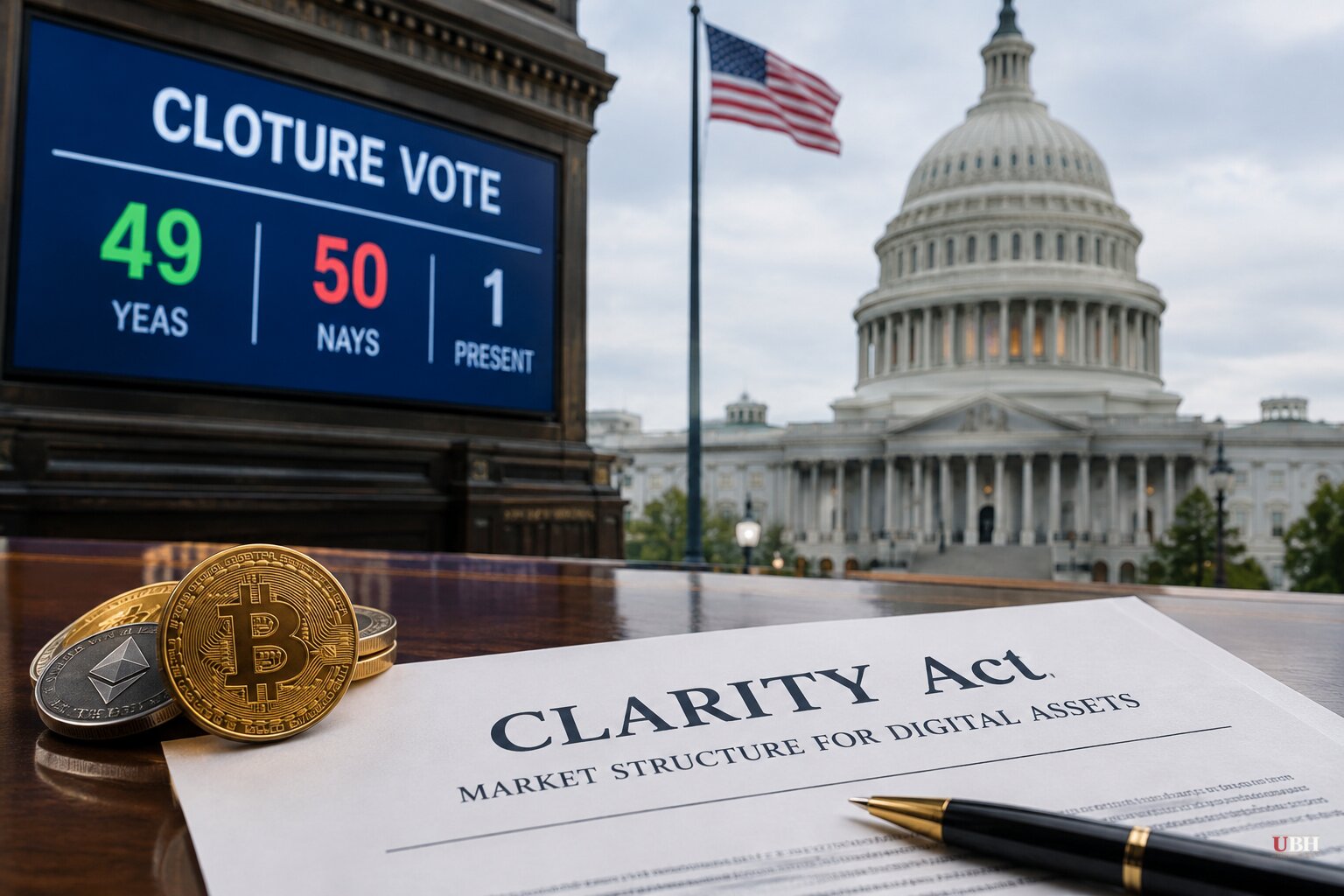
The Senate on Tuesday, September 15, blocked the Digital Asset Market Clarity Act on a procedural cloture vote, 49-50, according to Crypto.news, which cited the Senate's official roll call. The motion needed 60 votes to advance and fell 11 short. Every Republican vote was a yes. Every Democrat present voted no, and they were joined by Republicans Susan Collins of Maine, Josh Hawley of Missouri, and Jerry Moran of Kansas, per Crypto.news.
The vote was on a cloture motion to proceed, not a final rejection of the bill on the merits, according to the Bitcoin Foundation. With Congress heading toward its midterm recess, TradingKey (citing FXStreet) reported the bill is effectively stalled for now.
Why It Failed
Democrats cited ethics concerns tied to President Donald Trump's crypto holdings and those of his family, according to the Associated Press as cited by Crypto.news. An earlier revised draft of the bill did include restrictions barring public officials, government employees, and their spouses from issuing or sponsoring digital assets, with enforcement resting with the Justice Department and the provision set to expire in January 2029, Crypto.news reported. Republicans had already made concessions on those ethics terms and on enforcement powers during negotiations before the vote.
Democrats argued those protections still weren't strong enough. Republicans, having already revised the bill once to address the concern, saw the additional demands as a moving target rather than a good-faith gap. The bill contained real ethics restrictions, and Democrats judged them insufficient. Neither side's claim about "insufficiency" is something these sources prove or disprove; it's a policy judgment, not a fact in dispute.
Regulators Move Without Congress
The reaction from Washington's crypto regulators was fast. SEC Chair Paul Atkins and CFTC Chair Michael Selig each posted statements within about two hours of each other on Wednesday, September 16, saying their agencies will write crypto rules using existing authority, according to 24/7 Wall St.
Atkins had signaled this was coming. Speaking at the Solana Policy Institute on Monday, he said the SEC's crypto agenda would proceed "with or without" congressional legislation, according to TradingKey. Selig had already directed CFTC staff in August to draft potential rules in case Congress failed to deliver, TradingKey reported, including possible designations for leveraged crypto trading markets under CFTC oversight.
Legally, the two agencies aren't inventing new power. The SEC can lean on the Securities Act of 1933 and Securities Exchange Act of 1934; the CFTC can lean on the Commodity Exchange Act, according to OneBullex. The agencies plan to coordinate through memoranda of understanding and a joint task force to avoid the conflicting guidance that's plagued crypto oversight for years, OneBullex reported.
Former CFTC Chair J. Christopher Giancarlo backed the approach. "SEC Chair Paul Atkins and Chairman Selig are determined to do what their jobs require them to do and put in place sound regulatory frameworks that ensure that financial innovation, market modernization and economic growth take place under U.S. law and not outside it," he told journalist Eleanor Terrett on September 16, per Crypto.news.
Coinbase CEO Brian Armstrong called the Senate outcome disappointing but said the industry "can't be uninvented" and that regulators have what they need. "The SEC and CFTC have the tools they need to create clear rules under existing authority, and I expect they will begin working on this in earnest. So clarity is coming to crypto regardless," he posted on X, per TradingKey. Ripple CEO Brad Garlinghouse was blunter, calling for a post-mortem on why the bill failed and blaming what he called Democratic political opposition, according to the Bitcoin Foundation.
The Catch With Agency Rules
Rules written by the SEC and CFTC without a statute behind them are easier to unwind. A future commission, under a different administration, could rewrite or scrap them without needing 60 Senate votes, a point the Bitcoin Foundation's sourcing flagged directly. That's the tradeoff industry executives are accepting: faster clarity now, in exchange for rules that carry none of a law's staying power.
Regulators bypassing Congress because Congress couldn't get 60 votes is not "clarity" in the way a statute is. It's discretion, exercised by whoever holds the chair. That should concern anyone who wants durable, predictable rules regardless of which party appointed the SEC chair.
Banks Are Already Positioning
Michael Saylor, chairman of MicroStrategy, argued the lending side of this doesn't need Congress at all. He wrote that with CLARITY stalled, he expects the SEC and CFTC to advance crypto rules under existing law and for banks to expand Bitcoin-backed lending as a result, according to Yahoo Finance.
Deutsche Bank has already filed for institutional crypto custody approval through prudential supervisors, on a regulatory timeline that doesn't depend on Congress, Yahoo Finance reported. The Office of the Comptroller of the Currency has issued interpretive letters since March 2025 confirming national banks can already custody crypto and outsource that custody to sub-custodians, per Yahoo Finance, meaning some of this legal groundwork predates the CLARITY vote entirely.
The chokepoint for large-scale Bitcoin lending isn't Congress or even the SEC and CFTC. It's the Basel Committee and Federal Reserve capital rules that determine how much equity a bank must hold against Bitcoin collateral, Yahoo Finance reported. Those capital treatment rules remain unresolved, and no timeline for a decision has been announced by either body.
Bitcoin was trading near $76,000 and XRP near $1.31 as of Wednesday, September 16, according to 24/7 Wall St. Giancarlo was scheduled to appear alongside former CFTC Chairman Timothy Massad and former SEC Commissioners Troy Paredes and Caroline Crenshaw at a panel at the Avalanche Summit in New York later that day, Crypto.news reported. Whether the SEC-CFTC joint task force produces actual proposed rules, and how far they go without statutory backing, is the next thing to watch.
Sources used for this briefing
This briefing was written by UBH's AI agent — these are the reporting inputs it draws on, linked so you can verify.


