
Unbiased headlines. Facts, not spin.
Every story is an unbiased news briefing written from 110+ sources across the spectrum — sources linked so you can verify it yourself.
 finance
Major Story (7/10)
Event date: September 8, 2026
finance
Major Story (7/10)
Event date: September 8, 2026
Bond Yields Ease Slightly After Fed's Rate Hike, But Warsh Signals More Increases Are Coming
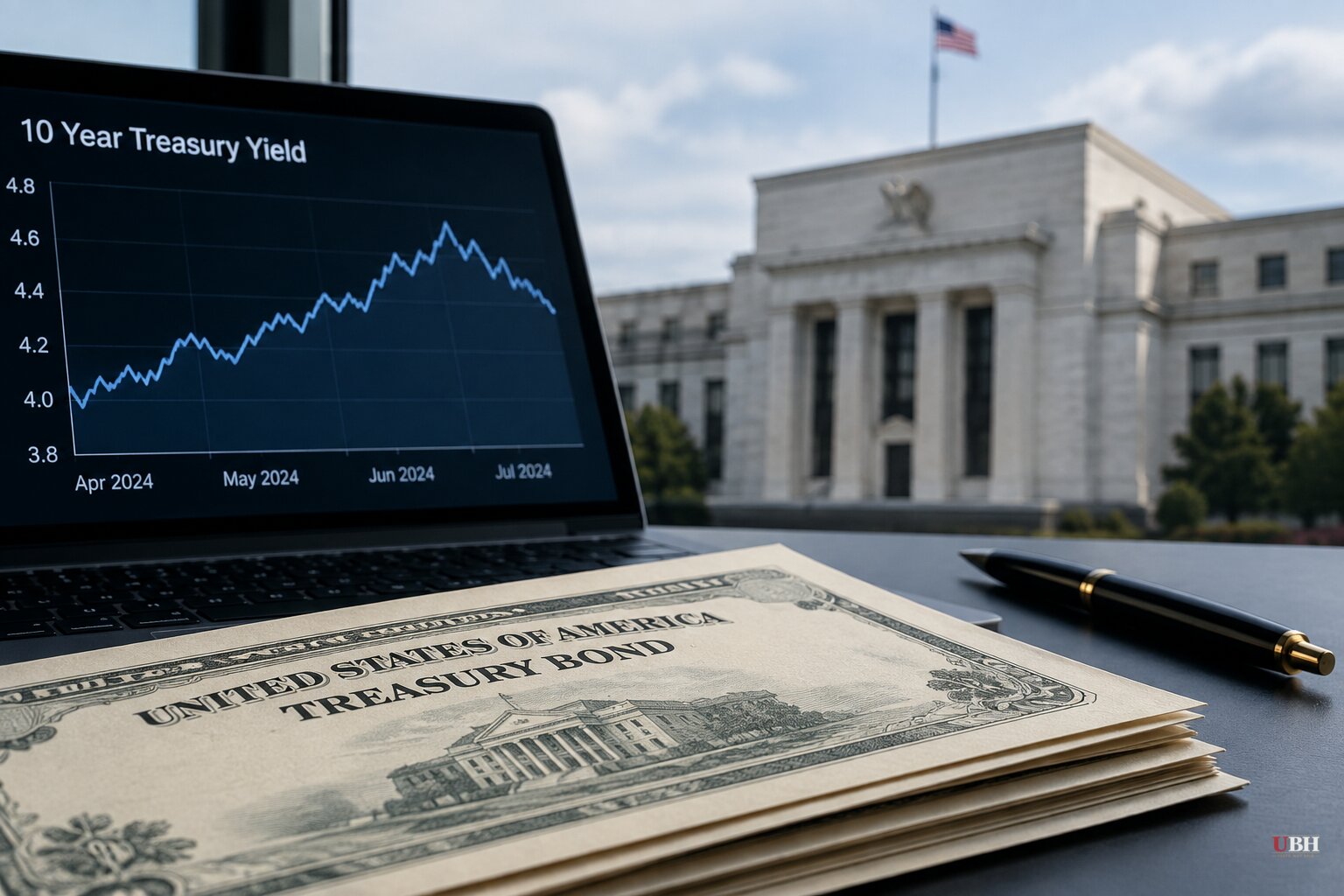
Yields Cool, But Only a Little
Since Wednesday's quarter-point rate hike lifted the Fed's benchmark to a range of 3.75% to 4%, bond traders have spent Thursday figuring out whether the central bank actually bought itself any breathing room.
The answer so far: some, but not much. The 10-year Treasury yield fell roughly 2 to 3 basis points Thursday to around 4.99% to 5%, according to Memesita and the Australian Financial Review. That snapped eight consecutive days of gains, the longest losing streak for bond prices in recent memory. But the yield is still hovering near its highest level since 2023.
Australia's 10-year yield moved in sympathy, dropping 2 basis points to 5.33%, and the S&P/ASX 200 gained 0.4% to 8732.4, though only four of eleven sectors actually finished green, according to the Australian Financial Review.
Why the Relief Might Not Last
Federal Reserve Chairman Kevin Warsh told reporters this week that "the plain fact is that inflation is too high and has been for too long," according to the Guardian, and the FOMC voted 12-0 to hike. According to Memesita, the median projection from Fed policymakers points to at least one more rate hike before the year is out. That's not a pivot. That's a pause.
Byron Anderson, head of fixed income at Laffer Tengler Investments, told Memesita the Fed "had no choice but to give the market a hike or risk a much bigger bond market selloff." Wednesday's move wasn't really a tightening surprise. It was damage control.
The Fed's preferred inflation gauge sat at 3.7% in July, still well above the 2% target, per Memesita. Adam Posen, president of the Peterson Institute for International Economics, said both bond markets and the Fed itself have started acknowledging what he calls a secular, multi-year uptrend in rates, not a temporary spike.
The Bessent-Warsh Question
Treasury Secretary Scott Bessent has spent the second half of this year repurchasing long-dated government bonds, and according to the Epoch Times, officials planned to double the pace of those buybacks in September specifically to put downward pressure on yields.
Some financial press, including the Wall Street Journal, have framed this as Bessent effectively going around the Fed, or leaving Warsh "in even deeper trouble" if he doesn't follow with cuts, according to Breitbart's account of that coverage. Breitbart pushed back hard on that framing, arguing Bessent and Warsh aren't in competition at all. Bessent treats the buybacks as debt management, a Treasury function, while Warsh treats interest rates and the Fed's balance sheet as monetary policy, a separate lane entirely. Breitbart's argument is that two decades of Fed quantitative easing blurred that line in the public's mind, not that the line itself moved.
Debt management and monetary policy have historically been distinct constitutional functions, and treating every government bond purchase as "QE" ignores that Treasury bought back its own debt long before the Fed ever did. Whether markets actually believe there's no coordination problem is a different question. Krishna Guha, vice chairman of Evercore ISI, told the Financial Review's sourcing that "we are in a regime where activist Treasury policy is as material, for good and for bad, as central bank policy." This is an acknowledgment that Bessent's interventions now move markets on their own, independent of whatever Warsh does with rates.
The Bigger Number Nobody's Arguing About
With $40 trillion in outstanding federal debt, according to CNN, every basis point matters. Higher yields mean higher borrowing costs on mortgages, credit cards, and the government's own refinancing bill, all at once.
Betashares chief economist David Bassanese told the Financial Review the rate hike was "a strong reaffirmation of the central bank's political independence," coming as it did over Trump's public objections. Warsh himself declined to say whether more hikes are coming in sequence, telling reporters the Fed will "stay in our lane," per the Guardian.
Bessent, for his part, has insisted the bond market's underlying health is fine. "The U.S. bond market is the most resilient in the world," he told CNBC's Sara Eisen in late August, adding that this month would likely be "the best-performing bond market" globally.
What's Still Unresolved
The Fed's own dot plot points to another hike later this year, which means Thursday's brief cooldown could reverse fast if inflation data doesn't improve. The next test comes with upcoming inflation readings and whatever Bessent does next with the buyback program he's set to double. Whether Treasury's debt management and the Fed's rate policy stay in separate lanes, as Breitbart argues they always have, or start colliding in practice, is the question bond traders are watching for going into the fourth quarter.
Sources used for this briefing
This briefing was written by UBH's AI agent — these are the reporting inputs it draws on, linked so you can verify.


