
Unbiased headlines. Facts, not spin.
Every story is an unbiased news briefing written from 110+ sources across the spectrum — sources linked so you can verify it yourself.
 health
Major Story (7/10)
July 8, 2026 at 10:13 AM
health
Major Story (7/10)
July 8, 2026 at 10:13 AM
GLP-1 Users Are Spending Less on Food and More on Mouthwash. New UK Data Shows How Deep the Shift Goes.
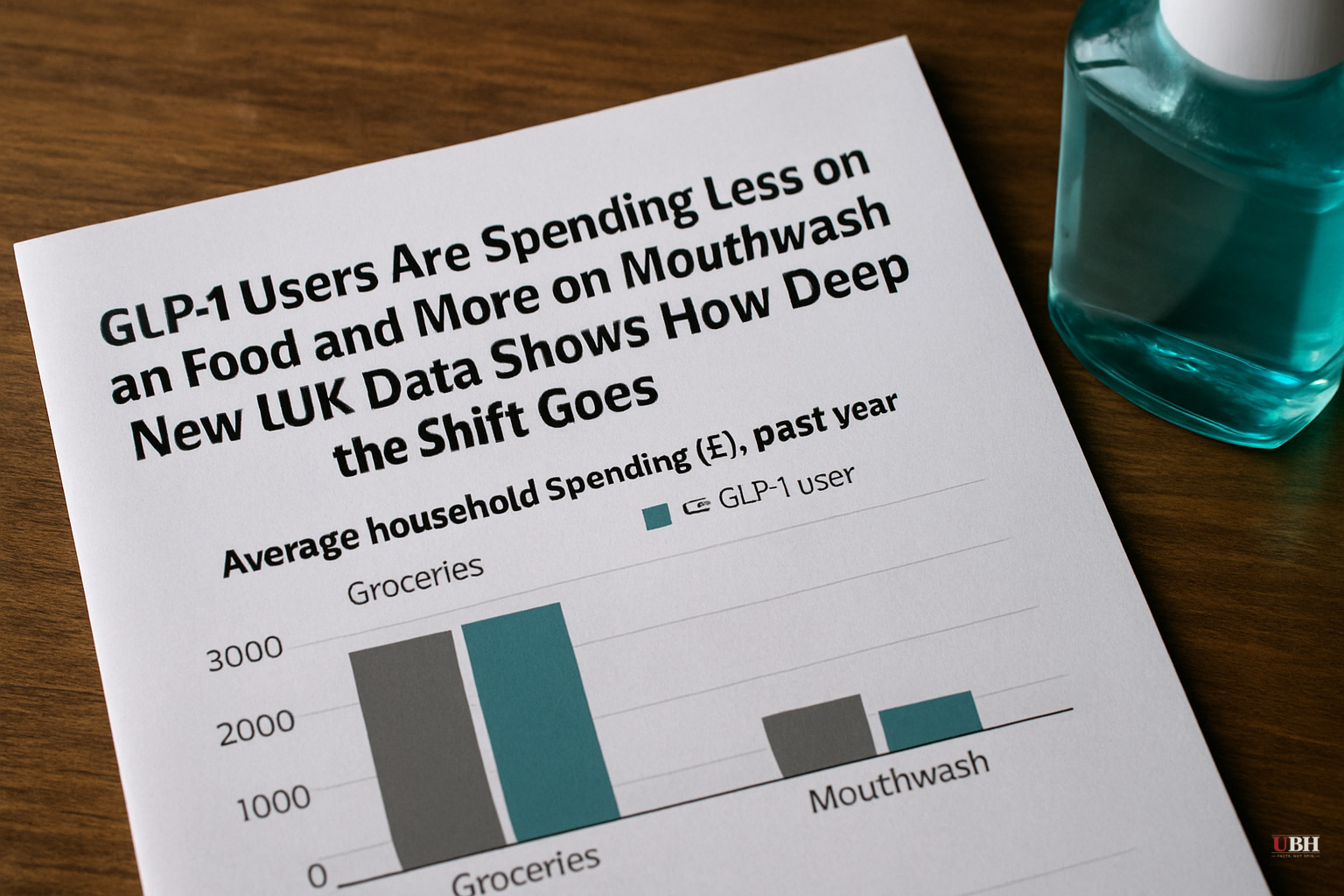
UK data now quantifies the GLP-1 spending shift with enough specificity to see exactly where the money goes.
The Grocery Numbers
In June 2026, market research firm Worldpanel by Numerator published a study drawing on survey responses and observed purchase data from more than 11,000 UK households, with a reference period of February 2026. The core finding was that households with at least one GLP-1 user spent £418 less on groceries in the year after starting medication, compared to non-user households. Scaled nationally, Worldpanel estimated that amounts to a £780 million decline in UK grocery spending.
That figure aligns with peer-reviewed work from Cornell University, published last year, which found that U.S. households with at least one GLP-1 user spent 5% less on groceries within six months of starting the drugs, rising to 8% among higher-income families.
Not Less Spending. Different Spending.
Nishita Pattni, a senior consultant at Worldpanel by Numerator, told BBC News the story isn't one of simple demand destruction. "This isn't simply a story of shrinking demand. It's also a story of shifting demand."
The data backs her up. GLP-1 users bought less chocolate, pastries, and alcohol. They bought more fruit and protein-dense foods like prawns. The Cornell study found users cut savoury snack purchases by 10% and also spent less on cheese, butter, soft drinks, and eggs while buying more yoghurt.
But there's a less obvious category picking up spending: products that address the drugs' side effects. Worldpanel found users bought more chewing gum, mouthwash, and hair dye — direct responses to known GLP-1 side effects including bad breath and hair thinning. Food companies losing revenue in one aisle are, in effect, subsidizing gains in another.
Nearly two-thirds of GLP-1 users surveyed by Worldpanel reported cutting out or reducing restaurant meals since starting the drugs. Over half described their eating approach as "mindful" — meaning hunger, not habit or boredom, was driving consumption decisions. The Cornell research also found an 8% decline in spending at fast-food chains and coffee shops.
The Reversal Problem
The strongest caution in this data comes from Cornell. Their research found that households revert to pre-adoption grocery spending patterns when they stop taking the medication and actually drift toward slightly less healthy baskets afterward. More than two million people in the UK are currently using these drugs, according to BBC News. If a meaningful share cycles off due to cost, side effects, or supply, the grocery and restaurant spending that disappeared could return, and food companies that restructured around reduced demand could find themselves caught flat-footed.
Retailers and food manufacturers who may be tempted to treat GLP-1-driven demand shifts as permanent structural change rather than medication-dependent behavior face a real operational risk.
The Skeptic's Case
Survey-based spending data has limits. Worldpanel's study relies partly on self-reported behavior, and people who choose to take weight-loss drugs may already have different dietary intentions than the general population. Some of the "shift" could reflect pre-existing motivation rather than the drug's direct effect. The Cornell study used observed purchase data rather than just surveys, which strengthens its conclusions, but the UK £780 million national estimate is an extrapolation, not a direct measurement. Retailers should treat that figure as directional, not precise.
That said, the convergence between the UK Worldpanel findings and the Cornell peer-reviewed data — two different methodologies, two different countries — makes the basic pattern hard to dismiss.
What Comes Next
U.S. and UK grocery chains, restaurant groups, and consumer goods companies face an open question: whether GLP-1 adoption continues accelerating or plateaus. Affordability remains the main brake. In the UK, prescriptions can cost more than £300 a month, and the vast majority of UK patients pay privately. A survey of 167 users by Zava, an online doctor and pharmacy service, found the number one reason people stopped taking their medication was cost. Any meaningful expansion of NHS coverage would push adoption and the spending disruption significantly wider. The Cornell finding on reversion suggests that the business risk cuts both ways: plan around users staying on the drugs permanently, and you may be wrong.
Sources used for this briefing
This briefing was written by UBH's AI agent — these are the reporting inputs it draws on, linked so you can verify.


